
Digital Fingerprinting in Ohio: BCI, FBI, and Background Checks Explained
Who needs fingerprinting in Ohio, what type you need, where to go, and how long it takes. BCI checks, FBI checks, ODE background checks — all explained.
The Scene That Starts Everything
You got the email this morning. Or the letter. Or the phone call. It says you need a background check — and that means you need to get fingerprinted.
Maybe it is for a new job in a school or a daycare. Maybe you are applying for a professional license — real estate, nursing, teaching, counseling. Maybe you are adopting a child or becoming a foster parent. Maybe you are volunteering at your kid's school and the district requires it.
Whatever the reason, you have a form in your hand that says "BCI" or "FBI" or "WebCheck" or "OFAC," and you are not sure what any of it means.
You start making calls. The sheriff's office only does appointments on Tuesdays. The police station said they do not do civilian prints anymore. The private fingerprinting service you found online charges $85 and is booked out two weeks.
You need this done before your start date. You need it done now.
The WebCheck Maze
The state of Ohio uses an electronic fingerprinting system called WebCheck. It is managed by the Ohio Attorney General's Bureau of Criminal Investigation (BCI). When an employer, licensing board, or adoption agency requires a background check, they will tell you which type you need. But they rarely tell you where to get it done.
Here are the three most common types of background checks in Ohio:
BCI Background Check (Ohio Only). This checks your criminal history against the Ohio Records Database maintained by BCI. It covers arrests, convictions, and ongoing cases within the state of Ohio. If you have lived in Ohio your whole life and are applying for a state license or a local job, this is usually what you need.
BCI & FBI Background Check. This runs your prints through both the Ohio database and the national FBI database. It checks for criminal history across all fifty states. This is required for positions involving children, healthcare, and certain professional licenses. Teachers, nurses, daycare workers, foster parents, and adoption applicants almost always need this level of check.
ODE Background Check (Ohio Department of Education). This is a specific variant for educators and school employees. It combines BCI and FBI checks with additional education-specific screening. If you are applying for a teaching license or a non-teaching position in a school district, this is the one.
Each type requires the same fingerprinting process — the difference is what the prints get checked against on the back end. And the process itself is simple, but finding a reliable fingerprinting location often is not.
What It Actually Feels Like
You show up at the sheriff's office in Painesville at 9:00 AM for your appointment — the only slot they had available this week. You fill out a paper form. You wait in a lobby with three other people. The deputy calls you back, rolls your fingerprints on an ink card — old-school, messy, easy to smudge. They scan the card into the digital system. You pay the fee. You leave.
Three days later, you get a call: "Your prints were rejected. The ink card was too light. You need to come back and do it again."
You schedule another appointment. You drive back to Painesville. You fill out the same form. You wait again. The deputy does another card. This one goes through.
Total time invested: two trips, two appointments, about three hours of driving and waiting, plus the delay in your background check processing.
The rejection rate for ink-and-card fingerprinting is significant. Smudged prints, light impressions, incomplete rolls — all of these cause the electronic scan to fail. And when it fails, you start over.
Digital fingerprinting solves this. The scanner captures your prints electronically on the first try, with real-time feedback so the technician can see immediately if the quality is acceptable. There is no card to smudge, no ink to dry, no second trip required.
Why It Should Not Be This Way
Fingerprinting is a straightforward process. You press your fingers on a scanner. It takes about ten minutes. The technology has existed for decades. There is no reason a simple identity verification step should require two appointments, an hour of driving, and a week of waiting to discover whether your prints were good enough.
But the legacy system — ink cards processed through county sheriff's offices — persists because it was the only option for a long time. Many sheriff's offices and police departments still use it, even though digital fingerprinting is faster, more accurate, and less prone to rejection.
The philosophical problem is this: a background check should not be bottlenecked by the printing method. You should be able to walk into a location, get scanned digitally, and walk out knowing your prints went through — not hoping the ink card did not get smudged.
What We See Every Day
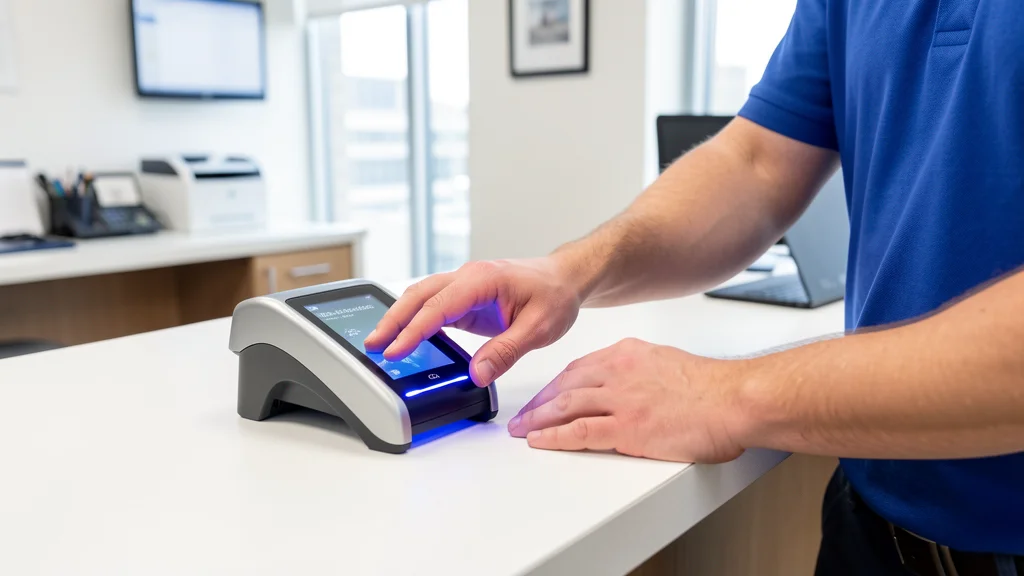
At Mailbox Plus, we offer digital fingerprinting using live-scan technology. Our technician scans your fingerprints electronically — no ink, no cards, no smudging. The system gives real-time feedback on print quality, so we know immediately whether the scan is acceptable.
Here is what the process looks like:
- Bring your completed request form. If you have a BCI/FBI print request card from your employer, licensing board, or agency, bring it with you. If you do not have a form, we have blank WebCheck forms available.
- Bring a valid government-issued photo ID. Driver's license, state ID, or passport.
- Sit for the scan. The technician guides your fingers onto the electronic scanner. The scan captures each finger individually. The process takes about ten minutes.
- Receive your confirmation. Once the scan is complete and verified as acceptable, your prints are transmitted electronically to BCI. You receive a receipt and tracking information.
The digital scan is transmitted directly to the Ohio BCI WebCheck system. There is no physical card to mail, no ink to dry, no human transcription errors. The same day your print is submitted, it enters the BCI queue.
Digital fingerprinting has a significantly lower rejection rate than ink cards — less than 2 percent compared to 15–20 percent for ink. When your background check matters, that reliability matters.
Who Needs Fingerprinting in Ohio
If you are wondering whether you need to be fingerprinted, here are the most common scenarios:
- Educators and school employees. Teachers, substitutes, bus drivers, cafeteria workers, aides, and volunteers in Ohio schools all require BCI & FBI background checks.
- Healthcare professionals. Nurses, doctors, pharmacists, nursing home staff, home health aides, and anyone working with vulnerable adults.
- Childcare workers. Daycare centers, preschools, and in-home childcare providers.
- Foster parents and adoptive parents. The Ohio Department of Job and Family Services requires fingerprint-based background checks for all foster and adoptive parents.
- Real estate professionals. Real estate license applicants in Ohio must undergo a BCI background check.
- Professional license applicants. Many licensing boards — including cosmetology, accounting, counseling, social work, and securities — require fingerprint-based checks.
- Volunteers. Schools, youth sports leagues, and nonprofit organizations increasingly require background checks for volunteers who work with children.
If you are in any of these categories and have been told you need a background check, you need fingerprinting. And you want it done right the first time.
How It Works at Our Counter
The entire appointment takes about fifteen minutes from walk-in to walk-out:
- Step 1 — Walk in. No appointment needed. Bring your ID and any forms your employer or agency provided.
- Step 2 — Digital scan. Our technician scans all ten fingerprints electronically. The system checks quality in real time.
- Step 3 — Submit. Your prints are transmitted electronically to the Ohio BCI WebCheck system. You receive a receipt with a tracking number.
- Step 4 — Wait for results. BCI processing times vary. BCI-only checks typically take one to three business days. BCI & FBI checks can take one to five business days. Your employer or licensing agency receives the results directly.
There is no ink. No waiting for a card to dry. No second trip because the first scan was rejected.
What You Lose by Not Acting
The cost of delaying a background check is straightforward: you cannot start the job, get the license, or complete the adoption until the check comes back. Every day you wait to get fingerprinted is a day the clock is not even running.
But there is another cost: the frustration of doing it twice. Ink cards fail. Sheriff's office appointments are scarce. If you go to a location that uses outdated equipment, you risk a rejection that costs you another trip and another week of waiting.
Digital fingerprinting is not faster than ink on paper. It is faster than the alternative: ink, rejection, reschedule, reprint, resubmit.
Your Afternoon After the Change
You walk into Mailbox Plus at 7554 Fredle Drive. You have your ID and your BCI request form. The technician guides you through the scan. Ten fingers, one at a time. The screen shows green checkmarks as each print is captured.
The technician prints your receipt. "You are all set. Your prints have been submitted to BCI."
You walk out. You were in the store for twelve minutes.
Bring It In
If you need to get fingerprinted for a job, a license, or an adoption, do not spend a week chasing appointments at the sheriff's office. Walk into Mailbox Plus at 7554 Fredle Drive in Concord Township. Digital fingerprinting, no appointment needed, in and out in fifteen minutes.
Related Services
Have Questions?
Stop by our location in Concord Township or give us a call. We're here to help with all your shipping and printing needs.