The Question You Asked Before You Drove Anywhere
You are renewing your Ohio driver license, or getting your first one, and the form hits you with the address block. Your mail goes to a PO box — it has for years, maybe because you moved often, maybe because you run a business out of your house and do not want the address printed on everything. So you ask the obvious question: can the license just say the box?
Here is the short answer before you burn a trip to the Deputy Registrar: no on the residence line, yes on the mailing line. Ohio's BMV keeps the two addresses in separate slots, and only one of them is allowed to be a box. By the end of this article you will know exactly which slot is which, what documents the state actually accepts, and how to set up a mailing address that never gets refused anywhere.
Two Slots, Two Different Rules
Every Ohio credential is built on your residence address — the street address of your principal residence in Ohio. Ohio's administrative code, the rule governing what documents establish an Ohio credential, requires applicants to prove that street address, and it says it in exactly these words: "a post office box or other mail box address is not acceptable."
The reason is baked into the federal rules Ohio opted into. If you want a Compliant Card — the one that works as a REAL ID at airport security — you must bring two documents, from different sources, proving your Ohio street address. The state is not asking where your mail lands. It is asking where you physically live.
But here is the slot most people never notice. The BMV's own change-of-address form, BMV 5756, splits the page in two. The top block asks for your "correct residence address (where you live; your permanent home address)." Below it sits a second block: "mailing address (if different from residence address above)" — and that line prints "street or P.O. box". You can even mark it permanent or temporary, with start and end dates.
So the answer to the headline question is a split decision:
| Address line |
What goes there |
Can it be a PO box? |
| Residence address |
Where you actually live — your permanent home |
No — a mailbox address is explicitly not acceptable |
| Mailing address |
Where the BMV sends your renewal notices and correspondence |
Yes — the form's mailing line prints "street or P.O. box" |
The box was never the problem. Putting it in the wrong slot was.
What It Feels Like at the Counter
You hand over your paperwork and the clerk slides one sheet back. "This is a box. I need your street address." You explain that the box is your address — you have been receiving everything there, some of it from the state itself. None of that matters, because the two slots look identical on the form and nothing anywhere told you they were different. Now you are standing in line you already waited in, holding your wallet, trying to remember whether your bank statement has your street address on it or the box — and whether it is from the last sixty days, which is the window the BMV allows for some proof documents.
Nobody warns you. You find out at the window, which is the worst possible place to find out.
Why the Rule Isn't Arbitrary
The rule is not the state being difficult. Your residence address is what ties your driving privileges to a jurisdiction — it determines your county of residence, which feeds jury duty lists, voter registration (a change of address filed with the BMV doubles as your voter registration update under Ohio law), and law-enforcement records. A mailbox slot in a post office lobby cannot do any of that. The state is not asking where to send your junk mail on that line. It is asking where you can be found.
The mailing line exists precisely because the state knows those are different things. That is why BMV 5756 gives you a second block with its own rules. The system already separates where you live from where your mail goes. You just have to fill in the right block — and have your mail set up so the right block is easy to fill.
What We See Every Day
At Mailbox Plus — 7554 Fredle Drive in Concord Township, just off Crile Road, minutes from SR-44 and I-90 — this question walks in the door constantly, usually from someone who already lost a trip to the BMV. Here is what you actually get when you ask this question at our counter: you get a real street address with your box number on it — written per USPS standards with a PMB or # designation — and a key that opens nothing but your own box. You get month-to-month terms that start at $15 with a $5 refundable key deposit, so you are not signing a contract to solve a paperwork problem. Your USPS mail lands there, and so do the UPS and FedEx boxes that bounce off a post office box.
That street-address quality is the whole point. A plain P.O. box is a box, and where a form demands a street address, a box number is what gets refused — that is the exact mechanism behind the BMV residence rule and a dozen other forms like it. A private mailbox is a street address, so it clears mailing lines that turn boxes away. And unlike a post office box, deliveries from private carriers do not bounce off it.
If you have read why PO boxes get rejected when a street address is required or the full PO box vs private mailbox comparison, you already know the distinction. This article adds the BMV-specific piece: which line tolerates what.
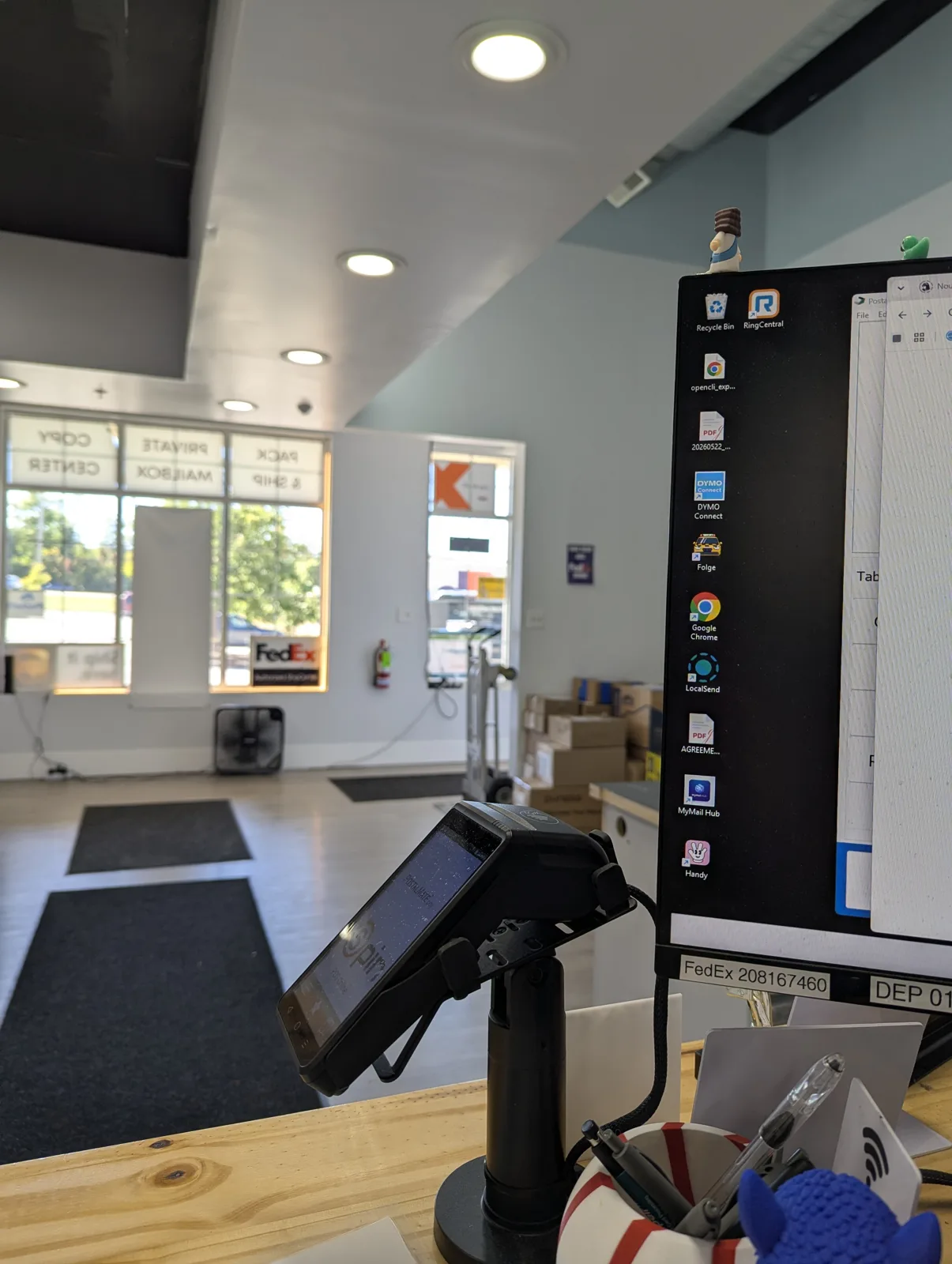
The Mailbox Plus counter in Concord Township, with the private mailbox wall behind it
How It Works
- Fill the residence line honestly. Wherever you sleep most nights — that is your residence address, and no forwarding arrangement changes it. If your proof documents (a bank statement within sixty days, a current insurance policy or card, a BMV change-of-address card) do not show that street address, the BMV lists exactly what does.
- Set the mailing line once. Bring your PO box question to our counter with two forms of ID — federal USPS rules (Form 1583) require one government photo ID and one proof of address before we hand over a key. You sign, pick a size and term, and walk out with a real street address.
- Update the mailing address with the BMV. File BMV 5756, mark the mailing line permanent, and every renewal notice and state letter lands at an address that does not depend on a forwarding order staying alive.
Three stops, one form, and you never have to improvise at a Deputy Registrar window again.
What You Lose by Guessing
The wasted trip. The most common cost is also the stupidest one: an hour in line, a sheet of paperwork slid back across the counter, and a second trip on a different day because the residence line said a box. The documents were fine. The slot was wrong.
Missed state mail. The BMV mails you things that matter — renewal notices, verification letters, correspondence with deadlines. Send them to a box you stop checking, or a mailbox that lapses, and the deadlines keep running whether you saw the letter or not. A mailing address that never changes and never forwards is how those letters keep reaching you.
Slot confusion everywhere else. The BMV is not the only form with a split address block. Insurers, banks, and county offices run the same two-slot pattern — residence versus mailing — and each one punishes guessing in its own way. Fix the setup once and every future form becomes trivial: residence is where you live, mail goes to your street-address PMB, no improvising.
Life After the Fix
The next form that asks for your address, you fill it in without pausing — residence line, your street; mailing line, your PMB. No second-guessing, no sheet slid back across a counter. Your renewal notice is waiting behind a lock at Fredle Drive, not stacked in a lobby that changed hands when you moved. That background hum of address anxiety is gone, and you only notice it was there because it stopped.
Bring the Form In
You do not need to have the BMV rules memorized before you walk in. Bring the form, the renewal notice, or just the question — deciding which slot an address belongs in is literally what the counter is for. We will verify your two IDs, walk you through sizes and terms, and hand you a real street address for your mailing line. The residence address stays honest and yours. The mail is ours to hold.