The Scene That Starts Everything
It is 10:40 on a Tuesday night and you are printing shipping labels at the kitchen table. The house is quiet. The dogs are asleep. You have eleven boxes to get out, and you are three weeks into running your Etsy shop as a real business instead of a hobby — which means you finally started looking at your numbers.
That is when you see it.
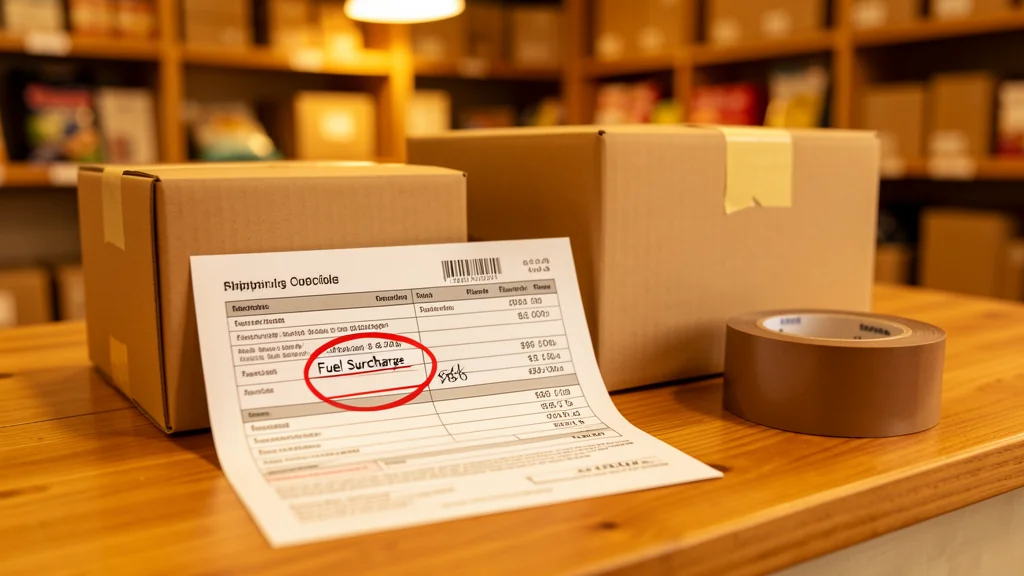
The label for the six-pound candle order to Columbus: $11.40. The base rate: $8.64. And then, sitting right below it, a line you have seen a hundred times and never once questioned:
Fuel Surcharge: $2.76.
Twenty-five percent of the shipping price is not the shipping price. It is a fuel charge added on top. You scroll back through your orders. June 1: $2.10. May: $1.98. You dig up an invoice from January, and the same package was $1.61.
Nobody sent you an email about it. Nobody raised your rates and told you why. The boxes are the same weight, going the same distance, packed the same way. But the shipping cost has quietly climbed 70 percent since January, and almost all of that climb is one line item you were never taught to read.
If you sell online, ship gifts to grandkids, or run any business that puts boxes on trucks, this article is about that line item. It is about what it actually is, why it is climbing right now, and — most importantly — what you can actually do about it.
The Fuel Surcharge
The fuel surcharge is a percentage that the carriers add to your base shipping rate, recalculated every single week against the national average price of diesel fuel. It applies to almost every package that moves through UPS, FedEx, and DHL in the United States. When diesel goes up, the percentage goes up. When diesel goes down, the percentage goes down — slowly, grudgingly, and only after the numbers have moved far enough to matter.
Right now, the percentage is high, and it is climbing. The week of July 27, 2026, FedEx Ground was charging a 25.75 percent fuel surcharge. UPS Ground was at 26.25 percent. That means more than a quarter of every ground shipment's price is a fuel adder. Air express is worse — FedEx Express package services were running at 38.75 percent for the same week.
Why now? Because the world is in a diesel supply crunch. On July 30, the Wall Street Journal reported that the escalating conflict in the Middle East has rattled diesel markets going into the high-demand autumn season. As Joe DeLaura, senior energy strategist at Rabobank, put it: "We're in a diesel supply crunch right now because none of the Persian Gulf refineries can get product out." Ukrainian attacks on Russian refineries and lower Chinese refinery runs are making the shortage worse. And diesel is not a luxury input. The Journal's own framing: "Crude oil is just the input, but diesel is the everything the industrial economy runs on." Everything in agriculture, everything in construction, everything in mining — and everything on the supply and distribution side — runs on diesel.
Every one of those diesel gallons eventually shows up as a percentage on your shipping label. That is the mechanism. It is legal, it is disclosed in the fine print of every carrier's service guide, and it is almost never explained to the person actually paying it.
What It Actually Feels Like
It feels like being taxed by someone who will not look you in the eye.
You bring a box to the counter, and the price is simply whatever it is. You have no leverage. You have no explanation. If you ask why it costs more than it did in March, the answer is a shrug and a gesture at "fuel." The number moves weekly, so even a savvy customer who tracked last month's rate cannot predict next week's. There is nothing to negotiate, nothing to shop around for at the store you are standing in — because the store you are standing in only sells one carrier's fuel surcharge.
For online sellers, it is worse. You did not price your products in January assuming a 26 percent adder. Your margins were already thin. The surcharge is not a rounding error — it is a business expense that moves against you every week, and you are the one absorbing it, because raising your prices to cover it makes you uncompetitive.
And here is the part that gets under your skin: nobody ever sits down with you and shows you the math. Not the carrier. Not the software. Not the store. You are expected to just accept that shipping costs what it costs.
Why It Should Not Be This Way
A fuel surcharge is not inherently evil. Diesel genuinely costs more, and carriers genuinely pay more to move your package. Passing that cost through, in theory, is fair.
But here is the problem: it was designed to be invisible. A surcharge is a price increase that does not look like one. The base rates went up too, around the turn of the year — UPS pushed through its 2026 general rate increase in late December, FedEx followed in early January, as they do every year. Then the fuel percentage goes on top of that increased base. The surcharge is calculated as a percentage, so it compounds. And unlike a price, it can change every seven days, which means nobody in the chain is ever accountable for the number on your receipt.
A 26 percent adder should be a headline. Instead it is a line item in the small print of an invoice, in a font slightly smaller than everything else, with no explanation attached.
You should not need a degree in logistics to understand why your shipping bill went up forty dollars this month. You should be able to walk into a store, put a box on a counter, and have someone show you the actual math — including the fuel line — and then show you a way to pay less.
What We See Every Day
We see this every day at Mailbox Plus, at 7554 Fredle Drive in Concord Township. We stand behind the counter while customers drop off boxes that cost visibly more than they did a year ago, and we watch them wince at the receipt.
Here is what we see that the big carriers do not want you to see: the surcharge is not the same everywhere. UPS and FedEx publish different percentages every week, on different schedules, based on slightly different fuel numbers. DHL runs its own table. And in April 2026, USPS joined the club — it imposed its first-ever fuel-driven surcharge, an 8 percent add-on to Priority Mail and Ground Advantage that runs through January 2027. That means the same package, the same weight, the same destination, can cost meaningfully different amounts depending on which carrier moves it this week.
A single-carrier store cannot tell you that. It makes no money sending you to a competitor. But we are not owned by any carrier. We are an independent, multi-carrier store — UPS, FedEx, USPS, and DHL all come to our counter. So when the fuel surcharges move, we can actually do something about it: we check the current tables across all four carriers, on the spot, before you pay. When FedEx is cheaper this week, we say FedEx. When USPS gets it there for less, we say USPS. Your package goes out on the carrier that costs you the least, and you see the comparison before you hand over a card.
That is the difference between paying the fuel surcharge and managing it.
How It Works
It takes three minutes:
- Walk in. Bring the package — taped, labeled, or not. If it is not packed yet, bring the item and we will pack it right there.
- Tell us where it is going and when it needs to arrive. Two weeks, three days, tomorrow morning. That is all we need.
- Watch us compare. We check live rates across UPS, FedEx, USPS, and DHL — including this week's fuel surcharges — and put the options on the counter in front of you. You pick. You pay. You walk out.
No account, no logins, no rate-shopping apps to learn, no spreadsheets. The comparison that takes a shipping manager an hour happens in the time it takes to print a label.
What You Lose by Not Acting
Time. Right now, if you want to beat the surcharge, you have to become a fuel-price analyst. Check the EIA diesel average, read the UPS and FedEx weekly tables, compare it against your package's zone and weight, and re-route accordingly — every single week. That is not what you started your business to do, and it is not what you should be doing at 10:40 at night.
Money. Do the math on your own volume. If you ship $500 a month, a 26 percent adder is roughly $130 a year that goes to fuel surcharges — more, when you count the compounding on top of January's rate increase. If you ship $2,000 a month, you are losing over $500 a year. And unlike a rate you can plan around, the surcharge moves weekly. Some sellers, frustrated by the creep, start fudging weights or declaring the wrong package class to claw it back. That is fraud, it gets caught in carrier audits, and the bill that follows is far bigger than the surcharge ever was. That is not a strategy; it is a gamble.
Peace of mind. The worst part of an invisible charge is the feeling that you are being quietly taken advantage of, and that you are alone in it. You are not. Every small business in Lake County shipping boxes right now is paying this same adder — the difference is that some of them have a counter where someone shows them the real comparison, and some of them do not. You also do not have to put your home address on labels or accept pickups at your front door to save a few dollars. Use a real business address, ship from a real counter, and keep the chaos out of your living room.
Your Afternoon After the Change
It is a Tuesday afternoon. You have four boxes in the back of your car — two returns, one birthday gift for your sister in Columbus, and one order for your shop. You pull off Crile Road onto Fredle Drive, park, and walk into Mailbox Plus.
You put the boxes on the counter. In the time it takes to check your phone, you hear four options across the carriers, including this week's fuel numbers, and you pick the one that makes sense. The birthday gift goes USPS — cheapest this week, arrives Friday. The shop order goes UPS Ground — faster than FedEx for the same price once you see the surcharge difference. The returns go wherever their labels say, one counter, no extra stops.
The total is on the counter before you. No surprises, no fine print, no line item you do not understand. You pay, you get your receipts, you are back in the car at 2:14. The whole thing took nine minutes — including the conversation.
And next week, when the fuel number moves again, it will not matter, because you are not the one tracking it. That is the point of the change: you stop being the comparison shopping engine, and you get your Tuesday afternoons back.
Bring It In
The fuel surcharge is going to keep moving. Diesel is in a supply crunch, autumn demand is coming, and the carriers have already told us the percentages are climbing. You cannot control the price of diesel — but you do not have to pay more than you should for the same box.
Bring your package to 7554 Fredle Drive in Concord Township. We will show you the real comparison across UPS, FedEx, USPS, and DHL — including every fuel surcharge — and put your box on the carrier that costs you the least. Three minutes, one counter, all four carriers.
That is what we are here for.