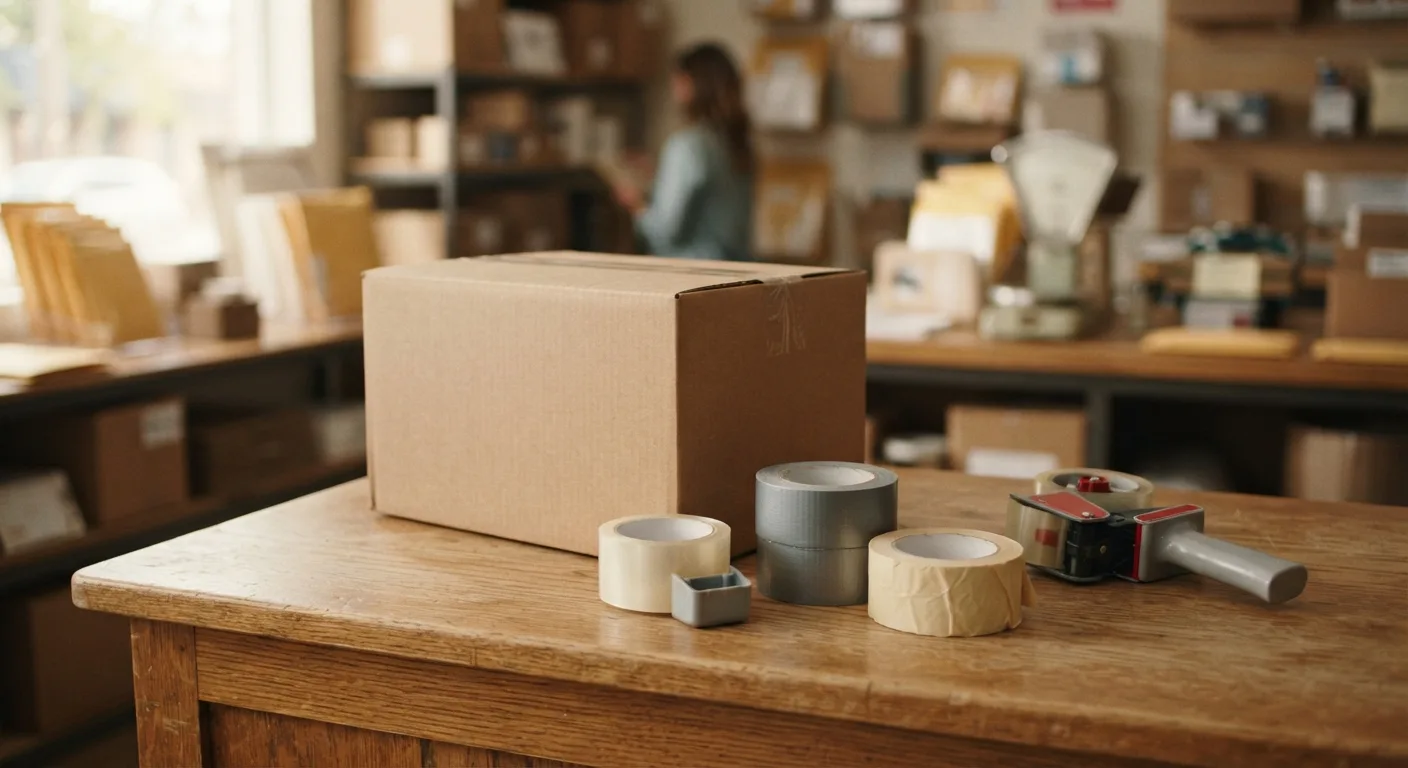
You Sealed It. You Mailed It. It Came Back Smashed.
You spent twenty minutes packing that box. Bubble wrap around everything, the good box, the label printed straight. Then you sealed it with whatever tape was in the junk drawer — a roll of gray duct tape, a strip of painter's tape, or the bargain-bin roll of plastic tape from the dollar aisle.
The box left your hands looking fine. It arrived at your buyer's door flaps-first, one corner peeled open, and now there's a claim form, a refund, and a one-star review standing between you and your Saturday.
That's the outcome you're after: the adhesive bond is what decides whether your box survives the sorters — and here is the mechanism behind it.
The Problem: The Junk Drawer Tape Trap
Nobody's careless on purpose. The trap is that duct tape, painter's tape, electrical tape, and cheap plastic tape all look strong, and your kitchen drawer has held them all at one time or another. So when the box needs sealing, your hand reaches for what's closest.
Here's the mechanism the tape companies and the carriers know and you were never told: the strength of a taped box isn't about how hard the tape pulls. It's about whether the adhesive stays stuck to cardboard through a trip that involves vibration, temperature swings from hot trucks to cold warehouses, humidity, and — because this is real life — getting tossed. Each of the drawer tapes fails that test in its own signature way:
- Duct tape sticks brilliantly to almost everything except cardboard. Its adhesive is engineered for cloth and metal ductwork. On corrugated fiberboard, the adhesive slowly lets go, especially in heat — the box holds in your kitchen and unravels in a trailer in Texas.
- Painter's tape (masking tape) is engineered to let go cleanly in a few days. That's its whole job. On a box it peels at the flap edge the moment anything pushes against it.
- Electrical tape stretches. It's made to wrap wire and stay elastic. An elastic adhesive on a box flap creeps and slides under load — the box slowly un-seals itself.
- Thin "economy" plastic tape (the cheap clear or tan rolls) is usually a thin film — around 1.6 mils of backing — with a thin adhesive coat. It snaps cleanly under tension and offers almost no flap hold, so a hard impact splits the seam in one hit.
And here's the part that turns an annoying problem into an expensive one: duct tape and masking tape are named as do-not-use in writing by all three major carriers. Electrical tape and thin economy plastic never get named — they simply fail the standard every carrier states: use tape designed for shipping.
What It Actually Feels Like
It feels like the counter clerk sliding your box back across the desk and saying, "I can't take this one." The line behind you shifts. You're holding a box that took you an hour to pack, being told it's not shippable because of one gray strip of tape.
Or worse — it feels like nothing at all, until eight days later when tracking says delivered and your buyer texts you a photo of a crushed corner and an open flap, contents rattling loose inside a clear carrier bag, and the claim you file comes back denied for "insufficient packaging."
You didn't fail at shipping. You were set up. Every hardware store sells duct tape next to the boxes, and nothing on the label says this will void your own insurance.
Why It Should Not Be This Way
Sealing a box is a two-minute job. Carriers shift all packaging liability onto you in PDFs you'll never open until after a claim is denied — that's the coin flip.
The carriers print their tape rules in public — you just have to know where to look.
The Comparison: Five Tapes, One Box
Here's the honest chart — the one the junk drawer never showed you.
| Tape |
Made for |
What happens on a shipping box |
Carrier verdict |
| Shipping/packing tape (BOPP plastic) |
Sealing corrugated boxes |
Stays bonded through heat, cold, vibration; holds flaps under impact |
✅ Accepted by UPS, USPS, FedEx (FedEx floor: 3" wide) |
| Reinforced / water-activated paper tape |
Heavy boxes, reinforced seams |
Fiberglass or water-activated adhesive fuses to the box — the strongest seal available |
✅ Accepted (USPS: reinforced packing tape; FedEx: water-activated) |
| Duct tape |
Ductwork, cloth, temporary repairs |
Adhesive releases from cardboard, especially in heat; leaves residue |
❌ UPS: "Do not use... duct"; USPS: "do not use... duct tape"; FedEx: "Don't use duct" |
| Painter's/masking tape |
Clean removal from walls in days |
Engineered to release; peels at flap edges in transit |
❌ UPS: "do not use masking"; USPS: "do not use... masking"; FedEx: "Don't use... masking" |
| Electrical tape |
Insulating wire |
Elastic adhesive creeps and slides under load; box un-seals slowly |
❌ Not named by any carrier — but fails every carrier's "tape designed for shipping" standard |
| Cellophane/gift tape |
Wrapping presents |
Backing far too thin; splits at the first edge stress |
❌ USPS: "do not use... cellophane tape" |
A few details from the carrier rulebooks worth knowing before you seal anything:
- Width matters as much as type. UPS says seal with plastic or nylon tape at least 2 inches wide. FedEx wants at least 3 inches wide pressure-sensitive plastic tape, applied with the H-taping method (tape across the center seam, then the two end flaps). USPS wants 2-inch-wide tape on the opening and all seams.
- The H-method is the difference between sealed and sealed. One strip down the middle leaves the flap ends as hinges. Center strip plus two end strips closes every flap edge.
- Thickness is measured in mils (thousandths of an inch). Economy tapes run thin film around 1.6 mils; serious packaging grades run roughly 2.5 mils and up of film-plus-adhesive. More adhesive thickness generally means more holding power on dusty corrugated surfaces. That said, adhesive chemistry matters more than raw thickness — a thick coat of the wrong glue (duct tape again) still releases.
- Temperature is the quiet killer. USPS's own guidance says masking, cellophane, and duct tape are "not strong enough to withstand temperature fluctuations during transit." A box rides from a 95°F truck bed into a 40°F warehouse and back out again. Cheap adhesive fatigues through every one of those cycles.
What Happens When the Tape Fails Mid-Transit
You asked the question every shipper should ask. Here's the answer, and it isn't comforting. (Prefer to hand the whole job to us? That's what professional packing is for.)
Carriers don't carry tape guns and repair staff for your box. When a taped seam splits in a sort facility, a few things can happen, none of them good:
- The repack bag. Shippers report that when USPS finds a package coming apart, the box often ends up in a clear plastic carrier bag and keeps moving. Your contents are now riding loose in a plastic sheath with a note attached. Contents that shook out along the way stay on the floor where they fell — the bag catches what's left.
- The damaged-goods claim. If contents are damaged or missing, you file a claim. But UPS's packaging guidelines state it plainly: packaging is the shipper's responsibility, and the carrier isn't liable for damage resulting from improper packaging. If the damage traces back to a seal that failed — a seal made with tape the carrier told you not to use — the claim gets denied for insufficient packaging. That's the paper trail duct tape leaves behind.
- The rejected box. Counter and hub employees can refuse visibly inadequately packaged shipments on the spot. A box that arrives at drop-off held together with painter's tape may not even start its journey.
The failure you prevent for a dollar is the failure that costs you the item, the refund, the claim fight, and the customer's trust.
What We See Every Day at Our Counter
We're Mailbox Plus, at 7554 Fredle Drive in Concord Township, and we seal boxes all day long — boxes that came in wearing every tape on that chart above. We're an independent shipping store, which means we answer to you, not to a franchise playbook, and we ship UPS, USPS, and FedEx from the same counter. We know each carrier's packaging rules because we're the ones who have to hand your box to them.
Here's the deal we make with every customer: we will tape your box up properly for one dollar. Right tape, right width, right H-pattern across every seam. We do it dozens of times a day. If your box needs a better box, cushioning, or a size that fits the contents, we'll tell you before we ship it — because a package leaving our store with our seal on it is our work walking out the door.
How It Works
- Bring the box as-is. Duct tape, painter's tape, half-finished seal job — doesn't matter. Set it on the counter.
- We inspect and re-seal. We check the flaps, the seams, and the box itself, then seal it with proper 2-inch-plus shipping tape in the H-pattern. One dollar. If the box itself is the problem, we'll say so and show you the fix — we stock boxes and packing supplies right at the counter.
- You choose the carrier and we ship it. UPS, USPS, or FedEx — we compare the rates and services on the spot and hand you the receipt. Package accepted first time, sealed to spec.
What You Lose by Not Acting
Time. A rejected box is a second trip. A denied claim is an afternoon of photos, forms, and phone calls. A re-seal at our counter is two minutes.
Money. One claim denial can erase a hundred successful shipments' worth of margin. A dollar of professional tape is the cheapest insurance you'll ever buy — and if the box is worth more than the insurance, the tape is still the part that decides whether the insurance ever pays out.
Trust. If you sell online, the buyer doesn't know about your junk drawer. They know the box arrived open. Reviews don't grade the tape; they grade you.
Your Next Shipment, After the Change
The box is on our counter. You're telling us where it's going. Two minutes later the receipt is in your hand, the tracking number is live, and the box goes into the outbound pile wearing a proper H-seal — every flap edge closed, every seam held, ready for the sorters and the trucks and the weather. No claim forms in your future. No texts with photos of crushed corners.
That's what shipping is supposed to feel like.
Bring It In
Got a box already packed — or one you're not sure about? Bring it to Mailbox Plus at 7554 Fredle Drive, Concord Township, OH 44077, or call (440) 709-1946. We'll re-seal it properly for one dollar, check it against the carrier's requirements, and get it on its way. And if you'd rather never think about tape again, hand us the whole job — packing, sealing, and shipping — and it's done right the first time.