What Should Take Two Minutes
You have a box to send. It is not complicated — it weighs a few pounds, it has an address on it, and it needs to get somewhere by a day you already know. But the errand keeps growing. Which carrier? Which box? How much tape? Do you need a printer at home just to make a label? Somewhere between the question and the answer, an afternoon disappears.
It should work like this: you walk in with the item, tell someone where it is going, and walk out with a receipt and a tracking number. That is the entire experience.
That is what a shipping and mailing service is. Not a franchise you have to decode, not a government counter with one lane open — a trained counter that handles USPS, UPS, and FedEx side by side, packs what you bring, and hands you the comparison instead of making you research it. Here is exactly what happens at that counter and what it costs.
Meet The Post-Office-Only Habit
The mechanism working against you is the Carrier Lock-In Counter. A USPS retail counter can only sell USPS — that is store policy by design — so you stand at the one register that is open and never see the UPS Ground rate that might have been cheaper, never hear that a flat rate envelope exists, and never get told that packaging decides whether your insurance claim lives or dies. Nobody is breaking a rule. The opacity is the rule. And riding on top of it is a habit most of us inherited: the belief that the post office is the only place mail happens.
So the box sits in your trunk for three days while you wait for a free hour. Then you drive to the post office, park, stand in a line that moves at the speed of the one register that is open, and get to the counter only to learn the box you grabbed is the wrong size for the service you need. The clerk is not the problem — they are working inside the lock-in, where USPS can sell you USPS, and that is all.
The cost of that habit is invisible because it never shows up on a receipt. It shows up as errands that take a morning instead of ten minutes, as packages you keep meaning to send, and as the quiet dread of the return label burning a hole in your inbox. It also costs real money: defaulting to one carrier means never seeing the cheaper option. USPS Ground Advantage starts at $7.90 at the post office, and a Priority Mail Flat Rate Envelope is $12.90 at the retail counter — but whether those are your best prices depends entirely on the weight, size, and destination of your specific box, which is exactly the comparison a multi-carrier counter runs in front of you in about a minute.
How It Feels, Honestly
It feels like standing on a line while the fluorescent tube above the register buzzes, the plastic chair sticks to the back of your legs, and the counter scale beeps once every time the clerk weighs somebody's box.
It feels like the moment the clerk asks, "Do you know if this contains anything liquid, hazardous, or perishable?" and you realize you have to narrate the contents of your own box on a speaker while four people behind you listen. It is filling out a customs or address form on a tiny pen chained to a ledge, realizing your phone is dead so you cannot pull up the address, and starting over.
And it is the specific exhaustion of coming home with the box still in the trunk. That is the real price of the errand — not the postage, the second trip.
Simple Things, Made Complicated on Purpose
Here is the part nobody says out loud: shipping is complicated at the edges because the carriers make money on the edges.
Dimensional weight pricing means a big light box can be billed by its size, not its scale reading. Packaging standards determine whether an insurance claim survives a sort-facility bump. Insurance declarations, address formats, delivery signatures — every carrier has its own version, and none of them publish a plain-English comparison at the counter, because each one wants you comparing them to nothing.
This is legal, ordinary, and never explained. A retail shipping store exists precisely to sit on your side of that complexity. We are not here to defend one carrier's rate card — we are here to run your box through all of them and hand you the number.
What an Independent Store Looks Like
At Mailbox Plus in Concord Township, you walk into a counter where USPS, UPS, and FedEx all live on the same screen. We are independent — not owned by any carrier — which means our job is the comparison, not the upsell.
What that looks like in practice: you walk up, we pull all three carriers up on one screen, and your box gets priced by whichever service fits its weight, size, and deadline — not whichever service the building belongs to. Packing is part of the job, so you do not need to find a box first: we box, cushion, tape, and seal at the counter (see professional packing), and a properly packed box is also a box whose insurance claim can actually survive. And because we are independent, the same counter handles the paper parts of the same errand — Certified Mail with the USPS fee ($5.55 as of the July 2026 rate change) and return receipt options, printing and copying, faxes, mailbox rentals that keep your home address off your shipments, even fingerprinting. Above all, you are dealing with a clerk who has packed ten thousand boxes — so you do not have to learn the carriers' rulebooks.
You are not buying postage. You are buying the two minutes of someone else's competence.
What It Costs, Line by Line
You came for numbers, so here are the published retail figures as of late 2026 — treat them as starting points, because your actual price depends on weight, size, and destination:
| What you send |
Published retail starting price |
Source |
| First-Class letter (1 oz stamp) |
$0.82 |
usps.com price list |
| USPS Ground Advantage (retail, smallest packages) |
from $7.90 |
usps.com price list |
| Priority Mail (retail) |
from $11.00 |
usps.com price list |
| Priority Mail Flat Rate Envelope (retail) |
$12.90 |
usps.com price list |
| Priority Mail Express (retail, overnight to most) |
from $35.65 |
usps.com price list |
| Certified Mail service fee (on top of postage) |
$5.55 |
USPS rates effective July 12, 2026 |
| Return Receipt Electronic (signature proof) |
$2.91 |
USPS rates effective July 12, 2026 |
Two things the table cannot tell you:
- UPS and FedEx prices are quoted, not posted. They move with weight, zone, and service level, and the honest answer is "let me run it" — which takes under a minute at our counter and is the single fastest way to find out you were about to overpay.
- Online and commercial rates are usually lower than the retail counter. USPS Click-N-Ship and commercial pricing regularly run cheaper — a Priority Mail Flat Rate Envelope is $11.12 at commercial pricing versus $12.90 retail. If you ship through us, you get access to discounted commercial rates you cannot always reach with a home printer, which is one of the quiet reasons a shipping store can cost less than the post office.
Packing service and materials are priced at the counter based on the box and the job — ask, and you will get a number before anything is charged, not after.
Bring What You Have: Three Steps
- Walk in with the item. Unwrapped is fine. No box, no tape, no label printed at midnight — bring the thing itself, and the address it is going to.
- Put it on the counter. We box it, cushion it, weigh it, price it across carriers, and tell you the options with the prices attached. You choose. That is the whole decision.
- Leave with a receipt and a tracking number. Two minutes to ten, depending on the queue ahead of you — not the afternoon the post-office habit was charging you.
If the errand also involves printing the return label, faxing the signed form, or a mailbox to receive the replies at, none of it requires a second trip.
What You Give Up by Defaulting
- Time. The three-day box in the trunk, the parking, the line, the second trip when the first one fails. Multiply that by every shipment you "keep meaning to send."
- Money. Defaulting to one carrier means never seeing the cheaper rate. On a single box it is a few dollars. Across a year of shipments — eBay sales, client documents, family care packages — it is real money, and the comparison that would have caught it takes about a minute.
- Confidence. A box packed with the wrong cushioning is a claim waiting to be denied. The FedEx-vs-USPS question is the visible one; the packaging question is the one that costs you the vase.
And underneath all three, the chronic drag: the errand you rehearse in the shower, three days running, before you ever leave the house.
What Your Next Errand Looks Like
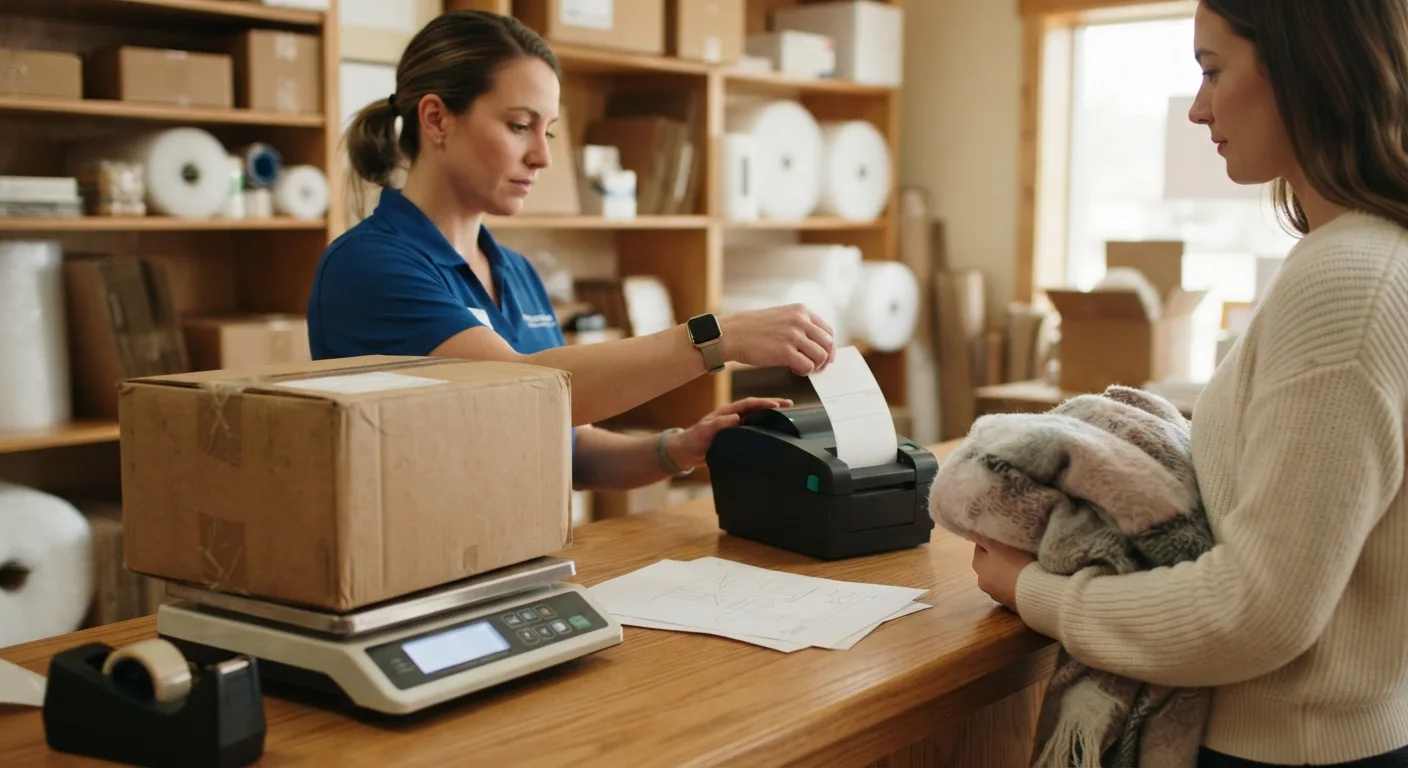
You pull in, carry the item in loose — tape still on the roll at home where it belongs. A counter person asks where it is going and when it needs to be there. It goes on the scale. You hear two prices, pick one, and watch the label print. The receipt slides across the counter with the tracking number already on it.
And the feeling is not triumph. It is silence — the errand that had been narrating itself in the back of your head since Tuesday simply stops. You are back in the car before the playlist finishes the song, and the box that owned your week is somebody else's problem.
Bring the Mess to Us
You do not need to know which carrier is cheapest. You do not need a box, tape, a label printer, or an opinion about dimensional weight. You do not need to have anything figured out before you arrive.
Bring the item loose, bring the address, and put it on the counter at 7554 Fredle Drive, Concord Township — open Monday through Friday 9:00 AM to 6:00 PM, Saturday 9:00 AM to 2:00 PM (see our packing and shipping services). Taking the mess from here is literally why the counter exists. Call us at 440-709-1946 if you want to ask about your specific box first — or just bring it in.