The Fine Print You Never Got
You filed the change of address — or you meant to, between the movers and the utility deposit — and now you want to know what you actually signed up for. Here is the part nobody reads before clicking submit: a USPS change of address does not change your address. It reroutes certain classes of mail from your old address to your new one, for a limited time, and leaves most of the rest to the address each sender already has on file — your bank, your license, your packages, and any catalog whose sender did not pay for forwarding.
The expected outcome of filing is simple: mail that used to hit the old mailbox starts showing up at the new one, on schedule, without you chasing it. What actually happens is narrower than that, and the fine print decides whether your statements follow you or pile up at a house you no longer own.
Here is how it actually works, step by step, including the fee, the forms, the letters USPS mails you along the way, and the mail it will not forward no matter what you file.
The One-Form Assumption in Plain Daylight
The gap starts with what the form actually controls. A change of address order is a forwarding instruction, not an address update. USPS says it plainly on its own page — your change of address order only changes your mailing address with the Post Office, and you are responsible for telling government agencies, companies, and anyone else who sends you mail. The form you file talks to one system: the postal routing layer.
That routing layer catches the mail classes USPS carries at the First-Class level and above. First-Class Mail, USPS Ground Advantage, Priority Mail, and Priority Mail Express forward free for 12 months. Magazines and newsletters forward free for 60 days, if the publisher prepaid the postage. Media Mail forwards too, but you pay the shipping cost from your local Post Office to your new address.
Everything outside that lane is deliberately untouched. Marketing mail and catalogs forward only if the sender paid for forwarding postage — otherwise it is delivered to the old address, or tossed by the carrier route rules. And the sensitive stuff is blocked on purpose: for security, mailers like government agencies and financial institutions do not allow forwarding of driver's licenses, voter registration, credit cards, bank statements, insurance documents, or medical information. A new debit card mailed to your old address is not forwarded to your new one. That is the system working as designed, not a glitch.
The Feeling Every Regular Recognizes
It starts around week three in the new place. You are unpacking the kitchen and you realize you have not seen your bank statement. Then the credit card you reordered never shows. You call the bank and they say it was mailed — to the old address — and getting it back now depends on whoever answers the door there.
Or the seasonal version: you filed a temporary change of address for a four-month contract job, and month five arrives with your insurance renewal sitting at an address 900 miles away. The forwarding window closed and you had not filed the extension, because nothing reminded you and nobody tells you the clock is running.
This is the part that stings. You did the thing you were supposed to do — you filed the form. The assumption that one form covers the move is what leaves the gap, and it is not stupidity. It is the most reasonable reading of the words "change of address." We broke down where those gaps concentrate in forward mail after a move; this guide covers the filing mechanics themselves.
The Assumption Nobody Questions
A two-minute form should not require a follow-up campaign. You told the Postal Service where you live now; a reasonable person reads that as done. But the COA system was built to move mail between postal addresses — not to notify independent senders, each with their own address database and their own rules about what they will mail to a forwarding order versus a confirmed address change.
That is why USPS requires the separate step, in writing, on its own page: contact each sender directly. The bank wants its own form. the DMV wants its own process. The retailer shipping your orders wants the address on the label changed, because a UPS truck does not check USPS forwarding orders — it delivers to whatever is printed on the box.
Once you see the split, the frustration moves off you and onto the structure. You did not miss a step. The step does not exist in the system you filed with.
Behind the Counter: Why We Shield You
At Mailbox Plus on Fredle Drive in Concord Township — Gristmill Village, next to Pub Frato, just off Crile Road and minutes from SR-44 and I-90 — we sit on the other side of this exact problem. People come in mid-move with a stack of questions the USPS website answers in four different places: when do I file, what does the $1.25 online fee actually buy, why did my magazine stop and my statements didn't.
We are not a Post Office retail counter and we cannot file your change of address for you — that has to happen at USPS.com or at a Post Office with photo ID. What we can do is give you the address that does not move.
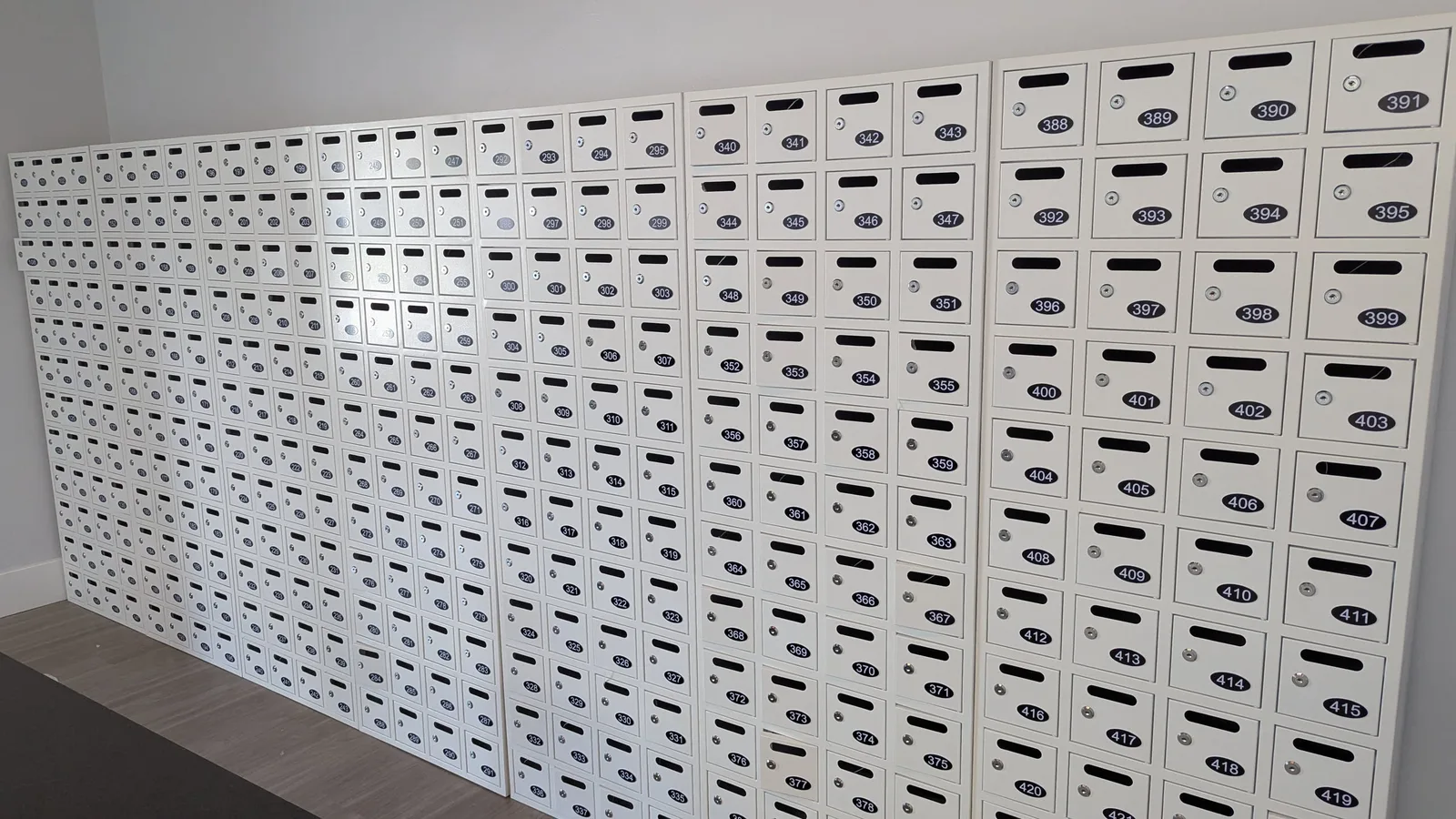
Wall of numbered private mailbox doors at Mailbox Plus in Concord Township
A private mailbox here is a real street address that receives your mail month after month, on USPS, UPS, FedEx, and DHL alike, and it starts at $15 a month on personal plans. Move houses six times and the mailbox stays where it is. Your mail lands at one address, held securely until you pick it up or ask us to forward, scan, or hold it — no forwarding clock, no 12-month cutoff, no letter chasing a house you left. The full comparison of the two routes is in mail forwarding 101.
We see the aftermath every week: the forwarded envelope with a yellow sticker, the card that had to be reissued, the catalog pile at the curb of a vacant house. We would rather hand you the workaround before the move than sort the wreckage after.
Zero Homework: Three Steps at the Counter
Filing the change of address itself is genuinely simple. Three steps:
- Pick your window. USPS accepts a change of address up to 90 days before your move date and up to 30 days after it. Once approved, allow 7-10 business days for forwarding to go into effect — so file before the move, not the week after the truck leaves.
- File online or at the counter. Online at the official USPS change of address site, it costs $1.25, charged to a card whose billing address matches your old or new address, and identity is verified with a code or link sent to your phone. Or take photo ID to any of the more than 33,000 Post Office locations, ask for the free Mover's Guide packet, and fill out PS Form 3575 with the retail associate — free, because the ID check replaces the card check. One warning worth more than the fee: third-party websites charge $40 or more for this, and USPS no longer accepts their submissions at all. Only USPS.com.
- Answer the two letters, then work the sender list. A Move Validation letter arrives at your old address to confirm the request is real. About 5 business days before your start date, a Customer Notification Letter with your confirmation code arrives at the new address — keep that code; it is the only way to modify or cancel the order. Then start the actual address change: your bank, your cards, your employer, the DMV, your insurer, every subscription. The form cannot do this part for you.
If online identity verification fails, USPS emails instructions and a barcode; bring that and acceptable photo ID to a Post Office and finish the verification in person. And a few situations are always in-person: moves outside the United States, filing for someone else, and any case where online verification will not clear.
What All This Adds Up To
Stay on the forwarding treadmill and the costs stack in three currencies.
Time. A permanent forwarding order covers 12 months for First-Class Mail, Ground Advantage, and Priority Mail; magazines stop at 60 days. You can pay to extend it 6, 12, or 18 more months — 18 is the maximum — and the extension is nonrefundable. Either way, you are renting a temporary patch on a permanent problem, and every billing cycle that ends before your senders update is a cycle you spend on hold with a bank.
Money. After your forwarding period ends, USPS returns mail to the sender for 6 months with a label showing your new address — so the senders you never notified keep getting their mail back, and some will simply stop sending until you call. Marketing mail forwarded at the sender's request can arrive postage due. And the missed mail has its own price: a credit card that must be reissued, a renewal notice that lapses into a penalty, a refund check that never gets cashed.
Privacy. The same routing that helps you can be turned around: a fraudulent change of address is a known identity-theft play, which is exactly why USPS hardened the process with the verification fee, the phone-code check, and the in-person fallback. It is also why your sensitive mail never follows the order — the system assumes the filing could be someone else. Treat your own confirmation code accordingly: anyone holding it can redirect or cancel your forwarding.
Temporary moves carry their own math. A temporary COA runs a minimum of 15 days and a maximum of 185 days per order; you can extend once for up to 179 more days, for a total ceiling of 364 days — 12 months. Return to the original address for at least 45 days and the clock resets for your next stint. Miss the end date and delivery simply resumes at the old address while you are still away.
The Trip You'll Stop Thinking About
Now flip it. You file early, in the 90-day window, and the confirmation code arrives by email once verification clears. The Move Validation letter confirms the request at the old address; the Customer Notification Letter shows up about five business days ahead of your start date, and the first forwarded envelope arrives on schedule.
The pieces that never forward — the bank card, the license, the packages on brown trucks — go to one fixed address that did not change: your private mailbox at 7554 Fredle Drive. On a random Saturday, say 9:57 in the morning, you swing through Gristmill Village, park next to Pub Frato, and walk out with two weeks of mail in one trip — statements, a package, the magazine that would have died at 60 days somewhere else. Nothing is sitting at the old house. Nothing needs rescuing.
That is the cognitive silence this article is really about: the low hum of "did anything follow me?" switching off, because the address your important mail uses is the one you chose to keep.
Walk In and Ask
You do not need to have the sender list built, the move date locked, or the forwarding math worked out before you stop in. Bring the situation as it is — the contract ending in March, the house sale closing, the kid leaving for school — and we will walk the counter with you: what to file, when, and which parts of your mail a forwarding order will never touch.
Bring the mess. Absorbing the address headache is literally why we exist. Mailbox Plus is in Gristmill Village at 7554 Fredle Drive in Concord Township, next to Pub Frato, just off Crile Road, minutes from SR-44 and I-90 — open 9:00 AM to 6:00 PM weekdays and 9:00 AM to 2:00 PM Saturday. If your question is "how do I stop my mail from going to the old place," the private mailbox is the version of that answer that does not run on a forwarding clock, and personal plans start at $15 a month. Ask at the counter; no appointment needed.