Your Seals Keep Cracking in the Mail
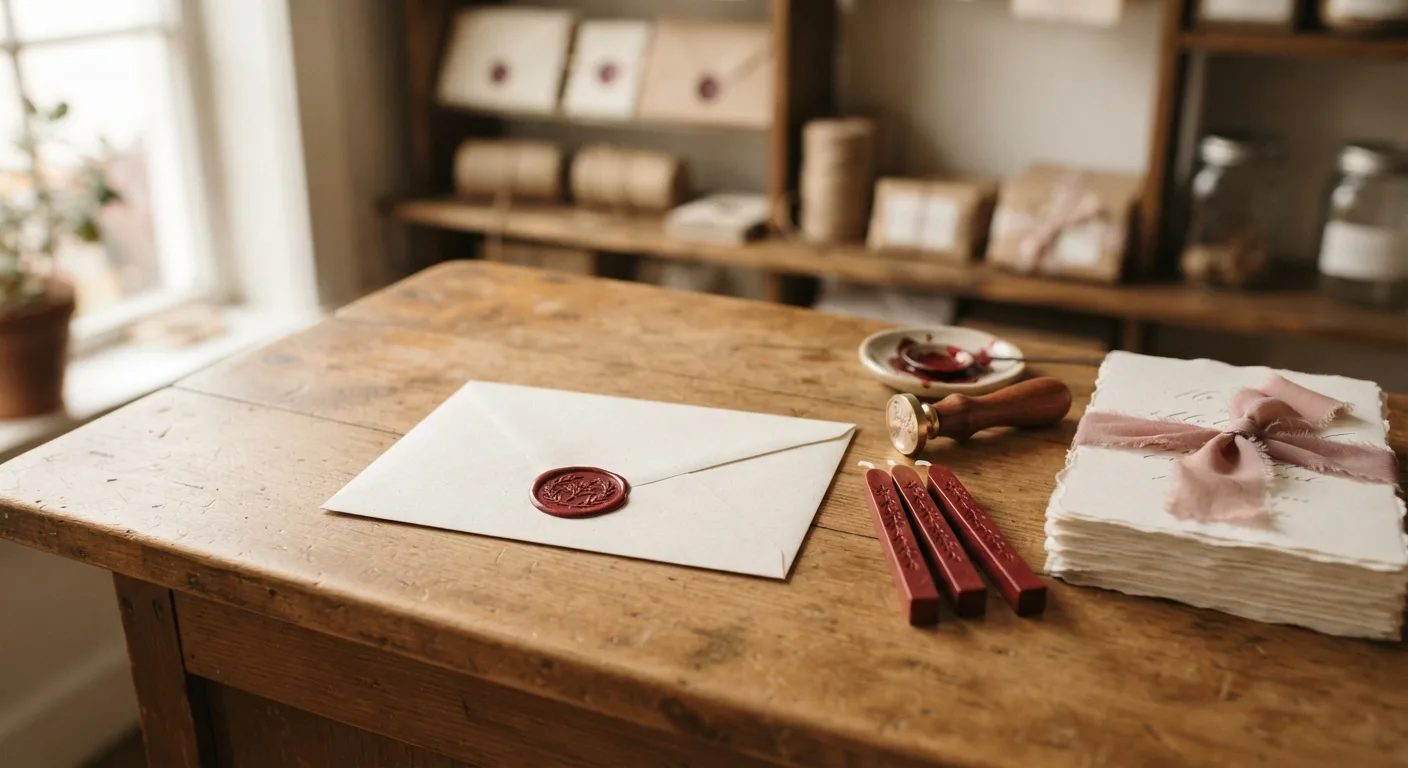
You stood at the kitchen counter past nine, the spoon hot in your hand, the sweet burnt smell of sealing wax filling the room as each monogram clicked into place. Every invitation got its seal — deep red wax, the envelope finally looking the way the day deserves. Then the first RSVP comes back, and the seal arrives in pieces: cracked across the middle, a corner missing, half of it stuck to the inside of the sorting machine somewhere between your mailbox and theirs.
Here's what should happen: the seal that left your hands arrives looking the way it left them. Whole, glossy, pressed. That's not luck — it's a matter of which wax is on the envelope and how the envelope is prepared. Sealing wax made the way it was made for a thousand years will not survive a modern sorting machine, and no amount of "FRAGILE" will change that. What follows is how sealing actually works in the mail system, and how to get your seals through it intact.
The Machine That Doesn't Know It's an Heirloom
The thing working against your envelopes isn't carelessness. It's physics plus automation, and it's worth understanding how the system actually treats your envelope.
When your letter leaves your hands, it doesn't get carried — it gets processed. Postal facilities run envelopes through automated machines for canceling and sorting, and those machines handle billions of flat, flexible paper envelopes at speeds and pressures no brittle material enjoys. They were not built with shellac in mind.
Traditional sealing wax — the formula that was historically made from wax, shellac, and resins for correspondence that traveled by hand and saddlebag — is brittle by design. Shellac is what gives it that crisp, glassy impression with knife-edge detail. Shellac is also what makes it crack like stained glass when something bends it. For most of history that didn't matter, because a wax-sealed letter was carried by a person. The hard math of the modern sort — pressure, impact, and bending that no brittle material survives — simply didn't exist when the formula was invented.
So the mechanism isn't that the postal system is rough with your mail. It's that the wax and the machine are two technologies from incompatible centuries, and the envelope is where they collide. The person who blames the carrier is misreading the situation — the problem is on the envelope, and it's fixable.
The RSVP Comes Back in Pieces
You open the returned RSVP and the pieces fall into your palm. The monogram is still legible — you can see it, broken cleanly through the middle of the "R." Your stomach drops, because you know what it means: every seal on every invitation you mailed is doing the same thing right now, in a hundred trays and machines, and the ones that survive will be the exception.
Or worse — you don't get a returned piece. The seal just never arrives, and you only find out when a guest mentions, a little too casually, "the envelope was kind of... open?" Now the question isn't cosmetic. A broken seal on an envelope that still has to reach its recipient means the flap may not be sealed at all, and whatever was inside traveled exposed.
And the feeling underneath both of those is the same: you did the careful thing. You chose the old way on purpose. It's supposed to be the durable tradition — it lasted a thousand years. What the moment teaches you is that the tradition lasted because it was maintained by hand, and your envelope has just been volunteered for something no hand ever did to it.
A Thousand Years of Proof, and Why Yours Snapped
Here's the part that makes this worth fixing rather than abandoning. The seal is one of the oldest document-security technologies humans have. For roughly a thousand years in Europe and long before that elsewhere, a seal meant one thing: this came from me, unbroken. Manuscript specialists at the University of Nottingham put it plainly — on medieval legal documents, the seal was the signature, the only personal authentication anyone trusted. Kings and public bodies authenticated official documents with them, and correspondents closed letters with them. The seal said: this came from me, unopened, unaltered — because a broken seal is evidence, and everyone in the chain knew how to read it.
That history is on your side in one way: the point of the seal — a visible promise that the contents are intact and genuinely from you — translates perfectly to a modern mailbox. The wedding invitation with a whole, glossy seal still says exactly what a charter said in 1200. What doesn't translate is the material, because the journey changed. The formula that survived a saddlebag dies in a canceling machine, and the fix isn't to give up the tradition — it's to use the modern version of it.
That's the whole misunderstanding, really. Flexible, mailable sealing wax isn't a cheap knockoff of the real thing. It's the real thing updated for the machine age — formulated to flex instead of crack, the way the old formula flexed for the journey of its own era.
The Counter Where These Envelopes Land
At Mailbox Plus on Fredle Drive in Concord Township, we see a steady stream of wax-sealed envelopes in wedding season — invitations, save-the-dates, holiday cards with the family crest. We also see the failure reports, and the pattern is always one of two things: traditional (breakable) wax that couldn't survive the sorter, or a seal applied in the wrong place on the envelope.
So here's the guidance we give at the counter, in order of what actually works:
First, use flexible wax labeled as mailable. Modern flexible sealing waxes are specifically engineered to bend with the envelope instead of snapping — that's the single biggest factor, and the specialist retailers are unambiguous about it: flexible wax is formulated to resist cracking during automated sorting, while traditional breakable wax is explicitly not recommended for postal use. If the listing doesn't say mailable, assume it isn't.
Second, put the seal on the inside — or protect it. The most reliable way to mail a wax seal is not to expose it to the machines at all. Tuck the wax-sealed card or liner inside an outer envelope, and machine-sort the outer envelope instead. If the seal is part of the look you want on the outside, use a rigid mailer or add padding so nothing bends it, and work out the handing with us at the counter — anything non-machinable should never go into a collection box.
Third, expect the machines to test even good wax. Even flexible wax can smear or pick up scuffs in a canceling machine. That's why the pro move for anything precious is the inner-envelope method above: the seal survives because the sorter never touches it.
Walk in with whatever you've got — even just the wax you bought and a finished sample. You don't need to know wax types, sorting rules, or postage categories; the counter absorbs those so you don't have to. We'll go through it with you — which pieces can ride as-is, which need an outer envelope, what the postage implications are for anything rigid or non-machinable. We're an independent shipping store, so we're not steering you toward one carrier's answer; we sort it by what your envelope actually needs.
Three Choices Before You Melt Anything
- Choose flexible, mailable wax. Check the product listing before you melt anything — "traditional," "breakable," or "high shellac" means display-piece, not mailbox.
- Decide where the sorter meets your seal. Ideally never: seal an inner envelope or card, then machine-mail a plain outer envelope. If the seal rides outside, cushion the envelope and hand it over the counter.
- Let us handle the edge cases. Rigid mailers, non-machinable shapes, and anything with a raised or protruding element may need different postage or packaging — the USPS services we handle cover exactly these edge cases, and we'll sort it out with you at the counter before it ships.
What Guessing Costs
The seal itself. Every cracked seal in the mail stream is one you made by hand. Wax made with breakable shellac doesn't sometimes fail in the machines — it reliably fails. Guessing on the wax type means gambling every impression you press.
The contents. A seal that snaps can take the flap closure with it. An envelope that opens in transit is no longer a cosmetic problem — it's an invitation, a card, or a check traveling exposed, and there's no tracing what fell out along the way.
The moment. This is the one that stings. Invitations go out once. The recipient's first physical impression of your event is the envelope in their hands, and a shattered seal says "rushed" even when it cost you three careful evenings. The whole reason you chose wax was that it lands differently than a lick-and-stick envelope — which is exactly what you give up when it arrives in pieces.
The Envelope That Arrives Whole
The last RSVP comes in, and you notice you've been holding your breath for the seal — and it's fine. Glossy, whole, the monogram crisp, exactly as you pressed it. The guest mentions the envelope before they mention the date. That's the version where the tradition actually works: a thousand years of "this is genuinely from me, intact," running correctly on a twenty-first-century mail stream, because you matched the wax to the journey instead of fighting the machines that carried it.
Bring a Sample In
Sealing a batch — invitations, announcements, holiday cards? Bring a finished sample to Mailbox Plus at 7554 Fredle Drive in Concord Township, or stop by with the wax you're planning to use, and we'll look it over with you before the whole run goes out. Pack and ship details are here, or just ask at the counter. The seal is the promise — let's make sure it arrives still keeping it.