What Does PMB Stand for in an Address?
You see "PMB" on an address and wonder what it means. PMB stands for Private Mailbox — the numbered slot behind the locked counter of a private mailbox store, not a compartment in the post office lobby. The number points to your box at that store:
Jane Smith
7554 Fredle Drive PMB 123
Concord Township, OH 44077
Miss the PMB tag and your mail bounces back to the sender. Here's the exact format that keeps it alive.
What Is a PMB Number?
A PMB number is your box number at the store. The Postal Service has hard rules about how it appears on mail, and they're worth knowing before you print a single label.
When you rent a box from us, know this: we're registered with the USPS as a Commercial Mail Receiving Agency (CMRA) — that's the government's word for a shop allowed to receive your mail for you. And because one storefront receives mail for many different people, the Postal Service requires your mail to carry a designator that says which box is yours. Per the Domestic Mail Manual, that designator must be either "PMB" or a # sign followed by your number: PMB 123 or #123. Nothing else — "Box 123" or "Suite 123" will not do.
Skip it, and the consequences are printed right in the rulebook: USPS may return the mail to the sender endorsed "Undeliverable as Addressed, Missing PMB or # Sign." Your envelopes don't sit in limbo. They go back.
So when you give out your address — to a bank, a supplier, your mother — give it exactly as issued: street address, then PMB and your number. That one line tells the entire mail system where your mail actually lives.
What a PMB Address Actually Looks Like
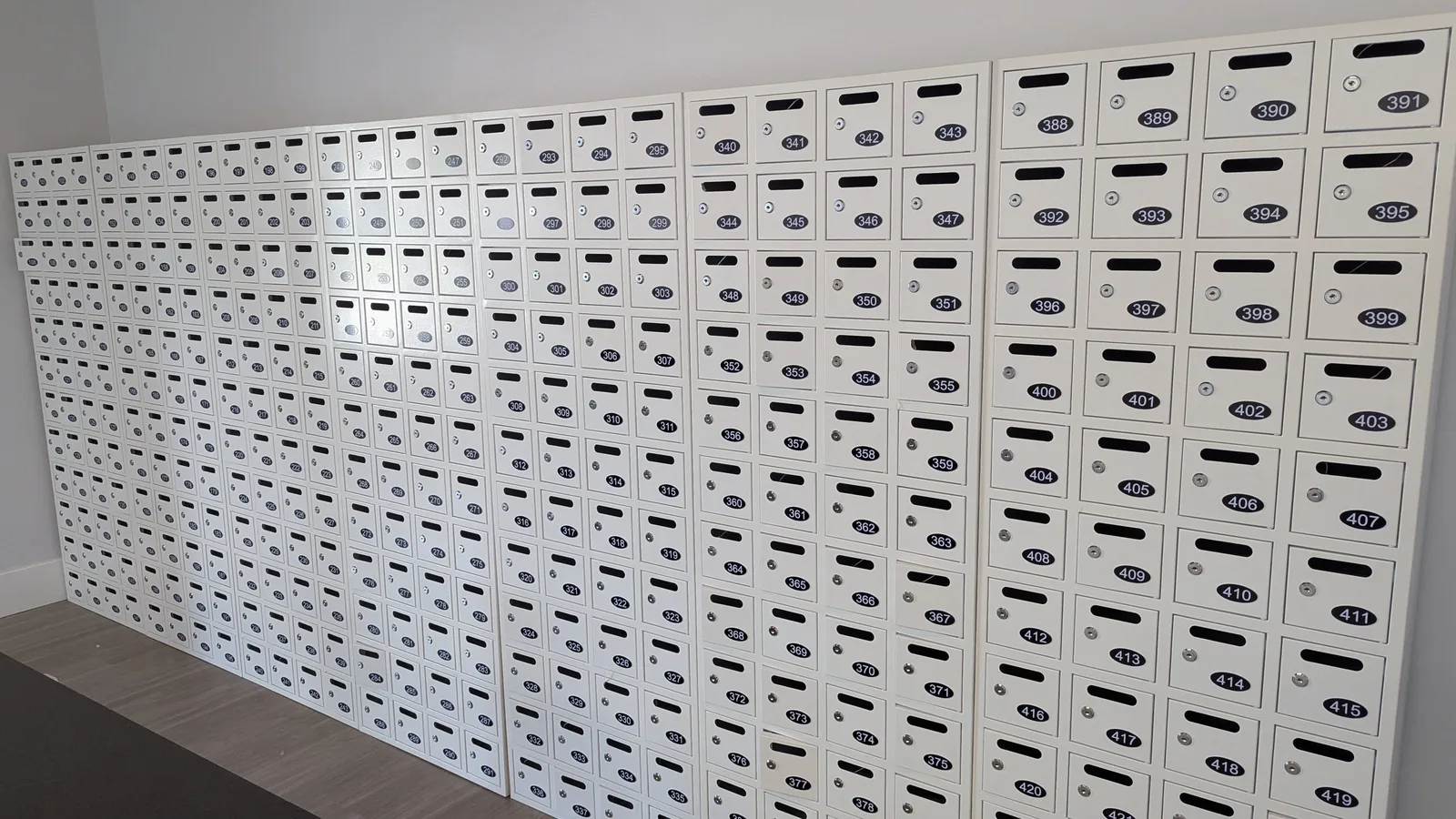
Wall of numbered private mailbox doors at Mailbox Plus in Concord Township, each with its own lock and mail slot
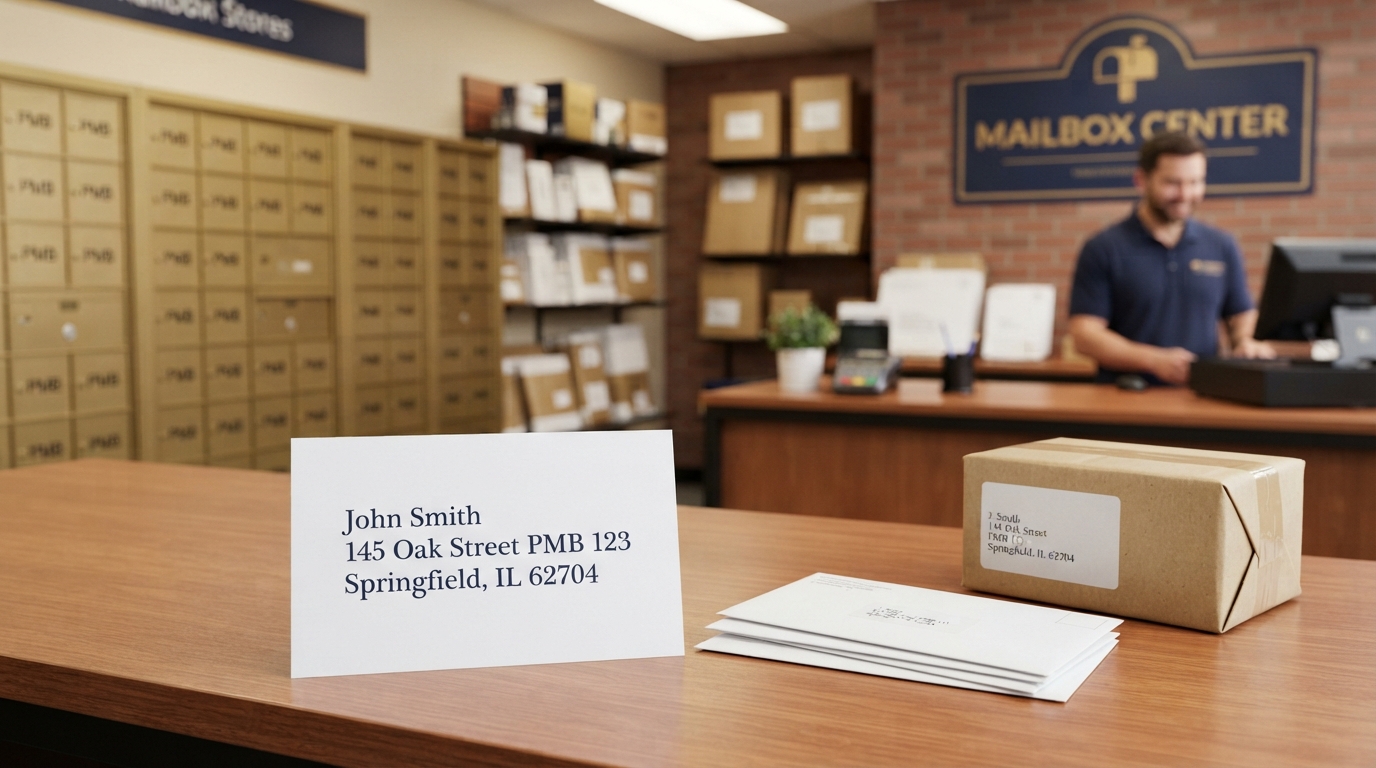
When Jane rents her box, she walks out with a card that reads like this: her name up top, then 7554 Fredle Drive PMB 123 — the store's street address with her box number riding the same line — then Concord Township, OH 44077. That's her real address now.
The address is a street address. Not a box compartment in a post office lobby — an actual storefront on an actual road that any delivery driver can pull up to.
The PMB number rides on the same line as the street address. That's the format the Postal Service prefers. It reads like an apartment or suite number, which is exactly why banks and marketplaces that refuse box numbers will take it.
The recipient name is doing real work. Your mail is addressed to you, care of the store. That's why every person on a shared PMB has to be authorized — more on that paperwork below.
If your CMRA's street address already carries its own secondary element (a suite number, a rural route box), the format changes slightly — the PMB goes on its own line instead of being merged in. The counter staff will write your exact, correct three-line format on your Form 1583, so you always have the authoritative version in hand.
PMB vs PO Box: The Honest Comparison
Look at your last week of deliveries. See a brown UPS truck on your street? Then a PO Box already fails you — it only takes USPS. A PMB wins, because it takes all four carriers and a PO Box physically cannot take any of them. A PO Box is a numbered compartment inside the post office, and USPS is the complete list of carriers that deliver to it.
But here's the honest concession: a PO Box is cheaper. If your mail is letters only — bills, cards, magazines, forever — and it always will be, a PO Box does the job for less money, run by the Post Office itself. We won't pretend that's not true. The comparison only tilts hard the moment a package from a non-USPS carrier enters your life, and for most people that moment isn't hypothetical.
Here's the counter version, the one that matters: hand me your PO Box mail and your PMB mail and watch the brown truck — it turns away from the box and pulls up to our storefront. That's the whole difference in one picture. Now the full comparison:
|
PO Box |
Private Mailbox (PMB) |
| Address type |
Box number at the post office |
Real street address at a CMRA store |
| Who delivers |
USPS only |
USPS, FedEx, UPS, and DHL |
| Packages from others |
Not deliverable |
Signed for and held behind a locked counter |
| Form to rent |
PS Form 1093 |
PS Form 1583 + two forms of ID |
| Best for |
Letters only, on a tight budget |
Anyone who gets packages or needs a street address |
One more row that doesn't fit in a table: institutions. Some banks, agencies, and marketplaces reject box numbers on an application but accept a street address. If you've ever had an application bounced for "no PO Boxes," that rejection is the price of the box format itself. We've written a whole piece on why PO Boxes get rejected and street addresses don't.
Who Needs a PMB?
Look at your own front porch. If you've ever flinched at a stranger reading your home address off a shipping label, you already know why this list exists. The pattern is always the same: a street address that isn't your home, receiving everything you get sent.
- You run a business from your kitchen and feel your home address on every invoice and filing — we give you a street address that reads like a firm, because a box number reads like a hobby.
- You sell online and don't want your home address printed on a label any stranger on your porch can read.
- Your porch takes more deliveries than it can defend — at a PMB, everything is signed for and held behind a locked counter.
- You travel, snowbird, or live on the road and need a stable address that holds your mail while you're gone — and can scan and forward it when you're farther away. That's the digital mailbox option.
- Your bank, the DMV, or a marketplace refused a PO Box — you need an address that works everywhere, and this is it.
And the honest flip side: if none of those describe you — you get letters, you get them at home just fine, nobody ships you anything — spend your money on something else. A PMB is a tool, not a trophy.
How to Get a PMB in Concord Township
Getting a PMB at Mailbox Plus is a one-visit errand, not a project.
Step 1 — Come in with two forms of ID. One photo ID and one showing your current address. That's the requirement on PS Form 1583, the USPS form that authorizes us to receive your mail. Federal rules require a completed 1583 for every private mailbox holder — you sign it in front of us at the counter, we verify your ID, and it takes about ten minutes. Bring the IDs and it's the only paperwork of the whole process.
Step 2 — Pick your plan. Mail-only plans start at $15/month. If you want us to receive and sign for your carrier packages — the reason most people choose a PMB — the $25 plan includes 10 packages a month with carrier delivery and signing, and larger boxes run $30 and $40. Month-to-month, cancel anytime — no 12-month lock-in.
Step 3 — Start using your address the same day. You leave with your real street address and PMB number. All four carriers deliver; we sign for your packages and hold them securely. Setup takes about ten minutes, and your address is active that day.
We're at 7554 Fredle Drive in Concord Township, Ohio — just off Crile Road, minutes from SR-44 and I-90, serving Mentor, Painesville, Willoughby, Eastlake, Madison, and the rest of Lake County. You don't need to pre-tape a thing or memorize USPS rules. Bring whatever ID you have — if it's not enough, we'll tell you what is. Sit at the counter and we'll fill out Form 1583 with you. Walk out with a real street address, and we carry the confusing mail rules so you don't have to. Rent a private mailbox or stop in and ask us anything first — the questions are free.
What You Lose by Choosing the Wrong Mailbox
This is the part of the PMB definition that actually costs people money:
- A PO Box costs you packages. Not delays — deliveries. A FedEx or UPS package addressed to a box number is undeliverable as addressed, and the drive to the carrier's facility to claim it is on you.
- Your home address costs you privacy. Every label and vendor form puts your home into systems you don't control, and porch pirates read delivery schedules better than you think.
- The wrong address format costs you mail. Use "Box" or "Suite" instead of PMB or # at a CMRA address, and the Postal Service's own rule sends it back to the sender — missing PMB or # sign, undeliverable.
Picture the counter at 7554 Fredle Drive: we sign for your UPS box, slide it behind the locked glass, and you grab it on your way home. No porch pirate, no home address on the label.
What Your First Week Looks Like
A seller on Etsy rents a mailbox on a Tuesday. The bell chirps when she pushes through the glass door; she slides her license and utility bill across the counter, signs Form 1583 while we verify the IDs, and walks out with a real street address and her PMB number — the address is active that same day. That evening she updates her Etsy shop, her supplier accounts, and her return-address stamp.
Wednesday, a supplier ships her inventory to "7554 Fredle Drive PMB ___." The box lands on our counter with a thud — we sign for it and slide it behind the locked glass. She grabs it on the way home: no missed-delivery slip taped to a door her customers will never see, no home address printed on a label a stranger could read. Every carrier — USPS, FedEx, UPS, DHL — delivers to the same line, so nothing bounces the way it would to a PO Box. That's a private mailbox doing its whole job in one week, and it never touches her house.
That seller walked out in ten minutes, and her address was live before she got back to her car. You will too — same counter, same form, zero prep. Rent a private mailbox, or come see the counter at 7554 Fredle Drive first and we'll show you exactly what your address would look like before you spend a dollar.
If you are weighing the decision on price alone, see what a mailbox rental actually costs — and if a virtual mailbox is on your list too, read virtual vs real local mailbox before you commit.