The Headline Says 5.9%. Your Invoice Will Not.
You budget your shipping like you budget everything else — same boxes, same routes, a number you can carry into January. Then the carriers start publishing their 2027 rate tables, and the number you budgeted quietly stops being the number you pay.
FedEx says 5.9%. Your January invoice will say something else — and UPS has not announced its 2027 numbers yet. The gap is not random. It is built into the average, the minimum, the delivery-area map, and a stack of fees that rise on their own schedules. Here is each carrier — what is announced, what is already published, and what the stack will look like on your invoice.
The Two-Number Trick
It is not greed. It is arithmetic with a decoy. FedEx raises thousands of individual rate cells, not one flat 5.9% — some services rise 3%, some rise nearly 8%, and the blend averages to the headline. Then the surcharges — fuel, residential delivery, delivery area, additional handling, minimum charges — rise on their own schedules, and several of them rise faster than the base rates. When you ship a package, you do not pay the average. You pay your cells plus your fees. The average is the marketing number; the stack is the invoice.
You do not have to compare 28,000 rate cells. The handful that hit your invoice are the ones we watch at the counter — and they are not the headline. The gap between headline and reality is wider than usual in 2027, and one specific fee schedule is doing most of the damage.
The Sigh You Make at the Counter
It feels like January 5th, the first Tuesday of the new year — the first shipping day after the Monday holiday effects settle. The store is still warm from the holiday rush — leftover shipping labels curling on the counter, tape gun empty, your breath fogging on the drive over. You print a label for the same 3-pound box you shipped every week in December, and the number on the screen is eleven dollars and some change before fuel and the residential fee stack on top — the floor itself is about to move to $12.70, and it will not move alone.
You stand there holding the box with both hands, the label half peeled, doing the math in your head while the clerk waits. You did this math in December, on the couch, with the December tables open in one browser tab and your spreadsheet in the other. Base rate, plus fuel, plus a little padding. What you did not have was the minimum charge — the floor FedEx charges no matter how light the box is. In 2026 that floor was $11.99. In 2027 it is $12.70. On a package that never actually costs $12.70 to ship, that floor is not a floor. It is the price. And your padding, which was sized off a 5.9% assumption, does not cover it — because the minimum rose 5.92% while your particular rate cells rose 6.49%, and the residential fee on top of it rose 7%, and the fuel percentage never went down.
Nobody stopped you at the door and explained any of this. You just feel it — that hot, small embarrassment of promising a customer a price in November and watching it come true at a different number in January, in front of them.
A quoted price should hold. The delivery-area fee, the fuel shift, and the calendar roll-over should not be able to break it. In 2027, they can.
Where the Friction Stops
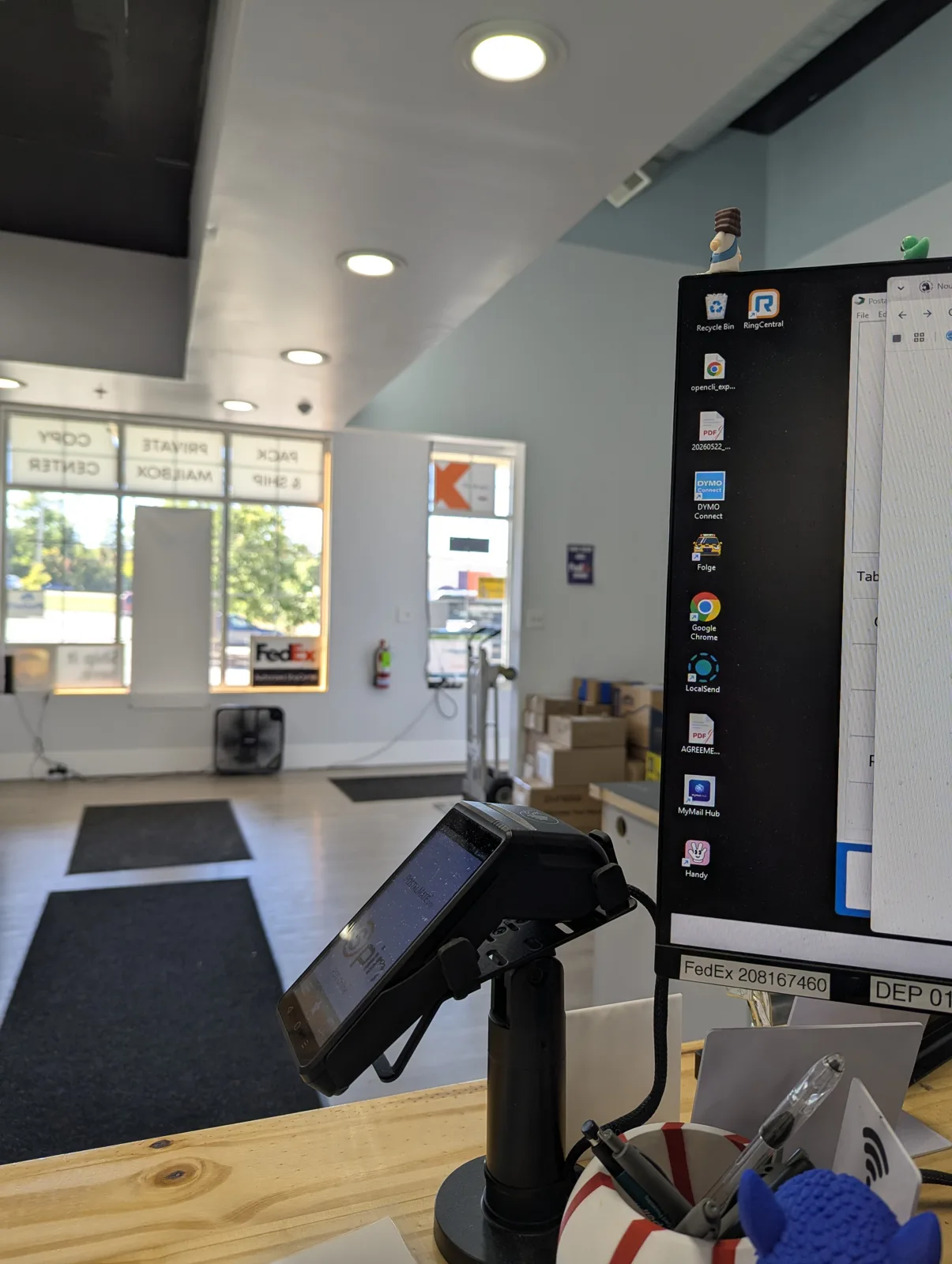
The pack-and-ship counter at Mailbox Plus in Concord Township, with the point-of-sale terminal, computer, and carrier rate sheets where every surcharge gets explained line by line.
At our counter on Fredle Drive, the FedEx receipts print with the new fees, the UPS labels stack up two weeks later, and the delivery-area map is taped to the back wall with the newly reclassified ZIPs circled. UPS, FedEx, USPS, and DHL all come through this one counter — so we see the stack before you do, and we have no reason to tell you any single number is fine.
What Each Carrier Is About to Do to Your Invoice
FedEx: announced, effective January 4, 2027
Here is what FedEx already locked in for you, effective January 4, 2027:
- 5.9% average increase on U.S., U.S. export, and U.S. import package standard list rates, effective January 4, 2027 — the fourth straight year at that exact headline.
- Ground rates rise about 6.1% on average, nearly uniform across every zone (6.08% to 6.15% across zones 2–8) — a reversal of the last two years, when FedEx loaded its increases into long-haul zones 7 and 8.
- Light packages take the steepest hit. FedEx Ground rates on 1–5 lb packages rise 6.49% — the hardest-pressed weight break in the table, and the one most e-commerce shippers live in.
- Express Saver is the exception, held to about 3.1% — deliberately priced to keep deferred air volume from sliding to Ground.
- The Ground minimum charge rises from $11.99 to $12.70 (+5.92%), taking the floor up 12.2% in two years. Four of FedEx's five service minimums rise faster than their own base rates.
- New paperwork fees, effective January 18, 2027: a $25 Paper Document Fee per shipment when trade documents are submitted on paper, and a $5 Paper Air Waybill Fee for shipments initiated with manual paper airbills. If you still hand a clerk a printed shipping form, that form now costs money.
- Residential fees rise above the headline: the Residential Delivery Charge on Ground/Home Delivery goes up 7.0% to $6.90, Residential Pickup rises 9.2% to $6.50, and the Extended Residential Delivery Area Surcharge rises 9.1% from $8.80 to $9.60.
- The DAS map changes, and this is the sleeper. FedEx is moving 2,533 ZIP codes from the Extended tier to the Remote tier for 2027. On those addresses, the residential delivery area surcharge more than doubles — $8.80 to $17.75 — and the commercial surcharge nearly triples, $5.55 to $17.75. If you ship to rural or outlying addresses, check your destination ZIP against FedEx's published 2027 DAS list before you budget it.
- Zone reclassification lands February 1, 2027, changing the zone classification for select origin-destination pairs — a third, later shift on top of the January 4 rate change.
If you ship light, residential, non-metro — the way most online sellers ship — 5.9% is a low starting assumption. When we run the 1–5 lb Ground cells for customers at this counter, the real planning number lands closer to 6.5% before surcharges.
UPS: not yet announced, expected this month
UPS has not published its 2027 general rate increase as of early October 2026. UPS usually follows FedEx by two or three weeks — so expect the announcement late October. What we can say with confidence, from UPS's own published record:
- Last cycle, UPS raised rates 5.9% effective December 22, 2025 — its increase landed before the new year, not in January like FedEx's.
- UPS has matched FedEx's 5.9% headline for several years running. What UPS does for 2027 is not announced yet — this article will say so plainly until the numbers are official.
- The 2026–27 peak surcharge schedule is already published and runs into 2027: additional handling surcharges of $8.75, rising to $11.90 from November 22 through December 26; large package surcharges of $96.25 rising to $117.50 in the same window; and per-package demand fees of $0.50 on Ground Residential rising to $0.75 at peak ($2.50 on air). All of it runs through January 16, 2027 — so the first two weeks of your 2027 shipping year carry 2026's peak fees on top of the new base rates.
- Fuel surcharges are near 30% on ground service right now. The week of October 5, 2026, UPS's domestic ground fuel surcharge is 29.75% and FedEx Ground's is 29.75% — both set weekly, both riding on top of everything above. We track the fuel surcharge separately; budget on the number you see this week, and re-check it monthly — the tables reset every Monday.
When UPS drops its number, you do not have to decode it alone. Bring your box in — we will show you which line changed and what it means for your shipping, the way we broke out UPS's 2026 holiday surcharges.
USPS: the 8% bump expires mid-January
USPS has its own thing going: a first-ever 8% temporary bump on Priority Mail Express, Priority Mail, USPS Ground Advantage, and Parcel Select — and it dies January 17, 2027. It expires days after the FedEx increase begins and the UPS peak fees end — so mid-January 2027 is the moment the whole stack resets at once. If you budget annually, mark January 17: it is the first week your USPS-heavy volume gets cheaper while everything else got more expensive.
How It Works: Budgeting 2027 in Three Steps
- Start at 6.5%, not 5.9%. If you ship light, residential packages on Ground services, a 6.5% base assumption matches the actual rate cells you use — the 5.9% headline is an average across services you may never ship. Add the new fees you know about: $6.90 residential delivery per Ground package, $12.70 minimum on light Ground shipments, $25 if any paperwork goes on paper.
- Check your destination ZIPs against the 2027 DAS lists. FedEx publishes the 2027 delivery-area ZIP lists as spreadsheets on its rate-changes page. Look up the ZIPs you ship to most. If any moved to Remote, your cost on that address roughly doubled — before you calculate anything else.
- Bring the stack to the counter. When UPS publishes its number, we will have all four carriers' tables side by side at 7554 Fredle Drive. Hand us your typical box — weight, size, destination — and we will price it across UPS, FedEx, USPS, and DHL with the current surcharge tables loaded. One package, four real numbers, about three minutes.
What You Lose by Budgeting the Headline Number
Money. Budget 5.9% and ship 6.5% plus fees, and the difference compounds every week of the year. Fifty light Ground boxes a week, at the 0.6-point gap plus the $6.90 residential fee and the $12.70 minimum, is real money — the margin you planned for January rent, leaking out one label at a time.
Promises. If you quote customers fixed shipping in January based on a December budget, the weeks where the minimum charge or a Remote-tier DAS catches your package are the weeks you eat the difference yourself.
The look on your customer's face. The shippers who catch the fine print before January 4 never have to explain a changed number — the ones who quote from the headline do. You can walk in before January 4 with one box and know your number, or you can find out on the first invoice with a customer already waiting for a quote. And every January that opens with a surprise on the label makes the next budget harder to trust — your own, and the one your customers hear from you.
Your January 5, After the Change
On January 5, the label prints at $12.70 — not $11.99, not something you have never seen. You already saw that number on our counter in December. Same boxes, same customers, same routes — the only thing that changed is that you read the fine print first, with someone whose job is reading it every day. That is the whole advantage: not cheaper shipping, but shipping that stops surprising you.
The Next Step Is a Drive
You do not need to have your 2027 volume modeled, your rate cells exported, or your ZIP lists parsed before you walk in. You do not need to know which tier your ZIP landed in, or apologize for not having read 28,000 rate cells — nobody has time for that, and that is exactly the part we carry for you. Bring one box — or even just a description of what you typically ship — to 7554 Fredle Drive in Concord Township. We put it across all four carriers with the current tables, show you every line, and tell you honestly which carrier is cheapest for your kind of shipping this year. If UPS's 2027 announcement changes the picture, bring the same box back and we will run it again — you never have to be the one watching the tables.
The headline says 5.9%. You have already read further into the fine print than most shippers ever will. Now let's put the real number on the counter.
Sources: FedEx rate changes page at fedex.com (updated Sept. 18, 2026); Parcel Industry, "Beyond the 5.9%: What Is New in the 2027 FedEx GRI" (Sept. 21, 2026); Reveel, "FedEx 2027 General Rate Increase" (Sept. 24, 2026); Transportation Insight weekly trends (Sept. 30, 2026); UPS and FedEx weekly fuel surcharge tables (week of Sept. 28–Oct. 5, 2026); USPS national release, March 25, 2026. Fuel surcharges adjust weekly — always confirm current percentages before you ship.