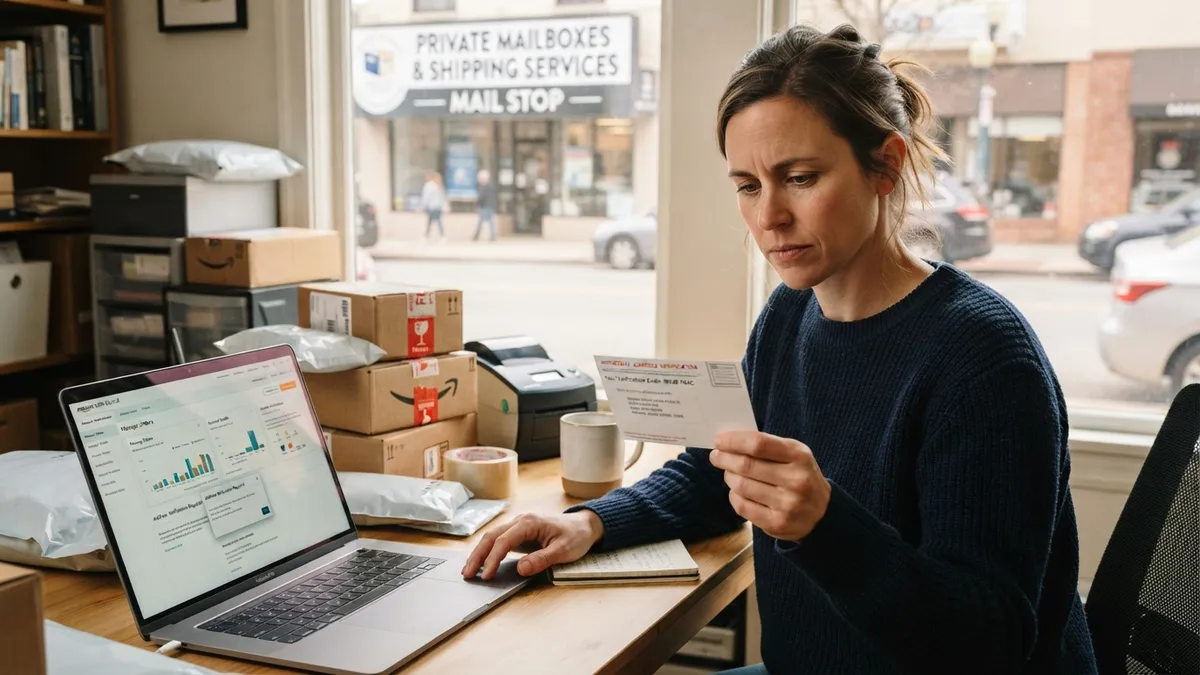
The Postcard That Lands on Your Doorstep
It starts with a small white postcard in your mailbox. On it, a six-digit code. No marketing copy, no coupon — just a code Amazon wants you to type into Seller Central so it knows your business address is real.
For most sellers, that postcard is a five-minute inconvenience. For a growing number of sellers, it's the moment they realize the address on file with Amazon is their home — and Amazon has just confirmed it, on paper, in the mail.
The address you registered with Seller Central isn't just a field in a form. It's the address Amazon verifies. It's the address that gets printed on that postcard. And in many cases, it's the address any customer can see on your public seller profile. That's the part nobody reads until the postcard arrives.
This article is the honest version of what passes Amazon's address verification, what fails it, and how to make sure your home address is never the thing being verified.
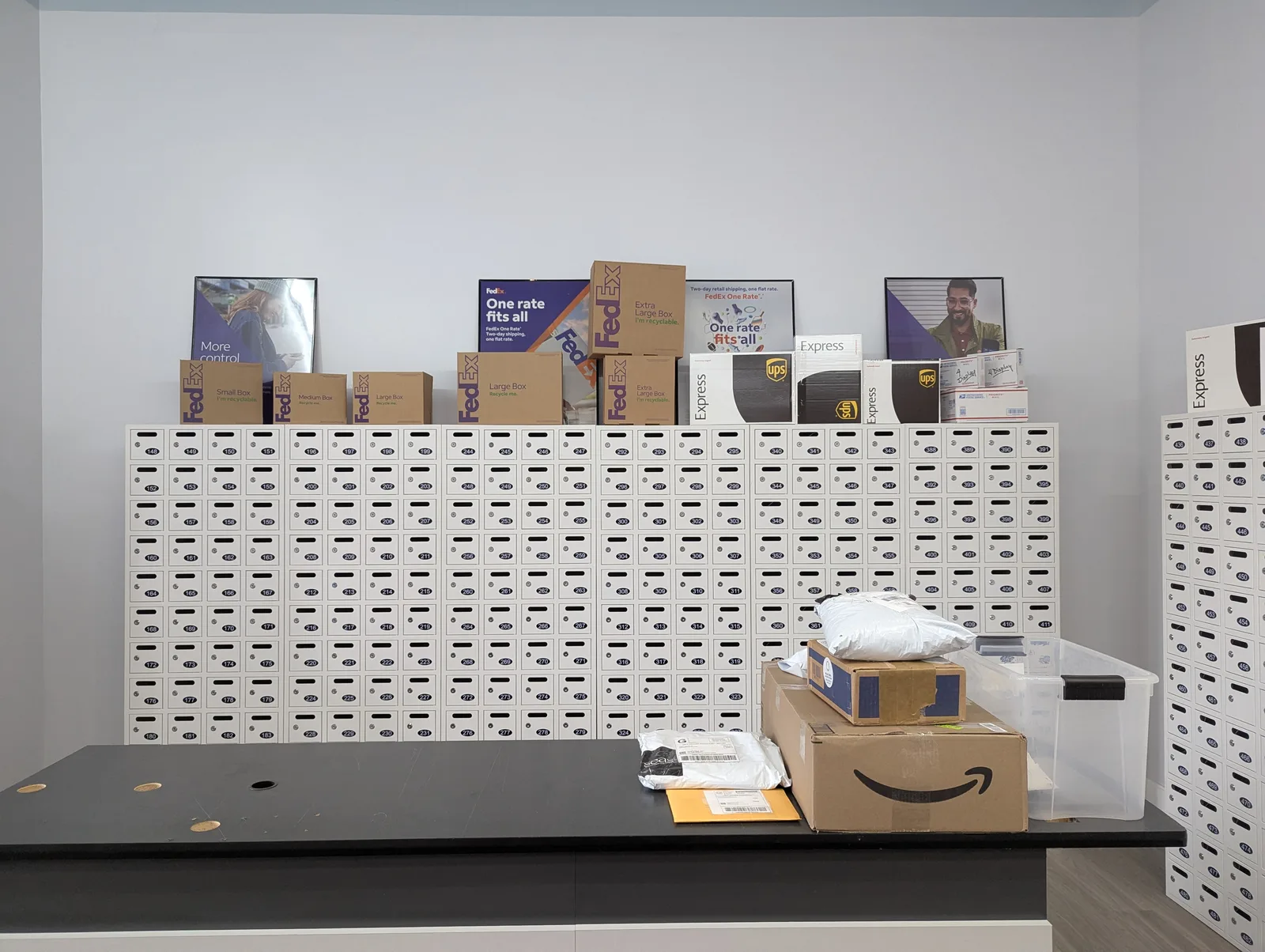
Shipping counter at Mailbox Plus in Concord Township with carrier shipments staged
Why Amazon Verifies Seller Addresses at All
Amazon hasn't always mailed postcards. It started in earnest in 2021 — the company told CNBC it was sending postcards to third-party sellers to confirm "the business address displayed on your Amazon.com seller profile page" was authentic. The stated goal was to keep counterfeiters and bad actors off the marketplace, and the mechanics are simple: Amazon mails a postcard with a verification code, the seller enters the code in Seller Central, and Amazon knows the address is real and reachable.
Then the rules got legal teeth.
In 2023, the INFORM Consumers Act took effect (June 27, 2023). Under that federal law, Amazon must collect, verify, and periodically re-verify specific information about "high-volume" sellers — defined as sellers who've sold 200 or more new or unused consumer products and had at least $5,000 in gross revenues in a continuous 12-month period during the previous 24 months. The information Amazon must verify includes your name, a government-issued ID, a working email and phone number, your bank account information, your tax ID — and your business address.
Here's what that means in practice: if you're an FBA seller, a merchant-fulfilled seller, or anyone moving real volume, Amazon is legally required to confirm your address. And it has to re-verify that information whenever it changes, plus ask high-volume sellers to certify it's still current at least once a year. The verification window is real. Miss the deadlines and Amazon can deactivate the account — and, per its own guidance and the CNBC reporting on the postcard program, it can withhold disbursements for sellers who don't verify.
What Amazon Actually Accepts
When Amazon asks you to verify your business address, the official Seller Central help page ("Address verification") walks through the steps:
- From Account Information, click the verification action items that are pending.
- If your current business address is incorrect, select a different address or add a new one.
- Upload a proof of address document.
- Click Save and continue.
The proof-of-address documents Amazon accepts are specific. For both individual and professional sellers, the official list includes:
- A bank statement (checking, savings, or loan account)
- A credit card statement or bill
- A certified bank letter
- A utility bill — gas, water, electricity, TV, internet, mobile, or landline phone
- A rent or lease agreement
- A mortgage statement
- A tax identity document that contains your address
- For business sellers: a business license or business extract
And the documents have to meet strict criteria:
- Issued within the last 180 days
- Show an issuing date, due date, or transaction dates
- Show the issuing institution's name, stamp, signature, or logo
- Show the name and complete address of the account holder — which must match what you entered in Seller Central
Read that last requirement again, because it's the whole game: the document must show your name and your complete address, and it has to match the address on your Amazon account. A utility bill in your spouse's name doesn't pass. A bank statement that still shows your old apartment doesn't pass. A document issued 8 months ago doesn't pass.
What Fails the Test
Now the part most sellers learn the hard way: a PO box doesn't pass.
Amazon's own address-entry guidelines in the verification flow flag PO boxes and remote locations as not acceptable for the business address. And even setting the guidelines aside, look at the document list — the proof of address has to be a utility bill, a bank statement, or a lease showing your name and a complete address. A PO box doesn't receive utility bills. Your bank doesn't mail statements to a PO box in most cases. There's no lease on a PO box. The documents that pass Amazon's verification simply don't exist for a PO box.
The seller forums are full of the aftermath. Long-time sellers who registered their business at a PO box — sometimes for a decade or more, with the IRS and their EIN tied to it — hit the INFORM re-verification wave and found themselves staring at deactivation banners, chasing bank statements that matched, and hoping a postcard sent to a PO box would clear the queue. One thread sums up the feeling: "I would prefer to not use my home address as my business address." It's the same panic, over and over: the address that passes isn't the address they want public.
Here's what fails Amazon's verification, in one list:
- A PO box — flagged in the address-entry guidelines; no acceptable proof-of-address document exists for one
- An address that doesn't match your documents — the bank statement says one thing, Seller Central says another
- A virtual-only address with no physical presence — Amazon wants an address that can receive a postcard and produce documents
- Documents older than 180 days — the date rule is a hard cutoff
And here's the trap: the address that passes every test — your home — is also the address you probably don't want in Amazon's system.
The Public Part Nobody Reads
Here's the fact that changes the calculation.
Since September 1, 2020, Amazon has displayed a seller's business name and address on their public Seller Profile page — the page any customer can open by clicking your store name. For individual sellers, Amazon displays the individual's name and address. Amazon's own announcement said it plainly: "Beginning on September 1, 2020, we will display a seller's business name and address on their Amazon.com Seller Profile page."
The INFORM Act made the same disclosure a legal requirement. Amazon's official help page on the act states: "Once verified, certain details including your business name, address, and contact information are displayed on your seller profile page so customers can identify who they're buying from." An Amazon staff member on the seller forums put it even more directly: for business accounts, the registered business address is typically what appears in the seller's public information.
Read that with your own account in mind. The address you registered — the one that passes verification, the one that produces a utility bill — is the address a customer can find on your seller profile. If that address is your home, then your home is part of your public storefront. Every competitor, every disgruntled buyer, every curious stranger with your seller name can see where you live.
This isn't hypothetical. It's the exact reason the r/FulfillmentByAmazon threads about "prefer to keep my home address private" exist. FBA sellers — even ones whose products never touch their own hands — still have a Seller Central account with a registered business address, and that address is the one Amazon verifies, re-verifies, and can display.
The Address That Passes Everything
What sellers actually need is an address that:
- Passes Amazon's verification — a real, documentable street address
- Accepts the postcard — staffed, physical, open during the day
- Produces proof of address — a lease agreement in your business name
- Isn't your home — so the public profile never shows where you sleep
That's the exact definition of a private mailbox (PMB) at a licensed mailbox service.
At Mailbox Plus, on 7554 Fredle Drive in Concord Township, Ohio 44077, that's the whole business. Here's what the setup looks like:
- Walk in with two forms of ID — one primary photo ID (driver's license or passport) and one secondary ID confirming the address on the form — a current lease, mortgage or deed, voter or vehicle registration card, or a home or vehicle insurance policy (a utility bill does not qualify under USPS rules). Like every licensed mailbox service, we're a registered Commercial Mail Receiving Agency (CMRA), so we keep a USPS Form 1583 on file for every mailbox holder — bring IDs that are current (not expired), since USPS rejects expired documents. This is the legal, above-board version of what the big national services do — minus the middleman.
- Get your street address. Your address is a real street address at our store — Suite/box number included — that all four carriers (USPS, UPS, FedEx, and DHL) deliver to. We sign for packages, which matters when the verification postcard or a returned FBA shipment arrives while you're at work.
- Update Seller Central. Change your business address to your new PMB, then use the lease agreement from your mailbox as your proof-of-address document. It's issued within 180 days, it shows your business name, and it shows the complete address. It passes.
Business mailbox rates start at $35/month (personal tiers from $15) — cheaper than an office, cheaper than most virtual-mailbox middlemen, and it comes with a real counter staffed by people who know your name.
What It Looks Like When You Switch
Picture the sequence with the new address in place:
- Amazon sends the verification postcard → it lands at a staffed mailbox store, not on your doorstep, and you get a text when it arrives
- You enter the six-digit code in Seller Central → verification clears
- The INFORM annual certification rolls around → your business address is still current, still verifiable, still not your home
- A customer clicks your store name on Amazon → the profile shows a professional street address in Concord Township, not a house
- A returned package or a supplier shipment comes back → someone signs for it during business hours, every time
That's the difference between reacting to Amazon's verification and being ready for it. Amazon verifies what you give it. Give it a real business address that isn't your house.
The Cost of Doing Nothing
Let's be concrete about the alternative.
- Your home address goes on your public seller profile. Not a "maybe" — it's the displayed business address for business accounts, and it's been Amazon policy since 2020.
- The verification postcard lands on your doorstep — which means Amazon knows exactly where you live, and so does anyone who opens the mail.
- A PO box doesn't save you. It fails the address-entry guidelines and can't produce the documents Amazon requires. Sellers with PO boxes spent 2023-2024 fighting re-verification, and the ones who won switched to a street address.
- Miss a verification window and you're not just annoyed — you're deactivated, with disbursements on hold while you scramble to fix an address problem you could have solved in ten minutes.
- Your home is now in Amazon's records forever — tied to your seller account, your tax information, and your bank details.
None of this is dramatic on the day you register. It's the cost of choosing an address without thinking about what Amazon does with it.
Take Your Home Off Your Seller Profile
Ten minutes, two forms of ID, and a street address that passes Amazon's verification without being your house. Start with our mailbox rental page for home businesses for pricing and details — it covers exactly this scenario — or stop by 7554 Fredle Drive in Concord Township.
If you're weighing a private mailbox against a post office box, our Private Mailbox vs. PO Box breakdown explains why the difference matters even more when an online marketplace — not just your mail carrier — is checking the address. And if you're an online seller across multiple platforms, our guide to keeping your home address off your shipping labels covers the eBay and Etsy side of the same problem.
The next verification cycle is coming. Amazon asks every high-volume seller to certify at least once a year — the only question is which address you'll be certifying.
This article is for information only and isn't legal advice. Amazon's verification requirements change and vary by account type and business location; check Amazon's current Seller Central help pages and your Account Health dashboard for the requirements that apply to you.