The Verdict First
Straight answer, no suspense: if your mail is letters only — bills, cards, magazines — and it always will be, a PO Box does the job. It is inexpensive, it is private, and it is run by the Post Office itself.
If anything you receive ever ships via FedEx, UPS, or DHL — and for a business, something always does — a private mailbox wins, and it is not close. A PO Box physically cannot accept those carriers' packages. A private mailbox gives you a real street address that all of them deliver to.
That is the whole decision. The rest of this page is the detail behind it — what each option actually costs you, and where each one breaks.
The bell over the Mailbox Plus door chimes as you step up to the counter, still cool from the AC. You slide your keys on the laminate and ask the question you came with: "PO Box or private mailbox?" You are not the first to ask it this week, and you will not be the last. Here is what we tell everyone who does.
That single fact drives almost every difference in this article. Everything else — cost, credibility, setup — flows from it.
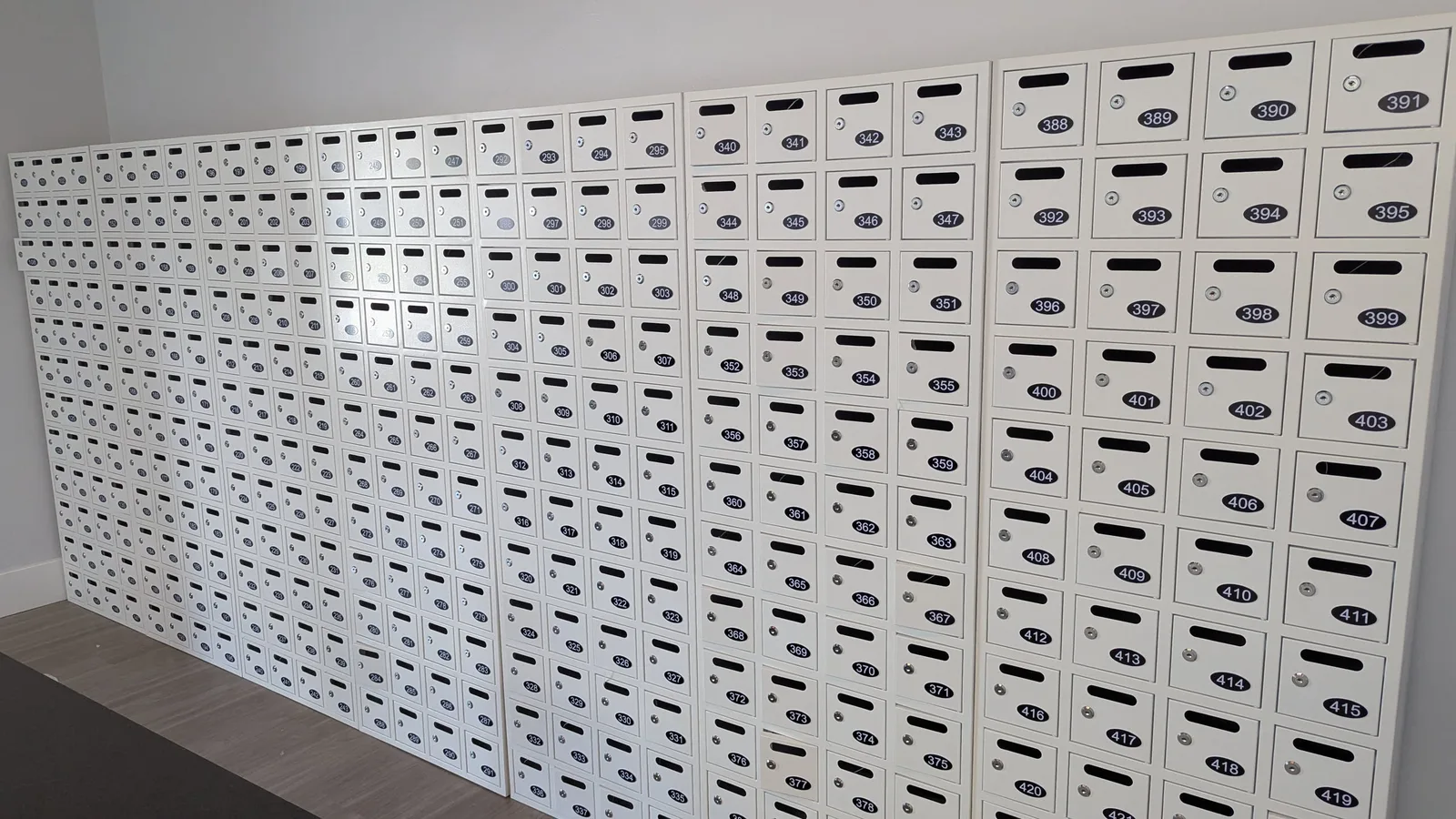
Wall of numbered private mailbox doors at Mailbox Plus in Concord Township
The One Fact That Decides Everything
A PO Box is a numbered compartment inside a post office lobby. The United States Postal Service delivers to it. That is the complete list of who delivers to it.
FedEx drivers do not have keys to the post office lobby. UPS does not route packages to box numbers. DHL does not sort by compartment. When a seller or supplier ships your order through any of those carriers and the label says "PO Box 47," the package is not delayed — it is undeliverable. It goes back to the carrier's facility, and you find out by chasing a tracking page that says "delivery exception."
A private mailbox — what the postal system calls a CMRA address, a Commercial Mail Receiving Agency — is a counter with a real street address. Every carrier delivers to it because every carrier delivers to street addresses. One address covers all four carriers — UPS, FedEx, USPS, and DHL — no exceptions. All four pick up and deliver to our counter, and we're an authorized shipper for each.
That is the entire comparison in one paragraph. The rest is what it costs, what it unlocks, and the one case where the PO Box still makes sense.
Side by Side
|
PO Box |
Private Mailbox |
| Address type |
Box number, post office |
Real street address |
| USPS mail |
✅ |
✅ |
| FedEx / UPS / DHL packages |
❌ undeliverable |
✅ accepted and signed for |
| Package notifications |
None |
Yes — logged on arrival |
| Carrier choice for your vendors |
USPS only |
Any carrier they use |
| Works for business registrations |
Limited |
Commonly accepted — a street address meets most banks' and registrars' requirements, but call ahead to confirm for your specific institution |
| Home address stays off your labels |
✅ |
✅ |
| Setup |
Post office form |
USPS Form 1583 + two IDs |
Read that middle row again, because it is the one people discover the expensive way. A vendor does not ask which mailbox you have. They ask for an address, then ship with whichever carrier is cheapest for them. If that carrier is not USPS, a PO Box turns your incoming shipment into a road trip.
Where the PO Box Still Wins
This is the part most comparisons skip, and skipping it makes the comparison dishonest.
A PO Box is the right answer if all of these are true: you receive letters only, you do not run a business that receives packages, and you want the cheapest private mail point that exists. The Post Office runs it, the price is low, and for a retiree who gets bills and birthday cards, it works.
The trap is not choosing a PO Box. The trap is choosing a PO Box for a business — or for a household with an online shopping habit — and finding out about the carrier wall after the first undeliverable package. If you are reading a comparison article, there is a decent chance you are already past that point.
What a Private Mailbox Actually Unlocks
The street address is not just a package receiver. Because a private mailbox is a real street address backed by a registered CMRA, it changes what your address can do:
It survives carrier diversity. Vendors ship with whoever is cheapest. Customers return with whatever label the marketplace generates. Suppliers switch carriers mid-season. A street address absorbs all of it without you ever thinking about it.
It keeps your home address out of the record. Every shipping label, vendor invoice, and public filing carries your address. With a home address, that is your house — on boxes, on forms, on storefronts across the internet. A private mailbox is a real address that is not your front door.
It reads as a business. "Suite" and "Studio" numbers on a street address tell customers and vendors what a box number cannot: there is a staffed counter here, a sign on the building, someone who signed for the delivery. Whether that matters for credibility is your call, but the difference is real.
It comes with a person. Packages are logged when they arrive. If you are on vacation, they are held. If something needs forwarding, it gets forwarded. A slot in a wall does none of that.
One honest caveat: because a CMRA address is not your residential address, a few institutions have their own rules about what they will accept it for — banks and government agencies vary, and the question to ask any of them is simply "do you accept a CMRA street address?" We will tell you honestly what our counter address can and cannot be used for before you set anything up. (For the specific case of bank and DMV rejections, see why PO Boxes get rejected.)
Switching Is a Form, Not a Project
If you already have a PO Box, the switch is not a migration. It is a form.
Federal law requires a signed USPS Form 1583 to authorize a CMRA to receive your mail — that is the one piece of paperwork, and it exists to protect you: no one can start receiving your mail without proving identity. Bring two forms of ID (a driver's license plus a second document confirming your current address works — both must be current, not expired), sign the form at our counter, and the address is live.
You keep your PO Box until the switch is done, tell the important senders your new street address — and since the new address accepts every carrier, this is the last time you will ever do it.
The Cost Question, Answered Honestly
A PO Box is cheaper. We will not pretend otherwise, and anyone who does is selling you something.
What you are comparing is not price against price. It is price against what the price covers: a PO Box covers USPS letters. A private mailbox covers every carrier, package logging, holds and forwarding, and an address you can put on public documents without publishing your home. When a single undeliverable package means a drive to a carrier facility across town — or a lost sale — the price difference stops being the deciding number.
For the exact numbers on our plans and sizes, the private mailbox rental page has the current breakdown, or ask at the counter — we would rather you compare than guess.
Who Each One Is For
Choose the PO Box if: your mail is personal letters, you rarely receive packages, and lowest cost is the priority. Genuinely — it is the right tool for that job.
Choose the private mailbox if: you run a business of any size, you sell or buy online, you receive carrier packages at all, you need an address that is public but not your home, or you have ever lost an afternoon retrieving a package the PO Box could not take.
Choose us specifically if: you are near Concord Township and want the counter twenty minutes from downtown Painesville or Chardon, with all four carriers and the packing help in the same stop.
Maybe you have stalled on listing your products because a PO Box return address made you look like a hobbyist. Maybe you dread explaining to the UPS driver, for the third time, why the box cannot take his delivery. That low-grade dread of looking amateur — that is the real cost of the wrong mailbox, and it is the thing nobody puts in the comparison table.
It is also the thing that disappears the day you switch.
Bring It In
You have read the comparison. The next step is smaller than you think: two forms of ID, one signature on Form 1583, and an address that works for every piece of mail you will ever be sent.
Forget pre-taping parcels or apologizing for a missing label. Bring your ID to Mailbox Plus, 7554 Fredle Drive, Concord Township — just off Crile Road, easy from SR-44 and I-90. We sign Form 1583 together, and from that minute the counter absorbs every carrier rule and return exception for you. You walk out with a real street address that all four major carriers deliver to, and none of the mailbox anxiety you came in with.
Still deciding? See what a private mailbox is or the mailbox rental cost breakdown — or just stop in and ask us.