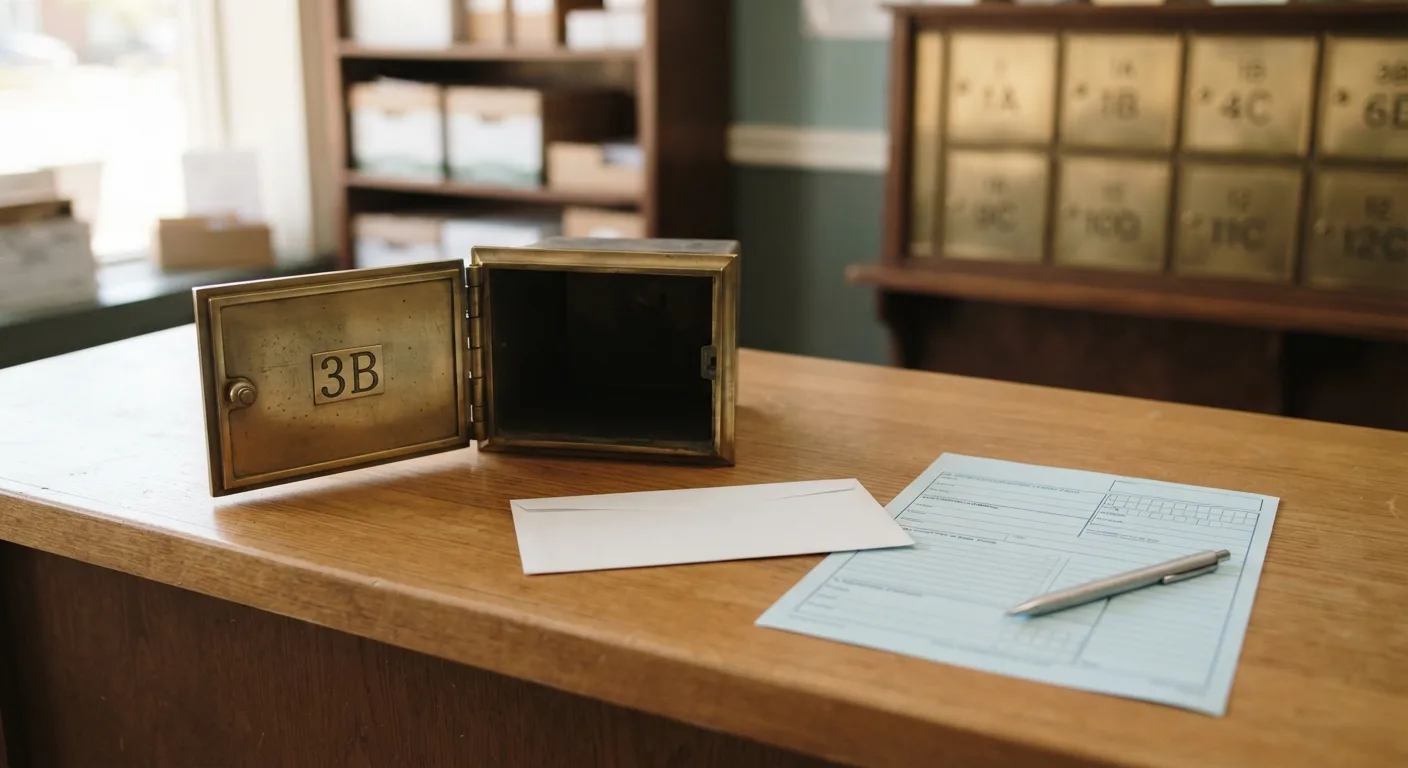
The Real Cost of One Simple Errand
You filled out the form at the counter or on your laptop, and you stopped cold at one blank line: residence address. You rent a PO box. You have had it for years, your mail lands there, you like it that way. But the blank says residence, and something in the back of your mind says those are not the same thing. You are right — and the wrong guess costs a rejected application, a second trip, or a letter from the bank three weeks later telling you the paperwork did not go through.
What should happen is simple: each agency that touches the word "residency" draws its own line, and the lines are public. Here is where each one sits.
The Address Registry Problem, Explained
The mechanism working against you is old, and it is not going anywhere: every agency that matters keeps a registry keyed to a place you can be found, not a place your mail goes. It is written into federal banking law, state licensing forms, and election directives alike. A post office box fails the registry because a box is a lock on a wall — anyone can rent it, it says nothing about where you sleep, and the agency cannot send a sheriff, an auditor, or a precinct boundary to a box number.
So the agencies solved it the blunt way: they hard-coded the exclusion. The Ohio BMV's license application form prints "RESIDENCE ADDRESS (No P.O. Box permitted)" right on the line. The Secretary of State's election-directive manual says flatly that a person "cannot list a post office box or a commercial mail store as their residence for voting purposes," while allowing a box as a supplementary mailing address. The banking rules under the USA PATRIOT Act require an individual customer to give a residential or business street address, and FinCEN has issued an administrative ruling (FIN-2009-R003(opens in a new tab)) that a bank accepting a post office box to fulfill that requirement would not be in compliance. None of this is a judgment about you. It is the system protecting itself against the one thing a box cannot prove: that you physically exist at a fixed location. If you have already run into this wall, our guide to why PO boxes get rejected for street addresses explains the pattern in detail — and the driver-license version covers the BMV line specifically.
The Tally You Never See
Here is what the rejection actually costs, because nobody adds it up at the time. First trip: you sit in the BMV lobby, hand over your paperwork, and the clerk stops at the residence documents. Two documents from different sources proving an Ohio street address — a box number is not one of them. You drive home without the license. That is an hour in line and a tank of gas gone.
Then the bank. You open an account online, type the box into the address field because it is the address you know, and the application either bounces or quietly opens a file that compliance flags later. The letter arrives a few weeks afterward asking for "proof of a residential street address." Now your account is half-open, your direct deposit is scheduled, and you are photocopying a lease you did not know you would need.
And voting. You register with the box as your residence, and the board of elections can knock the registration because the precinct system runs on physical location — your ballot depends on where you live, district by district. The rejection letter arrives in October. Each of these is small alone. Stacked on one unlucky month, they are a full week of errands spent fixing paperwork that one honest answer on day one would have avoided.
The Rule That Only Helps One Side
It should not work this way. You are not hiding anything — you just prefer that your mail, your bills, and your business correspondence not stack up in an unattended mailbox at the end of your driveway. The system selling you the box is the same system that then treats the box as a second-class address everywhere else. People feel this the first time a form bounces the box, and they feel it again at the next form. That is the part that only helps one side.
The fair version of the rule — the one Ohio and federal agencies actually run, once you read the fine print — is this: be honest about where you live, and keep total control over where your mail goes. The residence line belongs to your home. Every other line on the form is yours to fill with the most reliable, most private, most secure address you can get. Most people never learn the distinction because nobody explains it. Now you are ahead of the clerk.
What a Private Mailbox Actually Fixes
We are a small, independent mail-and-shipping store at 7554 Fredle Drive in Concord Township, and we rent private mailboxes every week to people who came in asking a version of your question. Here is what we tell them at the counter, and it is the same logic you have just read: a private mailbox gives you a real street address — not a box number — that accepts USPS mail and carrier deliveries from FedEx, UPS, and DHL, held behind a locked door we staff all day.
That street-address quality matters precisely because of the registries. When a form's mailing line rejects "P.O. Box 118," a street address often goes through, because the form is screening for a deliverable physical location. We hand you the Form 1583 paperwork when you sign up — federal rules for commercial mail agencies require one government-issued photo ID plus one document proving your physical residential or business address, which is the same honesty-about-residence principle in miniature — and from then on, your mail lands at a staffed address instead of an open slot on a rural road.
One honest boundary, stated plainly because we would rather lose a rental than mislead you: a private mailbox is a mailing address, and it is not a residence either. No mailbox is. What it fixes is every mailing line that a plain PO box fails.
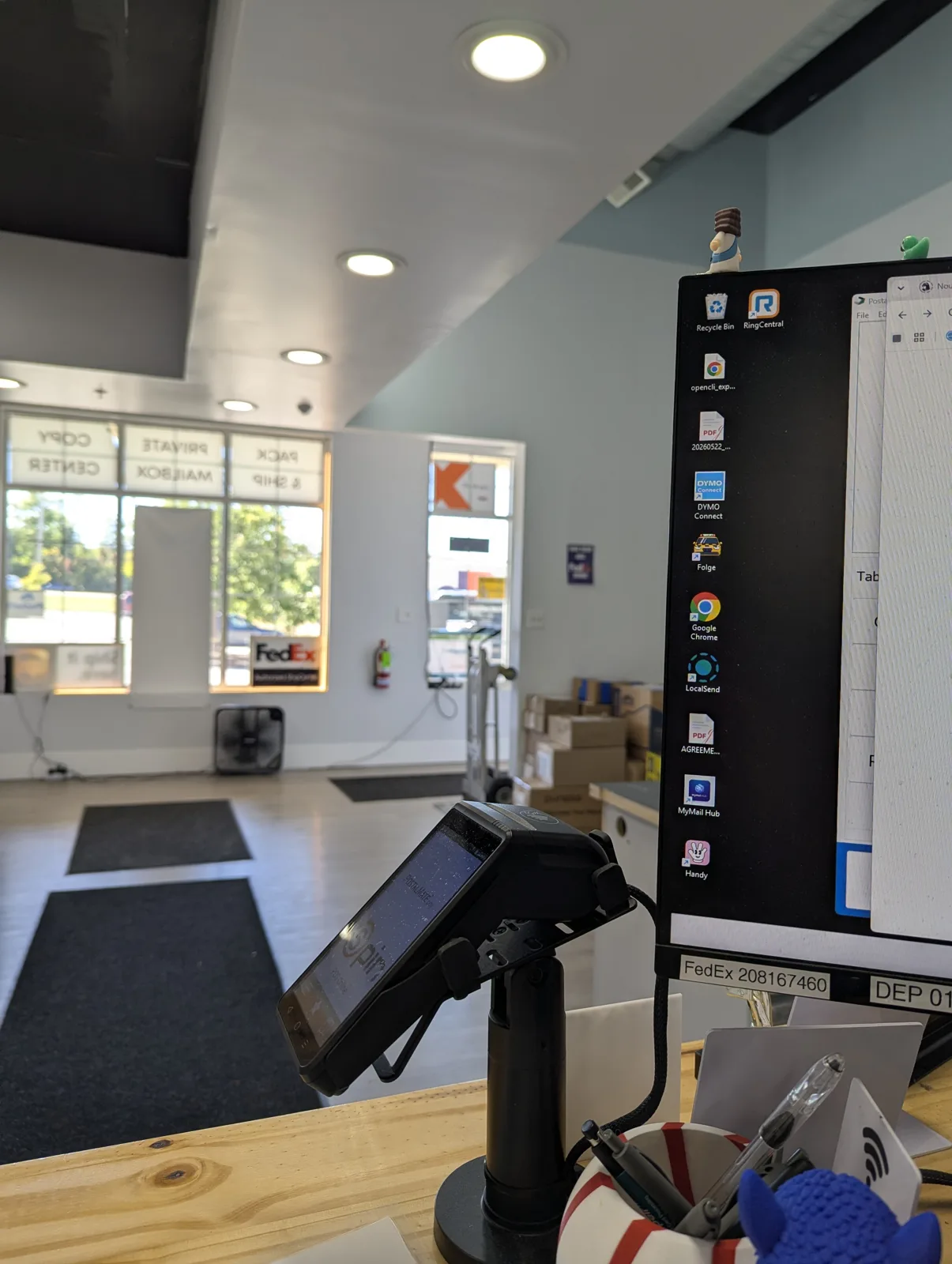
The Mailbox Plus counter in Concord Township, with PRIVATE MAILBOX on the storefront glass behind it
What to Bring to the Counter
The whole thing takes one visit and no homework:
- Walk in with two forms of ID. One photo ID (driver license, passport) and one document showing your physical address — a lease, a deed, a vehicle registration. That is the federal Form 1583 requirement; we keep blank forms at the counter.
- Pick a mailbox size at the counter. We show you the actual boxes, confirm the street address format with the PMB designator, and set up your keys while you are there.
- Use the right line on every future form. Residence line: your real home. Mailing line: your new street address. You never have to guess again, because now you know which is which.
The Three Costs of Staying Put
Keep trying to stretch a PO box past its legal reach and you pay three ways. Time: every rejected application is a trip, a reprint, a re-mailing — and agencies process corrections slower than clean submissions. Money: a flagged bank account can hold your funds pending address verification, and a returned registration or ballot application can cost you late fees or your vote in a given election. Privacy: here is the part people miss. The person who fakes a residence line is the person whose paperwork collapses in public, at a counter, with a line behind them. The person who splits the two addresses honestly gets more privacy, not less — their home address stays off the mailing lists, off the shipping labels, off the paperwork strangers handle. The box-only route exposes your home address more often, because you keep getting bounced into reprinting forms with your real residence at the center of them.
What Changes on the Calendar
Now the same errands run clean. You sit down at the kitchen table with a bank application, and the address section takes you ninety seconds: residence on the residence line, your street mailing address on the mailing line. At the BMV, the clerk asks for the two residency documents, you hand over the lease and the utility bill, and you walk out with the license — and the mailing-address field, the one the BMV lets you set separately, points at the counter where your renewal notice actually gets picked up. Your voter registration lists your real home for the precinct, with your box or street mailing address as the contact for election mail.
The internal shift is the bigger one. No form makes you hesitate anymore. You know what a residence is, you know what a mailing address is, and no blank line can surprise you. That low hum of paperwork dread — the one that made you postpone the errand twice — is gone, because the uncertainty was never about the forms. It was about not knowing the rule.
Transfer the Friction to Our Counter
You do not need to arrive with the Form 1583 filled out, the ID copies pre-sorted, or any of it figured out. Bring the questions and whatever ID you have in your wallet — working out which document covers which requirement is literally what we do at the counter every day. Tell us what you are trying to accomplish — bank forms, license renewal, business mail, packages from all carriers — and we will set up the mailbox that fits it. Walk in with the confusion, walk out with a street address and a rule you understand. That is the whole errand.