The Red Sticker Reflex
The box is packed, the label is printed, and the tape is on. One last thing — you reach for a bright red FRAGILE sticker and press it onto the side of the box. You feel a little better. You did something. Now the carrier will know to be careful.
It is the most natural instinct in shipping. And according to the research — including studies that strapped hidden sensors inside packages and watched what actually happens — that sticker does almost nothing to change how your package is handled.
That sounds like a bold claim, so let's show the evidence.
The Fragile Sticker Illusion
Here is what happens to your box after it leaves your hands. At the carrier's hub, it slides onto a conveyor belt, gets scanned by machines, diverted down chutes, and stacked with thousands of other parcels. At peak hours, a single facility moves hundreds of thousands of packages a day.
Automated sortation systems do not read "FRAGILE." They read barcodes. As packaging researchers put it in a peer-reviewed study of the DHL single-parcel environment: during sortation, diverting, and conveying, "pictorial markings do not play any role due to limited human interaction."
The only times a human handler sees your label are pickup, loading the truck, and the final steps at the door — moments measured in seconds, when a handler is moving dozens of packages at once.
The sticker is not maliciously ignored. It is simply not part of how modern parcel networks work.
The Vase That Did Not Survive
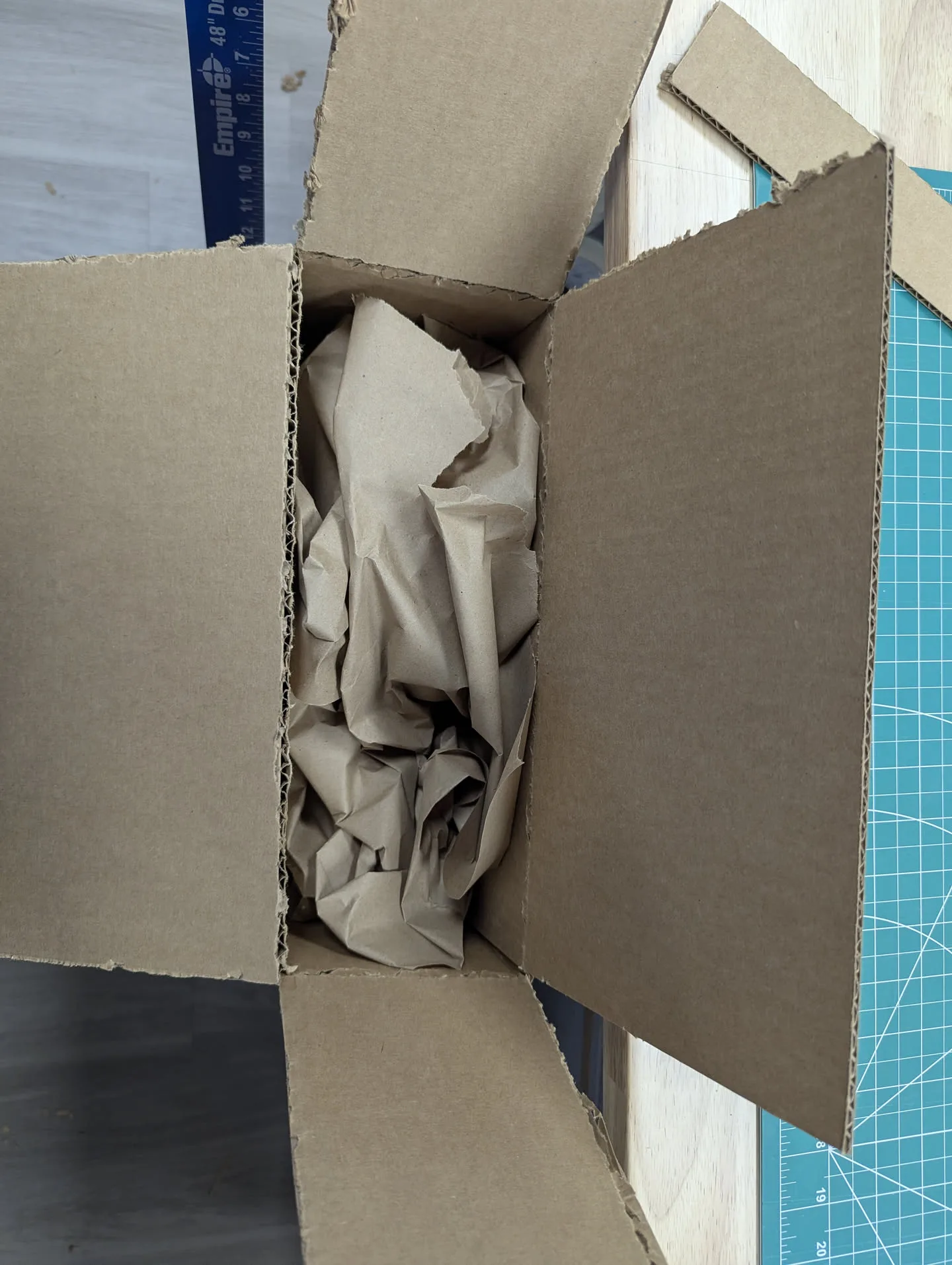
A cardboard box packed with crumpled kraft paper on the packing bench at Mailbox Plus
You know the feeling. You shipped a ceramic vase to your sister, wrapped in bubble wrap, marked FRAGILE on two sides. For three days you check the tracking. The package moves through hubs in the middle of the night.
It arrives. She opens the box. You get a text: "It broke. The top of the vase is cracked."
You did everything you knew to do. The sticker was right there on the box, bright and clear. And the package still got crushed.
That is the gap between what we believe the sticker does and what it actually does. And the carriers themselves have been saying this for years.
What the Carriers Themselves Admit
No carrier has ever promised that a fragile sticker means gentler handling. Ask them directly and they tell you the same thing.
UPS, in an official statement: "The most important aspect of any shipment, but certainly those that contain fragile items, is how they are packed – not necessarily how they are labeled... that handling method and our training that teaches it is the same for a package labeled 'fragile' as it is for one that is not."
FedEx, in its claims policy: "If a shipment is improperly packaged and/or packed and is subsequently damaged, FedEx will not be deemed at fault." Their packing guides do tell you to mark the box fragile — but their liability rules rest entirely on how the box was packed.
USPS: Even the Postal Service, which has long told customers to mark fragile packages, quietly discontinued its paid "Special Handling – Fragile" service in July 2022. In its Federal Register notice, the USPS said: "An investigation has revealed that operational procedures do not support the preferential handling of Special Handling – Fragile items." The Postal Service — the one carrier that still asks you to write "FRAGILE" — admitted in writing that it could not actually deliver special handling.
What the Research Actually Says
This is not an opinion. Researchers at Michigan State University and Cal Poly have spent years shipping instrumented packages — boxes with hidden accelerometers that record every drop, toss, and flip — through real carrier networks. Here is what they found:
- DHL single-parcel study (2009, 48 instrumented trips): "Pictorial markings and warning labels like 'Fragile' and 'Handle with Care' do not improve the handling of packages or result in lower drop levels in the DHL single-parcel environment."
- FedEx Second-Day Air study (2004): Fragile labels had "no significant effect" on how packages were handled.
- FedEx lightweight-package study (2004): "Neither the package size/weight nor the labels had any significant effect on the severity of drop heights." Their instrumented packages registered drops up to 1.85 meters — about six feet.
- Popular Mechanics' own test (2012): they instrumented a package and shipped it a dozen times across the country through USPS, FedEx, and UPS. Their finding was blunt: "One disheartening result was that our package received more abuse when marked 'Fragile' or 'This Side Up.'"
One caveat on that last one — a dozen trips is a small sample, not a statistically significant study. But it is real instrumented data, and it matches what the academic studies concluded.
So the research is consistent: labels do not change handling. Packaging does.
What the Packing Bench Shows Us
At Mailbox Plus on Fredle Drive in Concord Township, we pack fragile items every week — artwork, glassware, ceramics, electronics, instruments, antiques. And we see the same pattern over and over: the packages that arrive broken are almost never the ones with great packaging. They are the ones whose only protection was a sticker.
When you bring a breakable item to our counter, here is what actually protects it:
- The right box. Double-wall corrugated for anything over a few pounds. Single-wall boxes crush under stacking pressure.
- Real cushioning. Two to three inches of cushioning material on every side — not a single layer of bubble wrap. FedEx's own guide specifies 2–3" on all six sides; DHL says contents should sit at least 2.4" from the walls and corners with every gap filled.
- Double-boxing for high value. The item goes in one box, packed tight, then into a larger box with cushioning between the two. This is the gold standard for fragile and valuable shipments.
- No movement. If you shake the box and anything shifts, it will break. Void fill exists to make that impossible.
- Sealed like it matters. H-taping — one strip down the center seam and two along the edges, top and bottom — keeps the box structurally sound.
This is the same guidance the carriers publish. It is free. It is tested. And it is the thing the sticker was never able to do.
Your Two Options for the Next Breakable
So what do you do the next time you need to ship something breakable?
Option one — bring it to a counter that packs it right. That is what professional packing services are for. You hand over the item, and someone who packs fragile goods daily handles the box selection, the cushioning, the double-boxing, and the sealing. If something goes wrong after that, you have a service that stands behind the pack.
Option two — pack it yourself, but follow the real rules. Use the right box, cushion 2–3 inches on all sides, fill every gap, tape the seams, and place the label on the largest surface. If you want a deep step-by-step guide, we wrote one: How to Ship Fragile Items Safely. And if the item is worth real money, pair the packing with coverage — see our guide to shipping insurance in Concord Township, plus when a poly mailer beats a box for the soft-goods cases where fragility is not the issue.
And the sticker? Put it on if you want. It costs nothing, it does not hurt, and a "THIS SIDE UP" arrow can genuinely help the driver during the last mile — the one leg of the trip where a human is actually handling your box. Just do not treat it as protection.
What You Lose by Relying on a Sticker
Here is the part that really matters, and it comes down to one word: claims.
When a fragile package arrives damaged, the carrier does not ask whether it had a sticker. They open the box, look at the packaging, and apply their published standard. FedEx's policy is explicit: improperly packed shipments mean they are "not deemed at fault." USPS and UPS apply the same logic.
So the sticker does not just fail to prevent damage — it also does nothing to help you get paid when damage happens. The thing that protects your money is declared value or insurance, and the thing that makes that coverage hold up is proper packaging. A package with a sticker and no padding is a denied claim waiting to happen.
Skip the sticker-only approach. If the item is worth more than about a hundred dollars, insure it — and pack it so the insurance never has to pay out.
The Box That Arrives Whole
You bring the vase to Mailbox Plus. The attendant measures it, picks a double-wall box from the rack, and wraps the vase in cushioning — two inches on every side, every gap filled, nothing shifting when the box is gently shaken. They seal it with an H-tape pattern, attach the label, and offer declared value for the full amount.
You walk out. The box is quiet, solid, and done right.
Three days later your sister texts you a photo. The vase is on her shelf, in one piece, and it looks beautiful.
Pack It Like It Matters
If you are shipping something breakable — a painting, electronics, glassware, an heirloom — do not rely on a sticker. Bring it to Mailbox Plus at 7554 Fredle Drive in Concord Township, and let us pack it the way the research says it should be packed: cushion on every side, no movement, sealed to survive.
Visit Mailbox Plus today →