The Box That Arrived in Three Pieces
The package arrived this morning. You open it carefully, knowing what is inside. A ceramic vase your aunt shipped from across the state — her wedding gift to you.
You pull back the bubble wrap, and you hear it before you see it. A faint clinking sound. Small pieces shifting inside the box.
You open the last layer. The vase is in three pieces. The bubble wrap was too thin. The box was too big. The padding was almost nonexistent. Whoever packed it meant well, but they did not know the rules.
If you have ever received a shattered package, you know the feeling. It is not just the loss of the item. It is the waste — of time, of money, of the thing that was supposed to arrive whole.
And if you are the one shipping something fragile — a painting, a piece of electronics, a glass sculpture, a family heirloom — you carry that anxiety with you until the delivery confirmation comes through.
The Fragile Shipping Failure Chain
Fragile items break in transit for one of three reasons, and usually all three at once. Here is the chain — and notice how none of it is bad luck.
It starts with cushioning, or the lack of it. Slide that box toward you and tap the side — hear it shift? That hollow knock is cushioning failing before the truck even leaves the lot. The box gets dropped, stacked on, jostled; that part is out of your hands. What is in your hands is whether the item can travel far enough to strike the wall. When it does, you get the crack, the dent, or the complete break.
The industry standard — and the unofficially accepted rule among all major carriers — is a minimum of two inches of cushioning material on every side of the item. Not one inch. Not "a layer of bubble wrap." Two full inches of compressible material between the item and the box wall.
Reason two: the wrong box. A box that is too large allows the item to shift. A box that is too small prevents adequate cushioning. A box that has been previously used and flattened has lost its structural integrity. A single-wall corrugated box might be fine for a t-shirt, but for a framed mirror, you want double-wall corrugated at minimum.
Reason three: inadequate outer protection. Fragile items need a rigid outer shell that can absorb impacts. A single layer of cardboard is not enough for anything breakable over a few pounds. Double-boxing — placing the padded item in one box and that box in a larger box — is the gold standard for high-value fragile shipments.
Fifteen Minutes of Packing, Two Hundred Dollars of Regret
You stand at your kitchen table with a framed photograph that needs to ship across the country. It is a 16-by-20-inch print in a glass frame. You bought it from a local artist in Chardon and now a buyer in Portland wants it.
You have the frame. You have a roll of bubble wrap you bought at the hardware store. You have a box from an Amazon delivery that you saved for exactly this purpose.
You wrap the frame in bubble wrap — two layers, maybe three. You slide it into the box. There is an inch of space on each side. You stuff crumpled newspaper into the gaps.
You look at the box. It feels okay. Not great, but okay. You tape it shut. You print the label. You drop it off at the carrier.
Six days later, the buyer sends you a photo. The frame arrived with a cracked corner. The glass is shattered. The print is damaged.
You process the insurance claim. You apologize to the buyer. You refund the purchase. You lost the sale, paid for return shipping, and have a damaged frame sitting in Portland.
The packing took you fifteen minutes. The cost of doing it wrong was two hundred dollars.
The Rules Were Never Secret
The rules for fragile shipping are not secret — the carriers publish them. But nobody hands you that sheet at the kitchen table. So you guess. You use whatever box is available. You assume bubble wrap and a "FRAGILE" sticker are enough.
Call it the conveyor-belt absolution: carriers legally ignore your sticker, because automated sorters treat every box identically and the system never promises otherwise. The only thing that protects your item is the physical packaging — which is why the sticker feels like effort but absorbs nothing.
What We Reach For at the Counter
When you set that wobbly box on our counter, we have already seen its twin a hundred times. The vase, the console, the framed print — we know the wrap it needs before you finish explaining. Here is what we reach for:
Double-wall corrugated boxes for anything over five pounds or anything breakable. Pick one up and feel the difference — that rigid wall is what stays square when a hundred other parcels pile on top of it in the trailer. A single-wall box that held a t-shirt fine will fold under that load.
Bubble wrap in layers, not wraps. One layer of bubble wrap is not cushioning. It is a surface protector. Actual cushioning requires enough wrap to compress under impact. For a framed painting, that means four to six layers of small-cell bubble wrap, or two to three layers of large-cell bubble wrap.
Kraft paper or foam for void fill. Crumpled newspaper compresses to almost nothing under weight. It looks like padding but provides almost no impact protection. We use kraft paper, foam sheets, or foam peanuts for void fill — materials that maintain their shape under pressure.
Double-boxing for high-value items. This is the core of professional packing service, and it is exactly what it sounds like: the inner box contains the item with two inches of padding on all sides. The outer box has two inches of padding between the inner box and the outer wall. This creates a suspension system: impacts to the outer box are absorbed by the cushioning layer before they reach the inner box.
Custom crating for oversized or extremely fragile items. For large artwork, glass tabletops, or heavy electronics, we build custom wooden crates. These are overkill for most shipments but essential for items worth over a thousand dollars.
Packing Specific Items: What Changes and What Does Not
The two-inch rule never changes. What changes between item types is the wrapping order, the inner protection, and the one mistake most likely to destroy that specific item.
Electronics. The original box and foam inserts are the best packaging that exists for the item — engineered for exactly that shape. If you still have them, use them, then double-box. If not: wrap the device in anti-static bubble wrap (regular bubble wrap can leave marks on screens and finishes), remove batteries and loose media — loose lithium batteries have their own carrier restrictions, so ask before including them — and cushion with foam, not peanuts, which settle and let the device migrate. The classic electronics failure is not the drop; it is a cable or accessory loose in the box that chips the screen in transit. Bag every accessory separately.
Artwork and framed prints. Glass front faces first: cover the glass with glassine or a plastic sheet to hold shards together if it breaks. Then corner protectors on all four corners, then bubble wrap, then a mirror box or flat-fold carton sized to the frame. For anything over roughly 8x10 inches with glass, double-box. Canvas without glass skips the glassine but needs a rigid face layer — a sheet of foam board — so nothing presses into the paint.
Glass and ceramics. (We keep a full walkthrough of this category in how to ship glass and ceramics — it is the deepest of the three.) Wrap each piece individually, then cell dividers or a wrapped partition between pieces so they cannot touch each other. Fill hollow pieces (vases, pitchers) with cushioning — a hollow wall cracks inward when squeezed. Then the double-box rule, no exceptions: this is the category where single-boxing fails most often.
How to Pack a Fragile Item — The Right Way
Here is the step-by-step process, whether you do it yourself at home or bring it to our counter:
Step 1 — Choose the right box. Pick it together with the two-inch rule in mind: big enough for two inches of breathing room around the item, no bigger. A cavernous box means more void fill, more room to roam, and a higher dimensional-weight charge.
Step 2 — Wrap the item. Start with a layer of tissue paper or glassine if the surface is scratchable. Then apply bubble wrap — large-cell for heavy items, small-cell for lightweight or delicate items. Tape the bubble wrap in place with packing tape, not masking tape or duct tape. Masking tape dries out and fails. Duct tape leaves residue.
Step 3 — Cushion the box bottom. Place a two-inch layer of foam peanuts, kraft paper, or foam sheeting in the bottom of the box.
Step 4 — Insert the wrapped item. Center it in the box. Fill all remaining gaps with void fill. The item should not move when you shake the box gently. If it shifts, add more fill.
Step 5 — Cushion the top. Add another two-inch layer of void fill on top of the item before closing the box.
Step 6 — Seal and reinforce. Use packing tape — not duct tape, not masking tape. Seal all seams. For heavy items, reinforce the bottom with an extra layer of tape.
Step 7 — Label clearly. Attach the shipping label to the top face of the box. Cover it with clear packing tape to protect it from moisture. Write "FRAGILE" on multiple sides if it makes you feel better — it does not help much, but it does not hurt.
What You Lose by Not Packing Correctly
The cost of a damaged shipment goes far beyond the item value. Here is what you lose:
The item itself. This is the obvious cost. If the vase breaks, the vase is gone.
The shipping cost. You paid to send the item. If it arrives damaged, you do not get that money back.
The insurance gap. Declared value is not the same thing as full insurance. Carriers require proof of the item's value and can deny a claim outright if the packaging did not meet their published packing guidelines — another reason the two-inch standard matters.
The time. You have to file a claim, take photos, fill out forms, wait for resolution. A straightforward claim takes weeks to resolve, not days — and a contested one takes longer.
The relationship. If you shipped something to a customer, a damaged arrival damages trust. The customer may not buy from you again. If you shipped a gift to a family member, the thoughtfulness is undercut by the broken contents.
All of this can be avoided with proper packing. The packing materials cost a few dollars. Correct packing adds ten to fifteen minutes to your process. The alternative costs much more.
The Same Frame, Packed the Right Way
You bring the framed photograph to Mailbox Plus. You hand it to the attendant. They measure it, assess the weight and fragility, and select a double-wall box from the rack.
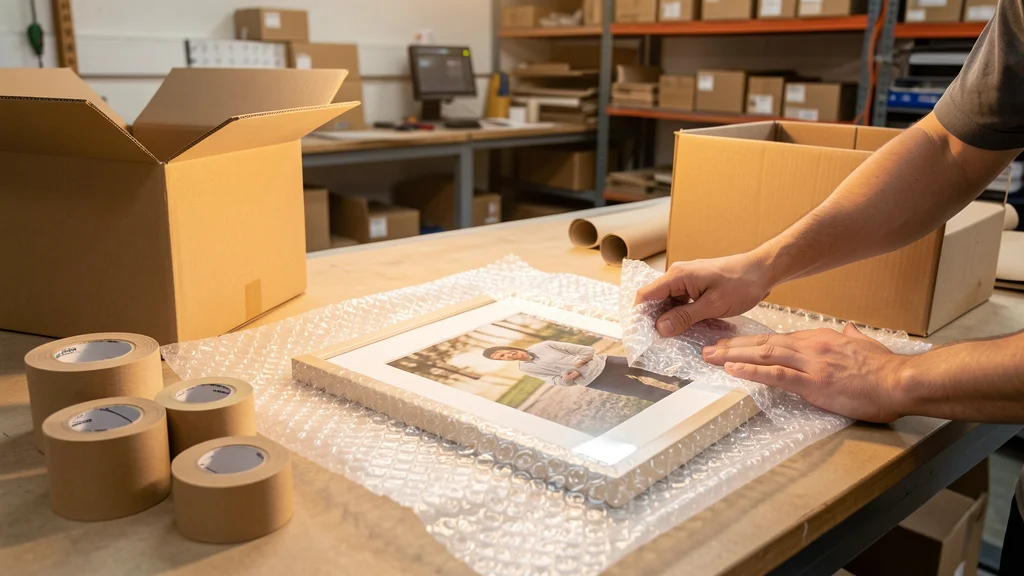
They wrap the frame in large-cell bubble wrap — four full layers. They place a two-inch bed of kraft paper in the box. They set the wrapped frame inside. They fill the gaps with foam sheets. They add another two inches on top. They seal the box with packing tape, reinforce the seams, and attach the label.
"Packing materials and shipping come to one total — and we insure it for the full value before you leave the counter."
You pay. You get your receipt. You walk out.
The buyer in Portland sends you a photo when it arrives. The frame is perfect. You never had to memorize the two-inch rule or argue with a claim clerk. That weight was ours to carry, and we carried it.
Walk In With the Bare Item
Walk in with the bare item — no box, no tape, no apology needed. You do not have to know the two-inch standard; that is our weight to carry now. We pack it right, in a box that can handle the trip, at Mailbox Plus, 7554 Fredle Drive in Concord Township.
Bring it in →