The Relief That Never Arrives
You have seen diesel prices coming down. The sign on Route 44 says so. The news says so. And you have been waiting, every week, for the fuel surcharge on your shipping labels to follow it down — because that is how a fuel surcharge is supposed to work. Fuel gets cheaper, the fuel fee gets cheaper.
It has not happened. And this week we can finally show you why, with numbers instead of a shrug.
The TD Cowen/AFS Freight Index, a quarterly measurement of what shippers actually pay, released its latest reading on October 16. It confirmed the good news first: in Q3, the average effective fuel surcharge shippers paid fell 4.7% from the quarter before, as diesel moderated. But it also confirmed the thing you have been feeling at the counter all year: that relief is a rounding error against a surcharge that has been ratcheted upward on purpose. Between Q1 of 2021 and September 2026, 72% of the ground fuel-surcharge increase came from carrier adjustments — changes UPS and FedEx made to their own surcharge tables — not from the price of diesel. The analysts' math is blunt: even if diesel went all the way back to 2021 levels, shippers would still pay roughly triple what they paid in Q1 of 2021.
And the relief is about to end anyway. The index projects the ground parcel rate per package will hit an all-time high in Q4 — 43.3% above its January 2018 baseline — as peak-season surcharges stack on top of elevated fuel fees. If you ship holiday orders from Lake County, this article is about the next eight weeks of your invoices.
The Fuel Surcharge Ratchet
A ratchet moves freely in one direction and locks in place when you try to pull it back. That is the mechanism, and it operates in plain daylight on pages the carriers publish themselves.
Here is how it works. The fuel surcharge is a percentage added to your base shipping rate, and the carriers update it weekly based on a diesel price index. That sounds mechanical and fair — fuel goes up, fee goes up; fuel goes down, fee goes down. What the index data exposes is the other hand: the table that converts diesel prices into a surcharge percentage is set by the carrier, and the carriers have repeatedly adjusted those tables upward. When they move the table, every future diesel price maps to a higher surcharge than it used to. Diesel at $4.00 does not carry the fee it carried in 2021. It carries a bigger one, permanently.
So the two components of your surcharge — fuel and adjustment — are not equal partners. Fuel is roughly a third of the increase since 2021. Adjustments are the other two-thirds. The part you assumed was out of everyone's hands is the smaller share.
Mingshu Bates, chief analytics officer at AFS Logistics, said the quiet part to Supply Chain Dive: "Even when we see relief on diesel fuel price, we are not going to see material relief on fuel surcharge."
This is not a conspiracy and it is not illegal. It is a published pricing table, updated in the open, that most shippers never read. That is exactly what makes it effective — a fee that would cause a revolt if it appeared as a line item on your rate quote instead rides on top as a percentage, week after week, and only moves in one direction.
The Label You Keep Squinting At
It feels like watching the gas station sign drop for a month and then printing a label that costs the same as it did in the spring.
You check the price. Same box, same weight, same zip code. Maybe two bits cheaper than October, and you squint at it, because diesel is down and you did the math in your head on the drive over. The surcharge line is still there, still thick, still in the double digits on a mid-size box. You do not know what percentage it is this week, and the label does not break it out for you in a way that invites the question.
There is a second feeling, and it is worse because it is about the future. It is November, you open a spreadsheet to budget December shipping, type a number, delete it, type another — and you are still guessing, because the surcharge changes every Monday and you will not be done until the season is over.
A Fee That Forgot Its Own Excuse
A fuel surcharge exists for an honest reason: trucks and planes burn fuel, fuel prices move, and someone has to absorb the volatility. Passing a real cost through is fair. We will say that plainly — the concept is not the villain.
The ratchet is. If the fee were truly about fuel, it would track fuel, in both directions, on the same table. When two-thirds of the increase comes from the carrier's own adjustments — and when the carrier's own analytics leadership confirms that diesel relief will not bring surcharge relief — the fee has stopped being a fuel pass-through and become a permanent price increase wearing a fuel sticker. And it compounds: the surcharge is a percentage, so it scales with every base-rate increase, and the peak-season fees stack on top of the surcharge, which stacks on top of the base rate.
A price that only moves up, whose stated justification disappears while the price stays, should have to say so out loud. Instead it hides in a weekly table.
The Counter at Gristmill Village
We stand behind the counter at Mailbox Plus at 7554 Fredle Drive in Concord Township — in Gristmill Village, just off Crile Road — and we watch the ratchet work on real boxes, not indexes. A customer brings in the same package they have shipped every month for a year and asks, reasonably, why it costs more when diesel is cheaper. Until this week, the honest answer was "because the surcharge tables moved and the carriers do not advertise it." Now there is a number: 72% of the increase was never about fuel.
The index also explained something we see directly: the discounting that exists is aimed at big shippers. Both carriers rebounded their shipping discounts in Q3, but the discounts target large-volume shippers — the customers whose packages keep the network full — not small and mid-size businesses. The 200-package enterprise account gets the break. Your twelve boxes get the surcharge.
Our answer to that is independence. We are not owned by any carrier, and we quote USPS, UPS, and FedEx side by side for your actual box, at the counter, before anything ships. When one carrier's surcharge stack runs hotter for your particular weight and zone, you see it in the comparison instead of discovering it on a receipt. We have written before about how the fuel surcharge works and about the peak-season fees already on the calendar — this article is the mechanism underneath both of them.
How It Works: Beating a Ratchet in Three Steps
- Bring the package in as it is. No measuring, no rate-table homework, no spreadsheet of this week's surcharge percentages. That homework is the ratchet's favorite weapon — it counts on you giving up and paying the first number.
- Get every carrier quoted on the real box. Weight, dimensions, destination, service level. The surcharge stacks hit differently depending on all four, and the cheapest headline rate is frequently not the cheapest total once fuel and peak fees land. The comparison takes minutes because the software and the rate tables are already at the counter.
- Pick the total price and ship it. You leave knowing what the label costs — the whole number, fees included — not a base rate with surprises attached downstream.
What the Ratchet Costs You by December
Money, through the holidays. The index projects Q4 as the most expensive quarter for ground parcel pricing on record — 43.3% above the January 2018 baseline, with express shipments forecast to hit their own all-time high of 20.3% above baseline. Ship your season on autopilot with one carrier and you pay whatever that carrier's surcharge stack says, on the worst-priced weeks of the year.
Time you will not get back. The alternative to a counter comparison is becoming your own fuel-surcharge analyst: reading weekly tables from three carriers, tracking the EIA diesel average, and re-running the math every Monday through December. Bates's quote tells you how that ends — the diesel input will not save you, because it was never the main driver.
The benefit of the doubt. The deeper cost of the ratchet is that it teaches you to distrust the label before you even print it — and to feel like the only person at the counter who does not know the rules. You are not. Every line is published somewhere; the system is just arranged so that finding out is your job. Hand that job to someone whose loyalty is to your box, not to a carrier's volume targets.
Your December, Priced Instead of Guessed
Picture the difference. It is early December, your busiest shipping week, and instead of wincing at labels you printed in the dark, you have already moved the season's boxes — each one quoted across carriers at the counter, each one shipped at the best total price available that day, peak fees and fuel surcharges already inside the number. There is no line item you have not seen. No Monday-morning table-checking. The dread that used to come with printing shipping labels in December is just… gone, because the pricing was handled where the box was handled.
That is the difference between a label you wince at and a total you already approved.
Bring the Box, Not the Homework
You do not need to know this week's surcharge percentages. You do not need to have read the carrier tables, measured anything, or figured out which carrier's peak fees are worst. Bring the box to the counter at 7554 Fredle Drive in Concord Township the way it is — tape half-done, address scribbled on a sticky note, no idea what it weighs.
The ratchet only wins when you pay the first number you are shown. Bring the box in — we will show you all of them.
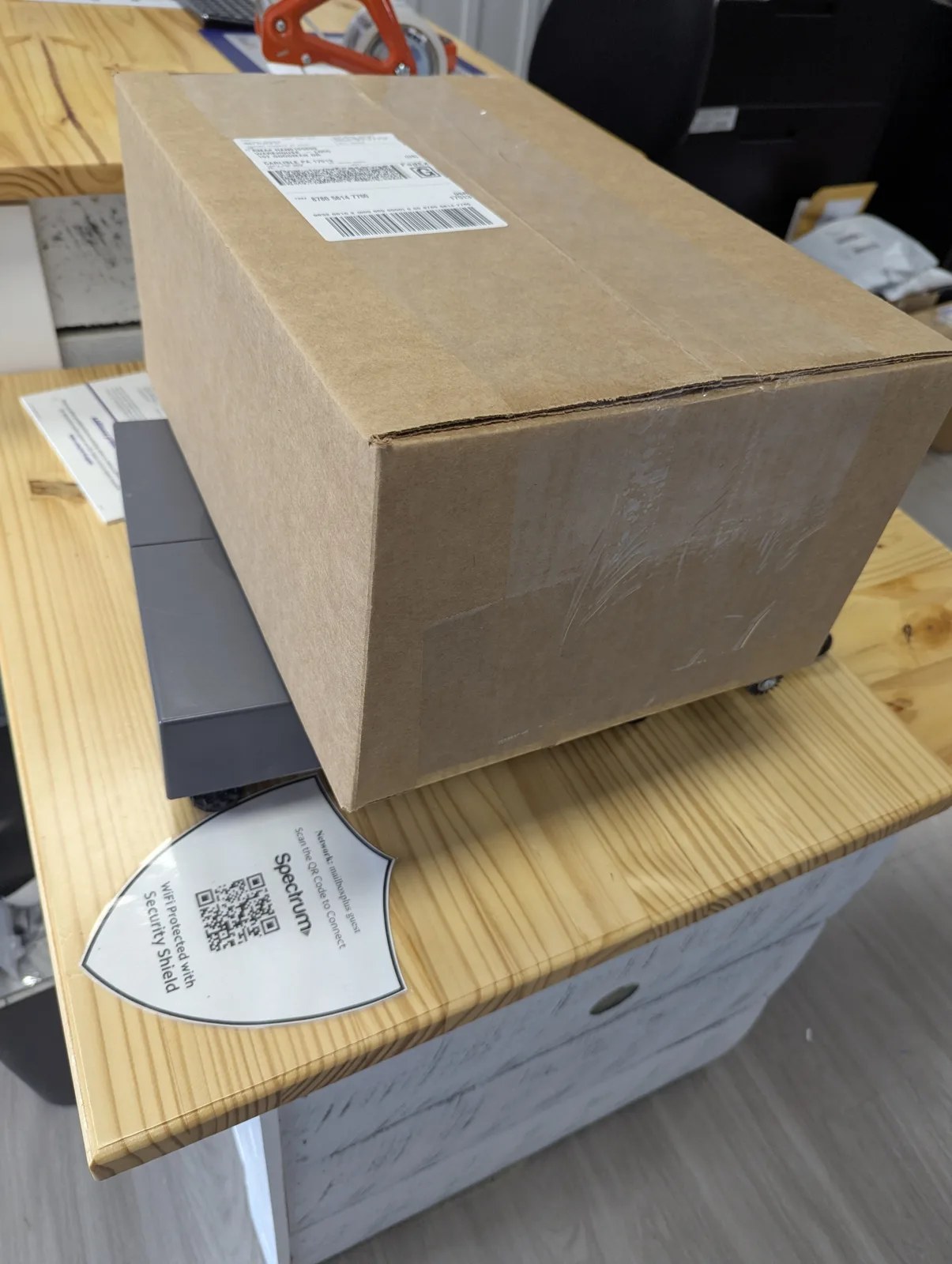
A sealed cardboard box on the parcel scale at the Mailbox Plus counter in Concord Township, where every carrier's surcharge stack gets quoted before it ships.