The Envelope That Comes Back Haunting You
You have a letter that has to be provably delivered. A notice to a tenant, a dispute letter to a creditor, a signed agreement that needs a paper trail. You know the words "certified mail, return receipt requested," and the deadline is already circled on your calendar. What you don't know is which form goes where, what the whole thing should cost, and whether you'll stand at the counter and get it wrong while a line stacks up behind you.
You shouldn't need to memorize a form catalog to prove a letter arrived. Fill out what the letter requires, hand it over, and get a dated receipt and the recipient's signature back. That's the whole job.
Here's how it actually works, every step, with the 2026 prices so nothing surprises you at the register.
The Receipt You Were Not Offered
The trap in certified mail isn't the fee. It's the quiet gap between what the tracking page shows and what your situation may require.
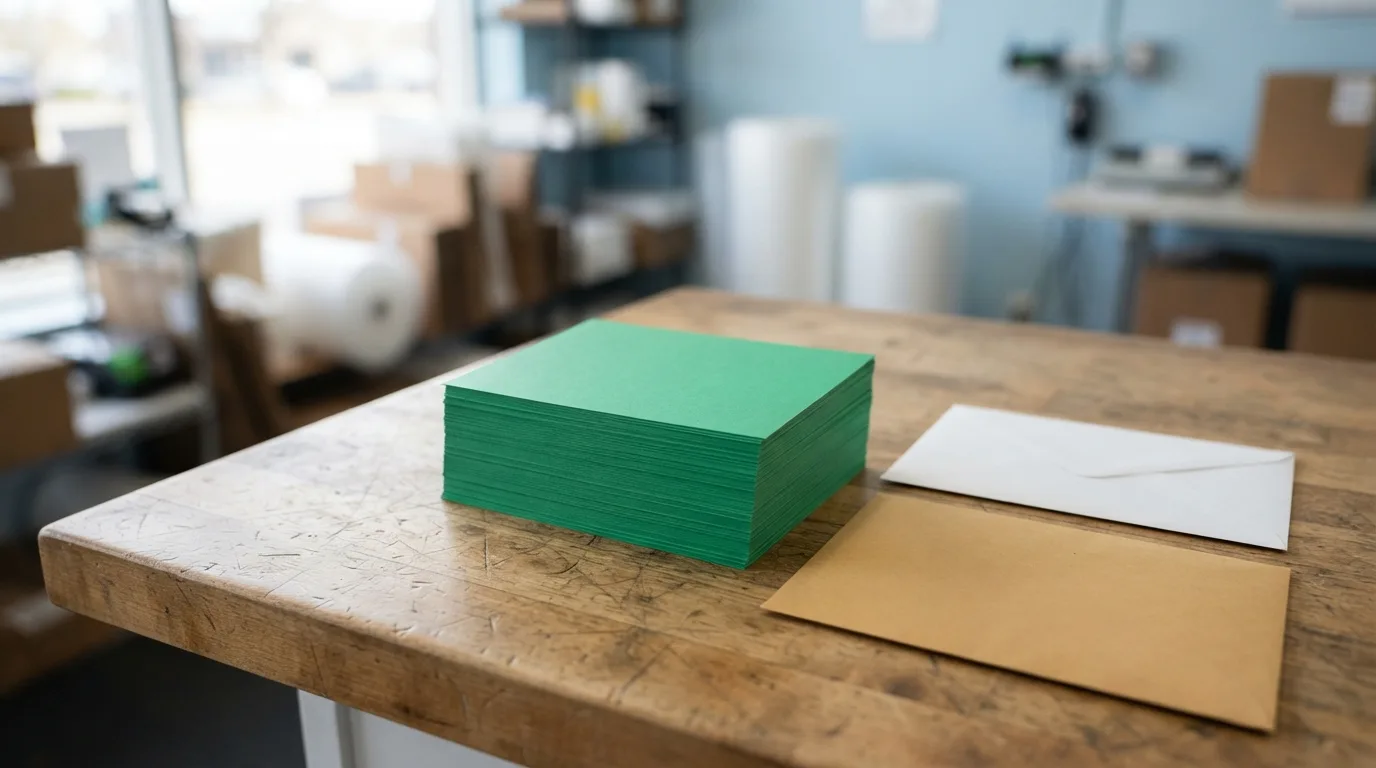
Certified Mail by itself gives you two things: a dated mailing receipt (PS Form 3800) and a delivery record in USPS tracking. What it does not give you, on its own, is the recipient's signature. That signature lives on the Return Receipt — the green card, PS Form 3811 — and it's a separate purchase. Plenty of people pay the $5.55, mail the letter, watch "delivered" appear on the screen, and only later learn the person who asked for the letter wants a signature, not a scan. ("Delivered" is a data point; a signature is a record — we break down how that proof stacks up against carrier signature options in certified mail return receipt vs. carrier signature required and against overnight couriers in Certified Mail vs. courier services.)
Picture it: you get home, set the receipt on the kitchen table next to your copy of the letter, and later that week the tracking page says delivered. But there's no card in your mailbox with a signature on it. The envelope is gone. The counter is gone. And whoever told you to send it certified starts asking who signed.
The second quiet gap: the Return Receipt has to be bought at the time of mailing. You cannot call the post office a week later and add it. USPS says if the green card never returns, you can request a delivery-record copy on PS Form 3811-A, and that record is available for 90 days. After that, you're relying on the tracking entry alone.
And the third: Certified Mail is not a speed upgrade. It rides on top of whatever mail class you paid for, typically First-Class Mail, which lands in 1 to 5 business days — with no delivery guarantee. People treat "certified" like "overnight," mail it the day before a deadline, and lose.
None of this is hidden. It's just never explained in one place, at one time, before you pay.
Standing in Line With Your Phone Out
Here's what the DIY version actually looks like. You're in line at the post office, envelope in one hand, and you're scrolling the fee schedule with your thumb because you're not sure what you'll be asked to pay. $5.55 for the certified service, 82 cents postage for a 1-ounce letter. Do you need the green card? That's $4.65 more, $2.91 if you take the electronic version. Only the addressee may sign? Restricted Delivery, another $14.35. Meanwhile the sticker strip for the form is in your other hand, and you're trying to remember whether it goes above the address or beside it.
For a single letter with the green card, you're at about $11.02. That's fair. The real cost isn't the money — it's the second trip when you under-bought, or the voided notice when you over-tracked. A notice sent without the signature the recipient demanded costs more than every green card you'll buy this year, and you find that out weeks later, not at the register.
Why the Counter Assumes You Already Know
USPS isn't hiding anything. The system is built for volume, not for first-timers. The form's peel-off strip goes above the delivery address, to the right of your return address. The green card's back flaps fold so your return address shows on the reverse — one more step nobody demonstrates. Every one of those details is logical once someone shows you, and completely arbitrary when nobody does.
The system assumes you'll be back next week and have learned the choreography by then. But most people mail certified letters a handful of times a year, and the learning curve resets every time. That's not your failure. It's the design.
What We See Every Week at the Counter
At Mailbox Plus in Concord Township, we fill out these forms every week. We see the landlord with the 3-day notice (Ohio's ORC 1923.04 names certified mail, return receipt requested as a permitted method for it), the business owner disputing a charge, the homeowner documenting a complaint. They all walk in with the same half-finished envelope and the same question: am I doing this right?
That's the question we answer before anything gets stamped. Which proof your situation needs, which options to skip, whether the document should be notarized before it mails — our notary service runs at the same counter. You're not studying a rate sheet in line — someone who does this weekly is checking the work while you watch.
The Three Steps to Transfer the Task
If you do it yourself, here is the honest procedure:
- Fill out PS Form 3800 — the certified mail receipt. Your name and address in the sender box, the recipient's on the article portion. Peel the barcode strip and stick it above the delivery address, to the right of the return address.
- Choose your proof. Want the signature? Buy the Return Receipt now — $4.65 for the green card, $2.91 electronic — because you can't add it after mailing. Only the addressee may sign? Say so and add Restricted Delivery ($14.35).
- Pay postage plus fees and keep the receipt. For a 1-ounce First-Class letter: 82 cents postage, $5.55 certified fee, plus whatever proof you selected. The postmark on your receipt is your proof of mailing and your evidence of the date.
That's genuinely all there is — three steps, one receipt, one card. The failure modes are all in the details you couldn't see from outside the system.
What a Wrong Mailing Actually Costs You
Not abstractions. Concrete: the reprint of the letter, the drive back, the re-mail, and the week the recipient spent holding your unproven notice. If the letter was backing an eviction, that's a re-filed case. If it was a dispute deadline, that's the argument you can no longer make. The signature you didn't buy can't be bought afterward, and the delivery record that could have saved you expires in 90 days.
And underneath all of it runs the part nobody prices: not knowing, again, whether this second envelope will come back with what you need on it.
The Morning the Letter Leaves Correctly
Mail it right and the letter leaves your hands once. You keep the dated receipt. In the normal 1-to-5-day window the tracking shows delivery, the green card or electronic record comes back with a signature on it, and it goes in the file next to your copy of the letter. The deadline you were nervous about is now paper in a folder. You stop checking the tracking page in the checkout line, because the answer is already on the card in your drawer.
Bring the Envelope, Not a Finished Package
You do not need the forms half-filled out, the card folded correctly, or the fee schedule memorized before you walk in. Bring the letter however it is — plain envelope, kitchen-table address, no tape. We'll ask the one or two questions that matter, fill out the form, fold the card, weigh it on the counter scale, and hand you back a receipt with everything attached the way it needs to be. If your situation needs a notary's stamp on the document before it mails, we handle that at the same counter, in the same stop. The confusion stops here.
Mailbox Plus is at 7554 Fredle Drive, Concord Township — open Monday through Friday, 9:00 AM to 6:00 PM, and Saturday, 9:00 AM to 2:00 PM. Bring the envelope. Take the proof.
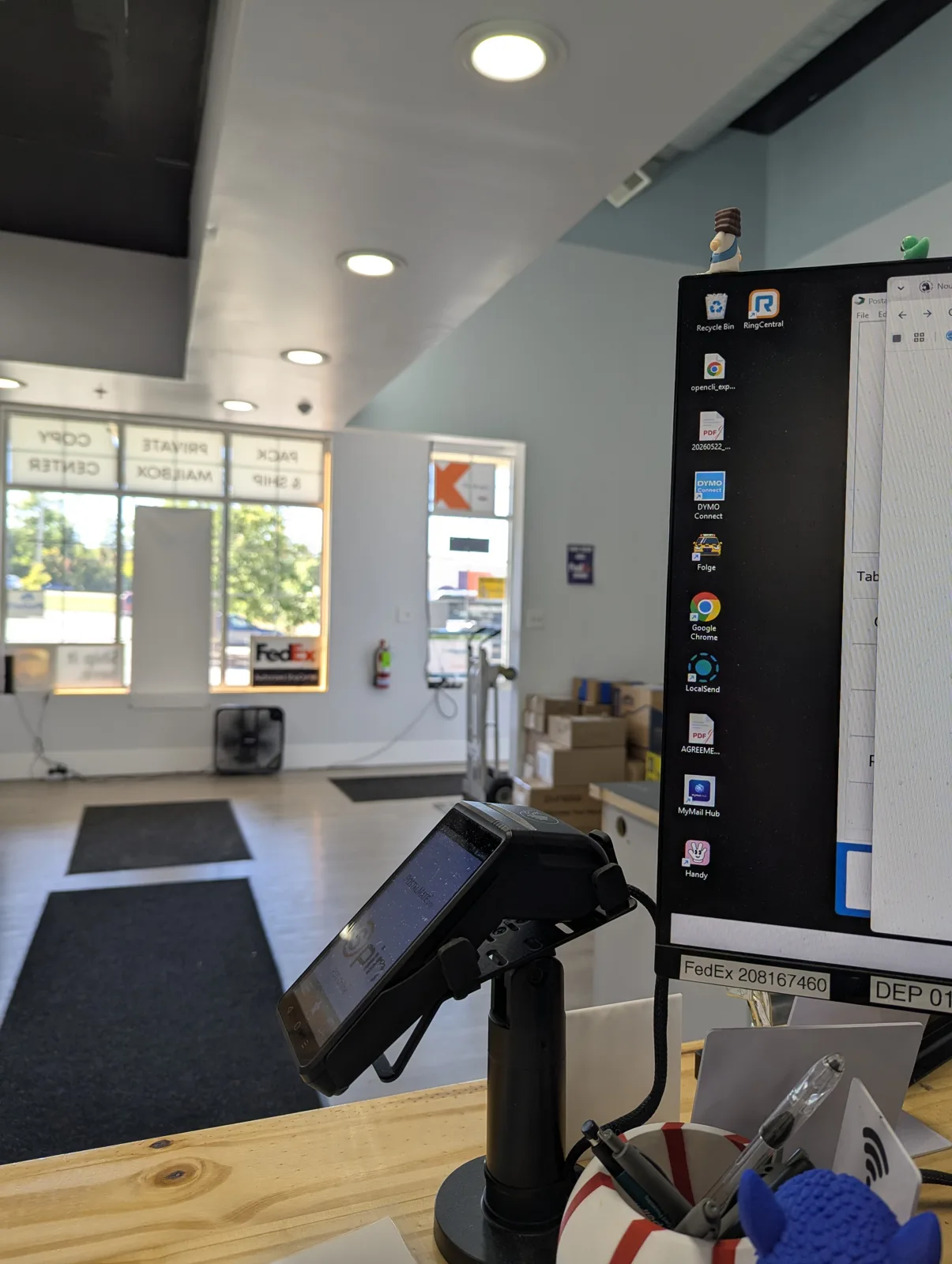
The shipping counter at Mailbox Plus in Concord Township, with carrier rate sheets and the point-of-sale terminal where certified mail fees get added up line by line.