A Small Job With a Hidden Tax
You list it, you sell it, you pack it, you ship it. Somewhere between the second and third step, the job picks up a tax you never agreed to: every label you print puts your home address in front of a stranger, every inbound return needs someone standing where the driver shows up, and every delivery you can't intercept sits on your porch while you're at work or running errands.
It should work like the rest of your business: a fixed place, a fixed process, no improvising. That's what a package receiving service is — a staffed street address where every carrier can deliver, someone puts your packages behind a counter, and your home address never has to ride on a label again.
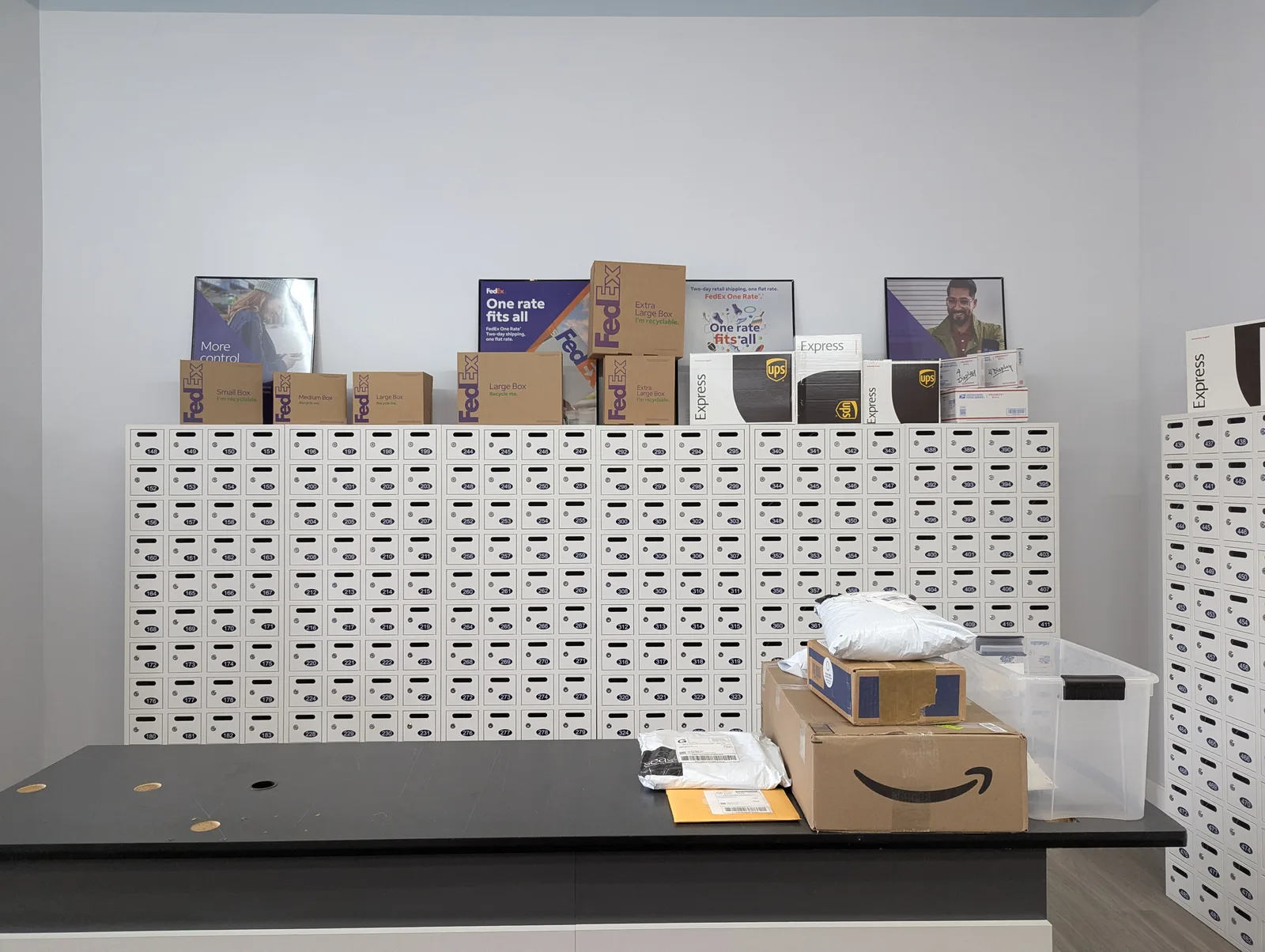
Shipping counter at Mailbox Plus in Concord Township with FedEx, UPS, and USPS signs overhead — one counter where every carrier delivers.
The Doorstep Drop: The Mechanism at Work
The problem isn't that carriers are careless. It's that residential delivery is designed around the assumption that someone is home. That assumption fails constantly for anyone who sells from home and works somewhere else — which is most eBay sellers.
So the system builds in failure modes, and each one lands on you: a box baking in the sun on concrete while its delivery confirmation says it arrived an hour ago, a door tag flapping where the package should be, a label with your name and street on it riding off in a stranger's mailbox photo:
- The unattended drop. Drivers on residential routes leave packages at the door because stopping to get a signature costs time. If nobody signs, the package sits in the open — a public, visible, empty delivery point.
- The missed-attempt spiral. When a carrier does require a signature, they attempt once. Miss it, and the package goes to a depot across town with pickup hours that don't fit a workday. Some sellers drive across town to retrieve an item they shipped in the first place.
- The address leak. Your return label is the mechanism. It's printed on every outbound package, visible to every buyer who handles the box, and tied to maps and people-search sites in a few clicks. A PO Box would fix the leak — except UPS, FedEx, Amazon, and other private carriers cannot deliver to a PO Box, per USPS's own guidance.
Notice the structure: none of these are your mistakes. You're using the postal system the way it's built. The system just wasn't built for a home-based seller, and the cost of that mismatch shows up as your stolen packages, your second trips, and your address on a stranger's screen.
What the Friction Costs in Real Terms
Run the actual numbers on one lost package. You refund the buyer — the item price plus the postage they paid toward a house nobody was watching. You're out the item, the postage, and the listing momentum, and you spend your evening filing a claim instead of listing the next item.
Then there's the steady leak: the buyer who asked where you're located and got quiet when the answer was a residential street. The neighbor who signed for your box and couldn't find it for a week. The vacation where you had a relative collect your porch because an unattended package during an announced absence is a beacon. Each one is small. Together they're the reason selling from home feels like running a shop whose front door can't close.
The buyer who Googles your street and sees a ranch house with a tricycle in the yard doesn't need to say anything. The address already did.
Your driver isn't paid to wait for you. He's paid to clear the route by six. So he drops your box on the concrete and keeps moving — the system rewards him for your risk. A secure handoff costs them minutes, a porch drop costs them nothing — so you eat the risk and they keep the margin. UPS and FedEx have no financial reason to make a porch drop secure for free — and no mechanism to know whether you're home. The Post Office solves half the problem with the PO Box and then, by rule, excludes the carriers that bring most of your eBay inventory in and out.
So the market leaves a gap: a fixed, staffed, secure delivery point that accepts every carrier and signs for the ones that need it. That gap is exactly what a commercial mail receiving agency fills. That's why the address works like a real storefront — and why the only paperwork is a single page we keep right at the counter, no government alphabet soup required.
The Counter Engineered for Zero Friction
At Mailbox Plus — 7554 Fredle Drive, Concord Township, in the Gristmill Village plaza next to Pub Frato, just off Crile Road and minutes from SR-44 and I-90 — this is the whole job, not a side service.
Picture your first pickup. You walk in with your IDs, and ten minutes later you're holding a key to a street address that UPS actually recognizes — because it's a real building with a staffed counter, not a box in a wall. UPS, FedEx, and DHL drivers walk through the same door the post office does, so your inbound stock and your buyers' returns all land in one place.
Whoever's at the counter scrawls a name, sets the box on the shelf behind them, and writes your PMB number on the log in black marker. You see the signature line and the shelf when you pick it up. And your return address stops being your front door. It becomes the store's street address with your PMB number on it, so the label that travels with every shipment points at a counter full of people, not a porch nobody's watching. Most sellers fit the $25 tier — ten packages, all carriers, someone to sign. Month to month. No lock-in — cancel anytime.
The setup is deliberately boring. You bring what you have — your driver's license and one more ID that confirms your address, which is exactly what Form 1583 asks for. No appointment, no forms to download, no second trip; the paperwork lives at the counter and we walk through it with you.
You pick your tier by telling us the truth about your volume. The $25 tier covers ten packages in and out a month; more volume or bigger boxes moves you up; the staff will tell you if you're over-buying. Your address goes live the same day — setup takes about ten minutes, most of it spent reading the form.
Then you fix your labels. "PMB" plus your box number on the new return address, and from that day forward every carrier delivers to the counter instead of your porch. That's the entire homework.
You already know the tax. The Tuesday you burned driving to the depot because the driver "missed" a porch that was clearly visible from the street. The $87 porch-pirate hit — item, refund, replacement postage — that cost more than a year of the $25 tier. And the buyer who Googled your return address and saw your front lawn, your spare room with the inventory, the exact door a stranger can knock on. Time you don't refund. Money that compounds with every listing. And privacy that doesn't come back — a screenshot in a stranger's messages doesn't expire the way a forwarding order does.
What Changes on the Calendar
Picture the next month running through the counter instead of your doorway. Inbound stock arrives at the store; staff signs, logs, and holds it until you come by — on the way home from work, whenever. A buyer's return gets dropped off on your lunch hour because the counter is on the way, not a depot across town. Your labels print with an address that routes to a building with people in it — the same address privacy mechanics covered in why sellers take their home address off labels, applied to every box that leaves the house.
The part you'll notice most isn't the packages. It's the silence where the tracking anxiety used to be — no refreshing the map, no craning out the window at every passing car, no math about whether you can leave the house during the delivery window. Someone else's competence took custody of the problem, and your evening got the space back.
One Stop to Close the Loop
Here's the fear underneath all of it: that shipping from your kitchen table marks you as small-time — that the buyer on the other end of the label can smell the spare room. A counter address doesn't make you a bigger business. It makes you look like what you are when the order comes in: a real operation with a real place where things get signed for. That's the whole gap, and it's a form and two IDs wide.
You don't need to have your volume figured out, your IDs organized, or your label template rebuilt before you come in. Bring your two IDs and your best guess at how many packages a month you move — the counter staff will walk Form 1583 with you, point you at the right tier, and have your address live before you leave. If it turns out you need a bigger box or the business plan instead, that's a counter conversation, not a contract renegotiation.
Come in with your driver's license and whatever second ID you have. You don't need to have your volume figured out or your labels rebuilt. I'll walk the form with you, and your address is live before you walk out. The burden stays at the counter, not in your car on the way home.