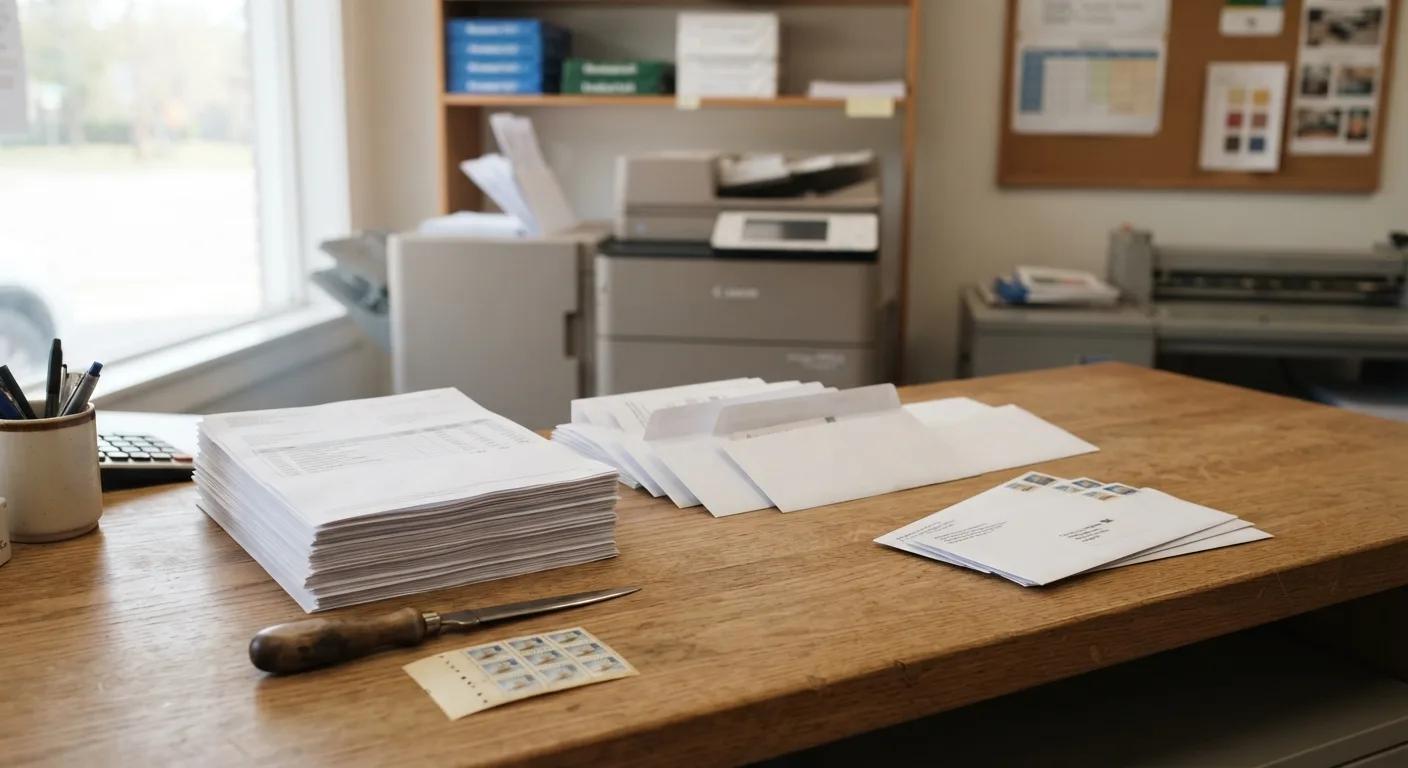
The Invoice Stack That Eats Your Friday
You bill customers the old way because your customers expect paper: an invoice in an envelope, a statement once a month, a past-due notice that actually arrives. So the job lands on you. Print the batch, fight the printer, fold, stuff, seal, stamp, and drive the stack to the blue box before the pickup. Thirty invoices later, your afternoon is gone and the toner light is blinking again.
What you actually want is simpler: your billing software produces the PDF, and the envelopes just... happen. Printed cleanly, addressed correctly, postaged, gone. That is exactly what a document print and mail service does — and there is more than one way to buy it, at very different prices. Here is how the whole thing works.
The Breakroom Printer, Explained
The systemic mechanism here has a name: the Volume Penalty. The USPS rate card prices First-Class mail for presort volume you do not have — so a business sending a few dozen letters a month pays retail postage and the hidden surcharge of doing a mailroom's work by hand. It is not a scam and it is not illegal. It is the assumption that because you send only a few dozen letters a month, mailing them should cost you nothing but a stamp.
Run the real count on doing it by hand. A one-page invoice mailed First-Class costs about $0.91 all-in — the $0.82 stamp (the 1-ounce letter rate effective July 12, 2026) plus roughly 5 cents for a #10 envelope, under a cent for paper, and a few cents of toner. Cheap. But the handling is the tax: printing, folding, stuffing, addressing, and stamping one letter runs 3 to 7 minutes by most estimates, before the trip to the mailbox. Thirty invoices a month is one and a half to three and a half hours of your life, every month, standing over a printer that jams precisely when the batch is due.
And the failure modes stack up quietly. The kiosk printer at the office-supply store flashes a paper jam with a queue behind it. Your home printer mangles the fold so the address sits wrong in the window envelope. You mail a statement to a stale address and eat the postage plus a week of delay while it comes back. None of these show up as a line item. They show up as your evening.
What the Friction Costs in Real Terms
Picture the actual scene: it is the last business day of the month, the stack is forty envelopes deep, the printer starts pulling two sheets at once, and you are re-printing page 3 of an invoice for the second time while a customer waits on hold. You are the business owner, and you are performing the job of a mailroom clerk — badly, with bad equipment, on a deadline.
And the cost nobody prices: every day the stack sits half-stuffed is a day your money sits in someone else's account. An invoice exists to get you paid. A past-due notice that goes out late stops being a nudge and starts being an apology. The mail system works when it is routine; the friction is what breaks the routine.
The Rule That Only Helps One Side
The USPS system is engineered to reward volume you do not have. Commercial presort pricing drops a First-Class letter from the $0.82 retail price toward the $0.62–$0.71 range — but it requires a permit, a $390 annual mailing fee, and a minimum volume in every mailing. A meter or online postage shaves 4 cents a letter but charges a monthly fee that eats the savings until you are mailing hundreds of pieces. The rate card is written for the statement houses and the banks. For a business mailing 10, 30, or 80 envelopes a month, retail is the price and your labor is the hidden surcharge.
That is not a reason to feel bad — it is a reason to stop pretending the math favors buying a permit. The honest comparison is between your time and somebody else's machine.
What Changes When the Job Stops Being Yours
Here's the part that matters: "print and mail service" is really three different products, and picking the wrong one costs you money in both directions.
1. The per-letter print-and-mail service. You upload each invoice PDF; the provider prints it, inserts it, applies postage, and mails it First-Class — one price per letter with printing, envelope, and postage included. A per-letter service typically charges around $2.05 for a one-page black-and-white letter, with printing, envelope, and postage included. No subscription, no minimum, nothing owed in a month you send nothing. This fits roughly 10 to 50 invoice PDFs a month.
2. The statement house. For thousands of statements a month — banks, utilities, medical billers — a statement-mailing house takes a data file, lays out each document, presorts for discounted postage, and prices by quote. A per-letter website is the wrong tool at that scale, and a permit is the right one. You are almost certainly not in this bucket, and you know if you are.
3. The hybrid: a staffed print counter. This is the option the guides skip, and for many small operations it is the smart one. You bring the file — on a drive, by email, or from the cloud — to a staffed counter that prints it cleanly on commercial equipment, checks the alignment and page count, and folds and stuffs the batch while you watch or while you run your next errand. You keep control of postage and the mail drop, or the same counter hands the finished envelopes across to the shipping side and the mailing goes out from there. You skip the printer war and the envelope assembly without paying per-letter service premiums on every piece.
Whichever route you pick, the evaluation stays the same — and a related guide covers the address-verification question in depth in our scan-and-email walkthrough. Before you hand a batch to any provider, ask one question: "Do you verify addresses before printing?" If they hesitate, walk — a bad address costs you the postage and a week. And know that ordinary First-Class letters carry no tracking; if a past-due notice needs proof of mailing or delivery, that is Certified Mail at the counter ($5.55 plus postage as of July 2026) or nothing. If your files carry patient or financial data, ask for the signed HIPAA business associate agreement or SOC 2 report outright — a compliance badge on a website is not a signed agreement.
Run the Numbers on Standing Still
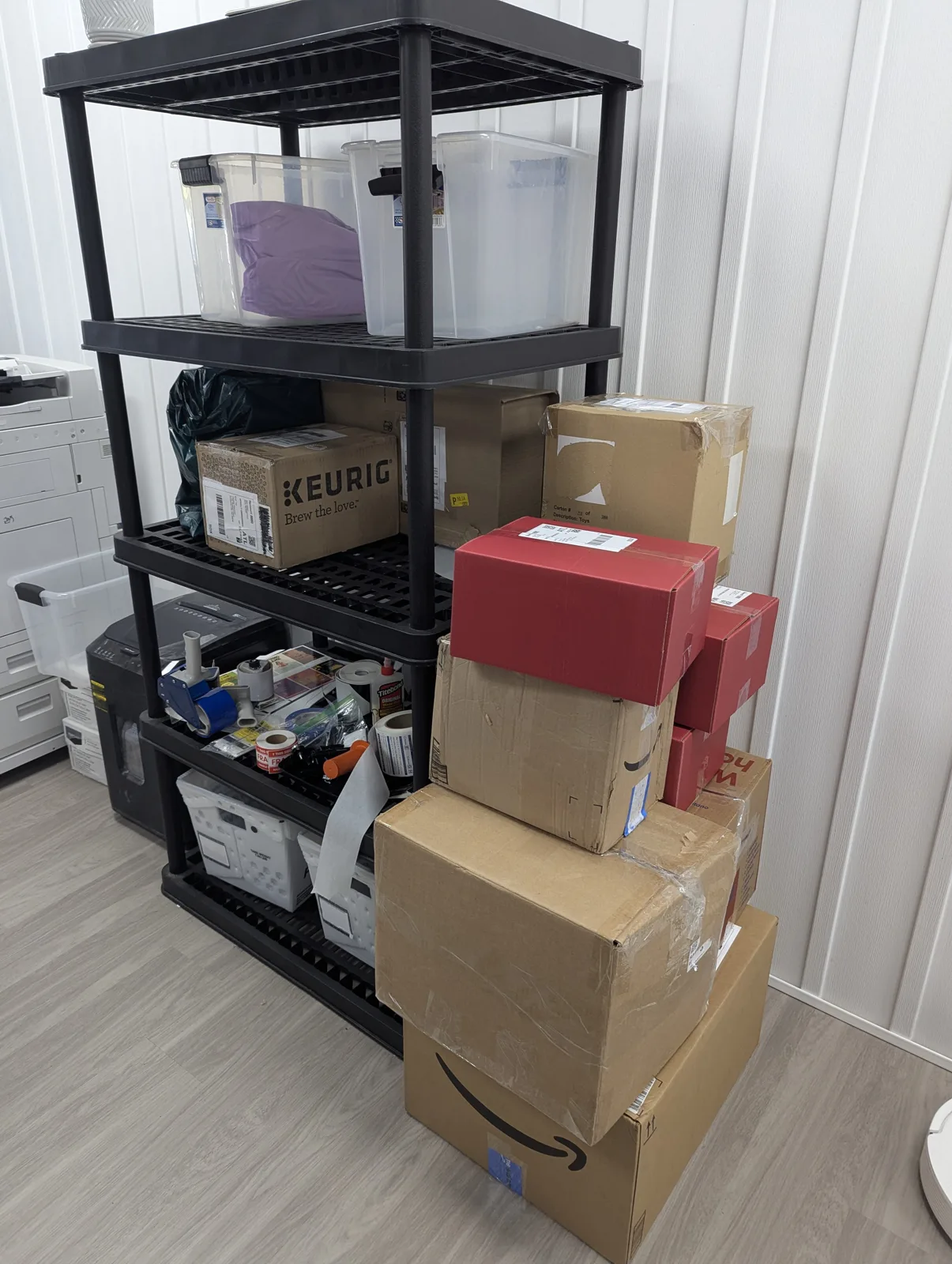
The commercial copier and print station in the back room at Mailbox Plus in Concord Township, Ohio, where invoice batches get printed before the envelopes get stuffed
Thirty invoices a month, done by hand: about $27 in stamps and supplies, plus one and a half to three and a half hours of handling. That is the baseline you are defending every time you decide to "just keep doing it yourself."
Buy the same thirty through a per-letter service at about $2.05 each and you spend roughly $61 — around $34 more in cash — to recover up to three and a half hours. At $25 an hour, your recovered time is worth more than the premium the moment your handling pushes past 80 minutes a month, which the 3-to-7-minute-per-invoice range guarantees at 30 pieces. Below a dozen invoices a month, the stamp wins and there is no shame in it. The error is not choosing the cheap option — it is never running the count at all, and letting the hidden tax ride because it never arrives as a bill.
And there is a third number people forget: the late-invoice cost. Every day the stack waits is a day of float on your receivables. If printing the batch "when you get to it" delays your billing cycle by a week each month, that week costs you more than a year of per-letter premiums.
Your Desk After the Change
The billing run closes. The PDFs exist. That is the end of your involvement. No printer, no fold, no envelope assembly, no drive to the blue box with the stack on the passenger seat. The mail simply goes out — printed straight, addressed clean, postaged, entered into the stream where USPS takes it the rest of the way in 1–5 days.
What disappears is not just the time. It is the stack on the passenger seat, the toner smudge on your thumb, the 4:45 PM drive to the blue box before the last pickup — and the mental tab labeled "the invoices still aren't out" that stays open through the last week of every month. That tab closes. Your receivables clock starts when it should, and your Friday afternoon belongs to the business again.
Bring It In
You do not need to have this figured out. You do not need to know whether per-letter, statement-house, or counter-based is right — you need to know how many pieces you mail in a normal month and what the file looks like when it leaves your billing software. Bring that much to the counter at Mailbox Plus, 7554 Fredle Drive in Concord Township — just off Crile Road, minutes from SR-44 and I-90 — and we will tell you straight which route fits, print a test piece so you can hold it before you commit, and take the printing-and-stuffing job off your desk entirely. Bring the mess. That is what the counter is for.