The Two Addresses on Every LLC Checklist
You're forming your LLC and the checklist keeps asking for two things: a registered agent and a business address. One form says "street address required." Another says "no PO boxes." A third service you're considering says "we'll be your registered agent — oh, and you'll also need a physical address for your LLC."
It's confusing because everyone talks about them as if they're the same thing. They are not. They are two separate jobs, filled by two separate addresses, and — this is the part nobody explains — the LLC needs both.
This article clears it up: what a registered agent actually does, what a business address actually does, what Ohio requires for each, and the one thing a private mailbox cannot do for your LLC.
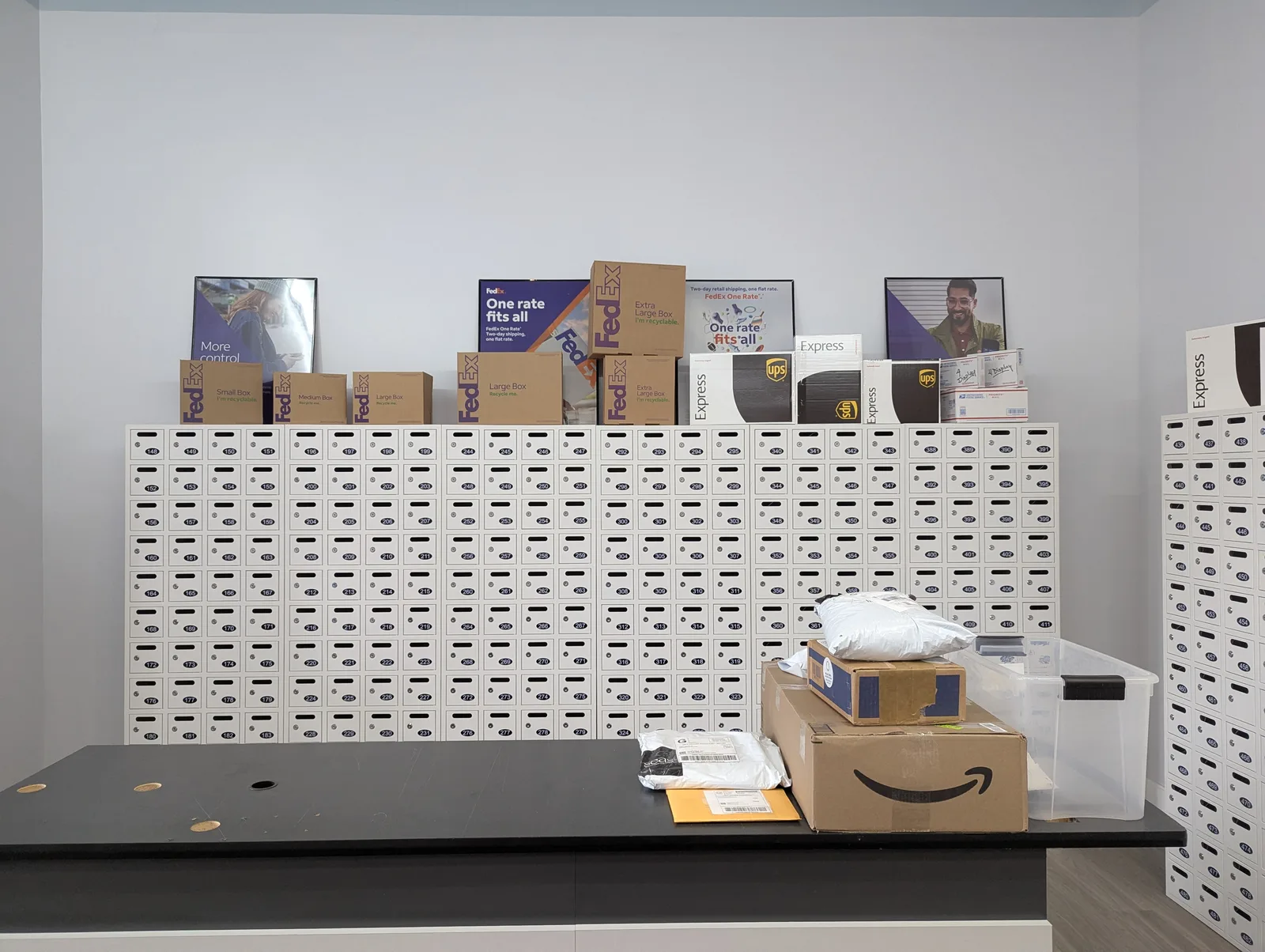
Shipping counter at Mailbox Plus in Concord Township with carrier shipments staged
What a Registered Agent (Statutory Agent) Actually Is
In Ohio, the registered agent is called the statutory agent, and it's a legal role, not a mailing preference. Under Ohio Revised Code Section 1706.09, every Ohio LLC and every out-of-state LLC doing business in Ohio "must appoint and maintain a statutory agent to accept service of process."
Service of process is the legal phrase for being handed official documents: a lawsuit summons, a subpoena, a court notice, or certain official state notices. When someone sues your LLC, the court doesn't hunt for you on Facebook — it serves your statutory agent at the address on file with the Secretary of State. That's the entire job: someone, at a specific Ohio address, who can be handed legal documents and who will get them to you.
Because that job matters, Ohio sets strict rules for who and what qualifies. From the Ohio Secretary of State's own instructions on Form 610, the Articles of Organization:
- The statutory agent must be a natural person residing in Ohio, or a domestic or foreign business entity with an Ohio address.
- The agent's address must be a primary residence or a usual place of business — and it must be an Ohio address.
- Post Office boxes are NOT allowed (the one exception: if both a PO Box and a Rural Route number are provided).
- Commercial Mail Receiving Agency (CMRA) addresses are NOT allowed. The form defines a CMRA as "a private business that rents private mailboxes to customers."
Read that last line twice, because it's the part most mailbox-services marketing won't tell you: your private mailbox cannot be your LLC's registered agent address in Ohio. A PMB is a street address for receiving mail — but the statutory agent slot requires a place where a person is present during normal hours to accept legal documents, and Ohio explicitly excludes commercial mailbox agencies from that role.
The agent also has to sign an Acceptance of Appointment, and the agent's name and address go on the public record — anyone can look them up in the Ohio business search. Miss this and the consequences aren't subtle: Ohio can cancel your entity for failing to maintain a statutory agent.
What a Business Address Actually Is
The business address is the address your LLC lives at in the everyday world. It's the address that goes on:
- Your business bank account (banks must collect a street address under the federal Customer Identification Program — a PO box alone won't pass)
- Your business licenses and permits
- Your vendor and supplier forms (which routinely say "physical address required — no PO box")
- Your website, invoices, and business cards
- Your shipping labels and return addresses
- The contact information on your LLC's public filings beyond the agent slot
This is a different job from the statutory agent. Nobody is handing a lawsuit to your business address; they're sending invoices, bank statements, tax documents, supplier shipments, and customer mail. The business address is where your LLC runs, not where it gets served.
Both Are Needed. Here's the Split.
Think of it as two doors on the same building:
|
Statutory Agent |
Business Address |
| Job |
Accept legal service of process |
Receive mail, packages, filings, statements |
| Ohio requirement |
Required by O.R.C. 1706.09 |
Required in practice by banks, licenses, vendors |
| Address rule |
Ohio residence or place of business; no PO box, no CMRA |
Street address; PO boxes often rejected by banks/vendors |
| On the public record? |
Yes — agent name + address |
Your choice of what you list |
| Can a private mailbox do it? |
No — Ohio excludes CMRAs |
Yes — a PMB is a real street address |
The mistake most new LLC owners make is trying to use one address for both jobs. If you use your home for everything, your home goes on the public record and into every vendor database. If you use a private mailbox for everything, Ohio will reject your filing — because the statutory agent slot can't be a mailbox. Neither extreme works.
What Ohio Actually Requires (Straight From the Form)
Here's the honest, verified breakdown of Form 610, so you're not guessing:
- Name your LLC. It must include a designator like "LLC" or "Limited Liability Company."
- Appoint a statutory agent. A natural person residing in Ohio, or a business entity with an Ohio address, who agrees to accept service of process. The agent signs an Acceptance of Appointment.
- Give the agent's Ohio street address. Primary residence or usual place of business. No PO box. No CMRA. No exceptions for mailbox suites.
- File it. The state filing fee is $99, and the form must be typed.
That's it for the filing itself. The business address — the one for your bank, your licenses, your vendors, your website — is not a field on the state form, but every institution you touch afterward will ask for it, and most will reject a PO box.
What That Means for You, Step by Step
Step 1 — Fill the statutory agent slot. You have three legitimate options: use your own home address (legal, but it goes on the public record); use a trusted Ohio resident's address with their consent (same public-record caveat); or hire a commercial registered-agent service — a real Ohio office that accepts service of process and forwards documents to you. The last option typically costs $50–$150 a year and keeps your name and address off the public agent slot entirely. Ask your accountant or attorney what they recommend for your situation; this is the one slot a mailbox can't fill.
Step 2 — Give your LLC a business address that isn't your home. This is where a private mailbox earns its keep. A PMB at a licensed mailbox service is a real street address — your own suite number at a real commercial location — that all four carriers (USPS, UPS, FedEx, DHL) deliver to. It's not a PO box. It satisfies the "physical address required" fields on bank accounts, vendor forms, licenses, and your website. And it keeps your home address out of every database your business touches.
Step 3 — Keep the two separate and document both. Your statutory agent is the address the courthouse uses; your business address is the address the world uses. Write both down, keep the agent's contact current (Ohio cancels entities that lose their agent), and use your business address everywhere your LLC operates.
How a Private Mailbox Covers the Address Half
At Mailbox Plus in Concord Township, the process is simple and the paperwork is federal-grade:
- Walk in with two forms of ID. We're a registered Commercial Mail Receiving Agency, so we keep a USPS Form 1583 on file for every mailbox holder — the same federal paperwork national mailbox services use, minus the middleman. One primary photo ID and one secondary ID with your current address, about ten minutes, and you're done.
- Get your street address. Your LLC gets a real street address — 7554 Fredle Drive, Suite #___, Concord Township, Ohio 44077 — that all four carriers deliver to. We sign for packages and hold them in a locked area.
- Use it everywhere a business address is required. The bank's business-address line. The vendor form's physical-address field. Your licenses. Your website footer. Your invoices. Your shipping labels. One professional address, repeated everywhere, none of it your home.
- Optionally, go digital. Our digital mailbox rental adds scanning — we scan envelopes within four hours and you manage, forward, or shred everything from your phone. Same street address, plus remote control for the weeks you're not in town.
Rates for a business mailbox start at $35/month (personal tiers start at $15) — a fraction of an office lease, month to month, no annual contract. For a new LLC, that's the cheapest "real street address" you'll find.
The Honest Boundary (Read This Before You Sign Up)
We're a mailbox business, so this next part costs us a little honesty: a private mailbox cannot be your statutory agent in Ohio. The Secretary of State's form says so in plain terms — CMRA addresses are not allowed for the agent slot. If a mailbox company tells you they can be your registered agent, they are either a licensed registered-agent service (a different thing, with an office and legal-document handling) or they're telling you something that will get your filing rejected.
What a private mailbox does for your LLC is the business address half — and that half is genuinely important. Bank accounts, vendor forms, licenses, and your public-facing presence all want a street address that isn't a PO box and isn't your kitchen table. That's the gap a PMB fills.
What It Looks Like After Both Are Handled
Picture the setup once everything's in place:
- Your LLC is filed with a legitimate statutory agent — a person or service that can legally accept service of process, with their address on the Ohio record.
- Your bank account, vendor applications, licenses, and website all show 7554 Fredle Drive, Suite #___ — a real street address, none of it your home.
- A supplier shipment arrives on a Tuesday while you're with a client — we sign for it, hold it, and you pick it up when it's convenient.
- Your home address is out of the business loop entirely. No business mail in the driveway. No business packages on the porch. No "come find me at home" signal to anyone who looks you up.
You did not rent an office. You did not put your home on the public record as your business address. You just gave your LLC the two addresses it needs — with a registered agent handling the legal half and a real street address handling everything else.
The Cost of Getting It Wrong
Skipping either half isn't free — the cost just shows up later.
- No statutory agent (or a rejected one): Ohio won't accept your filing, or will cancel your entity for failing to maintain an agent. Your LLC doesn't exist until it's filed.
- Missed legal documents: If a lawsuit summons goes to an address nobody checks, you can lose by default judgment without ever seeing the paperwork.
- Home address everywhere: Every bank, vendor, and license adds your home to another database — and those lists get bought, merged, and leaked.
- A PO box that fails the form: You'll be typing your home address into the street-address fields anyway, because the PO box got rejected.
Give Your LLC the Address It Deserves
Forming the LLC is the easy part — the address decisions are what most owners get wrong. Fill the statutory agent slot properly, then give your business a real street address that isn't your home.
Ten minutes, two forms of ID, and your LLC has a professional address at 7554 Fredle Drive in Concord Township — right off the highway, all four carriers delivering, and a staffed counter that signs for your packages. Start with our mailbox rental page for home businesses for pricing and details. If you're still deciding between a post-office box and a real address, our Private Mailbox vs. PO Box breakdown covers the difference in plain terms — and our guide to real street addresses for local businesses explains the Ohio filing side of the same decision.
Your business is real. Give it an address that looks the part — and keep your home exactly where it belongs.
This article is for information only and isn't legal advice. Ohio's statutory agent rules, filing forms, and fees change; confirm the current requirements with the Ohio Secretary of State and consult an attorney or qualified formation service for your specific situation.