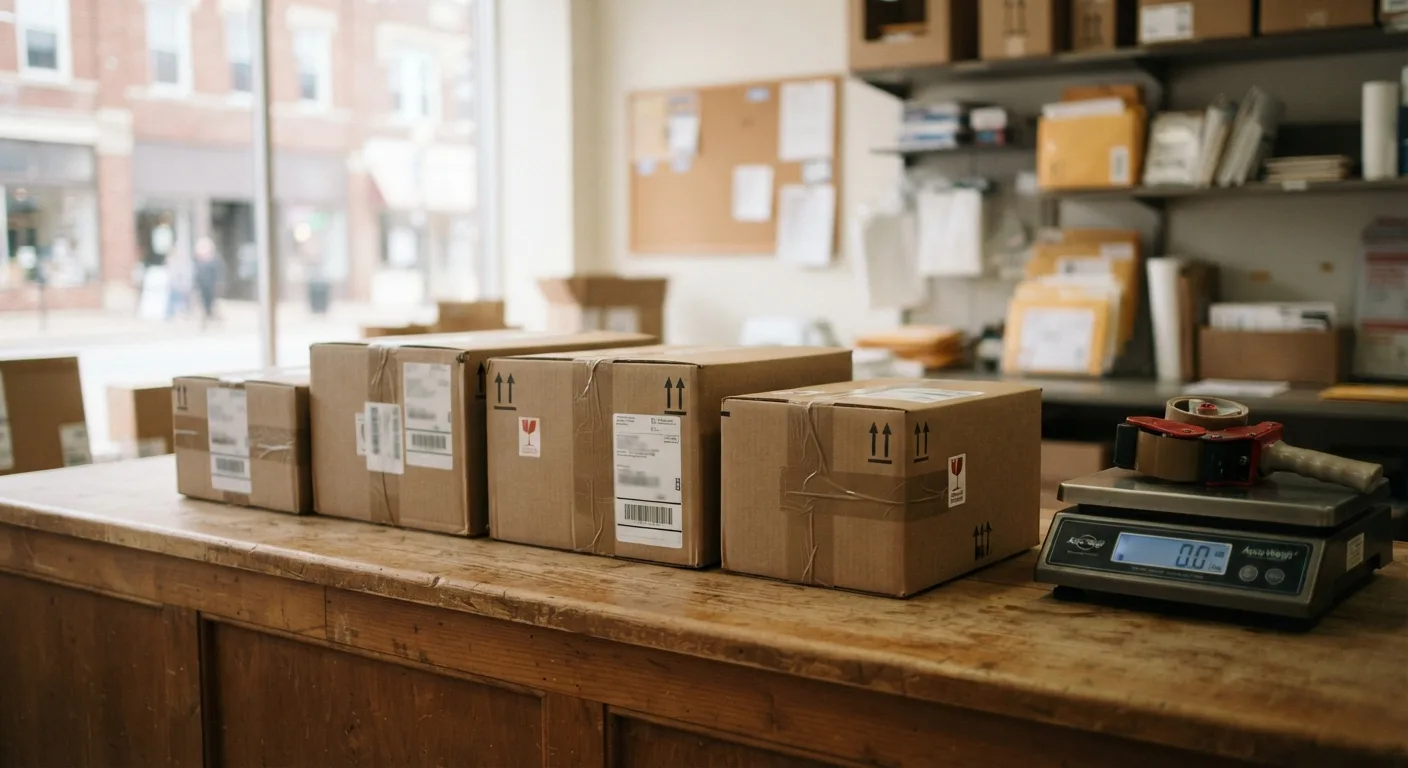
The Headline Is Real. So Is the Math.
You probably saw the headline: UPS is hiring more than 100,000 seasonal workers for the holidays. It sounds like good news: more hands on the sort floor, more drivers on the road, your December covered.
Here is the part the headline doesn't tell you: that number is not a promise to you. It's a confession about the calendar. UPS hires that many people because, every year between late November and early January, the volume moving through its network roughly doubles, and no standing workforce on earth absorbs that quietly. Here is what that math does to your December — and how to get your boxes out before it does.
The Peak Season Squeeze
Reuters reported the announcement on Oct. 7, 2026: more than 100,000 seasonal hires across hundreds of U.S. locations, people who will sort, move, and deliver packages through the rush. The same report carries the reason in one line — during the holiday period, daily volumes tend to double. The same trucks, the same sort floors, the same drivers, the same air cargo space. When a network built for X is handed 2X, it shows: a trailer waiting for a door, a driver waiting on a belt, a package sitting one scan longer because the sort floor is full. It's not laziness. It's twice the boxes moving through the same doors, belts, and trucks.
And this year the surge lands on a leaner network than the one you remember. The more than 100,000 seasonal workers UPS announced it is hiring for 2026 is down from the 125,000 it hired in 2024. In January, UPS said it would cut up to 30,000 operational jobs and close 24 facilities in 2026 as it scales back volume for its largest customer, Amazon, and steers toward more profitable shipments. Those are business decisions that make sense on a spreadsheet — and every one of them removes a little slack from the system your package travels through.
UPS's own announcement leads with automation — new facilities in Denver, St. Paul, Syracuse, and Portland — and with tracking that gives a precise, real-time read on more than 4 billion RFID-enabled packages by the end of 2026. All useful. But a precise read of a stuck box is still a stuck box.
That is the Peak Season Squeeze, and it shows up in small, physical ways: a package that sits an extra day between scans, a pickup that reaches your block an hour later than usual, a trailer that pulls away only when it's finally full — all in the same six weeks you needed yours to move.
What the Rush Does to a Tracking Page
You know this feeling already, even if you've never named it.
You hand off a box on a Thursday afternoon, convinced you're ahead of it. The tracking page says "label created" — and nothing else, all weekend. Monday it shows an origin scan from a state you didn't expect. By Wednesday it has sat in the same regional facility long enough that you know the name of a town you'll never visit. You refresh at a red light. You refresh before bed. The box isn't lost; the page just stopped pretending it can tell you anything.
Now multiply that box by every other one in the trailer it's riding in. That's December. Nobody at the sorting facility is being lazy — the seasonal crew is there, working — UPS says it is hiring more than 100,000 people for exactly this. They're standing in a building where twice as many boxes came in overnight as the trucks can carry out. The tracking page goes quiet not because your box stopped moving but because there are more boxes than scans, more trailers than doors, more packages than hours in the shift.
And if you shipped late — after the surge starts — the fix you reach for is the expensive one: pay for faster service to buy back the days the calendar took. It works, at premium prices — and it's almost always optional.
Twice the Boxes Doesn't Care About Your Deadline
Here is the uncomfortable truth about peak season: your deadline is not one of the inputs.
The network's computers have no field for your mother's birthday, your customer's promise date, or the night of the school pageant. You cannot argue with volume. You can only beat it to the dock. A box shipped in the calm weeks rides a network that still has room for it: the same truck trip it would take in December, minus the waiting.
The people whose packages land calmly in December are not luckier than you. They aren't smarter or more organized, either. They just decided earlier — stopped treating mid-December as shipping season and let November be the deadline. That switch is available to you today, not next year.
The Counter at 7554 Fredle Drive
We ship through this squeeze every year from the counter at 7554 Fredle Drive in Concord Township — in Gristmill Village, just off Crile Road, minutes from SR-44 and I-90. We see the same pattern every fall: the stacks on our counter start calm in early November, then get taller and more panicked as the steepest weeks approach, and we spend late December tracking boxes that needed to move three weeks sooner.
So let's be honest about the news. The announced hiring is real, and the tools UPS announced — RFID tracking on billions of packages, PIN-protected delivery for eligible shipments, better pickup visibility — genuinely help you watch your package. We're glad the network is hiring. But a hundred thousand extra hands sort faster. They don't add a door, a truck, or a day to December. The packages that arrive on time in December are the ones that entered the system with room to spare.
When you bring a box to us, it gets looked at against UPS, FedEx, USPS, and DHL — on price and transit time, for your package, on your date. During peak season that matters more than any other month, because the surcharges and the slowdowns don't hit all four networks equally, and the cheapest label in November is often the wrong label by December 15.
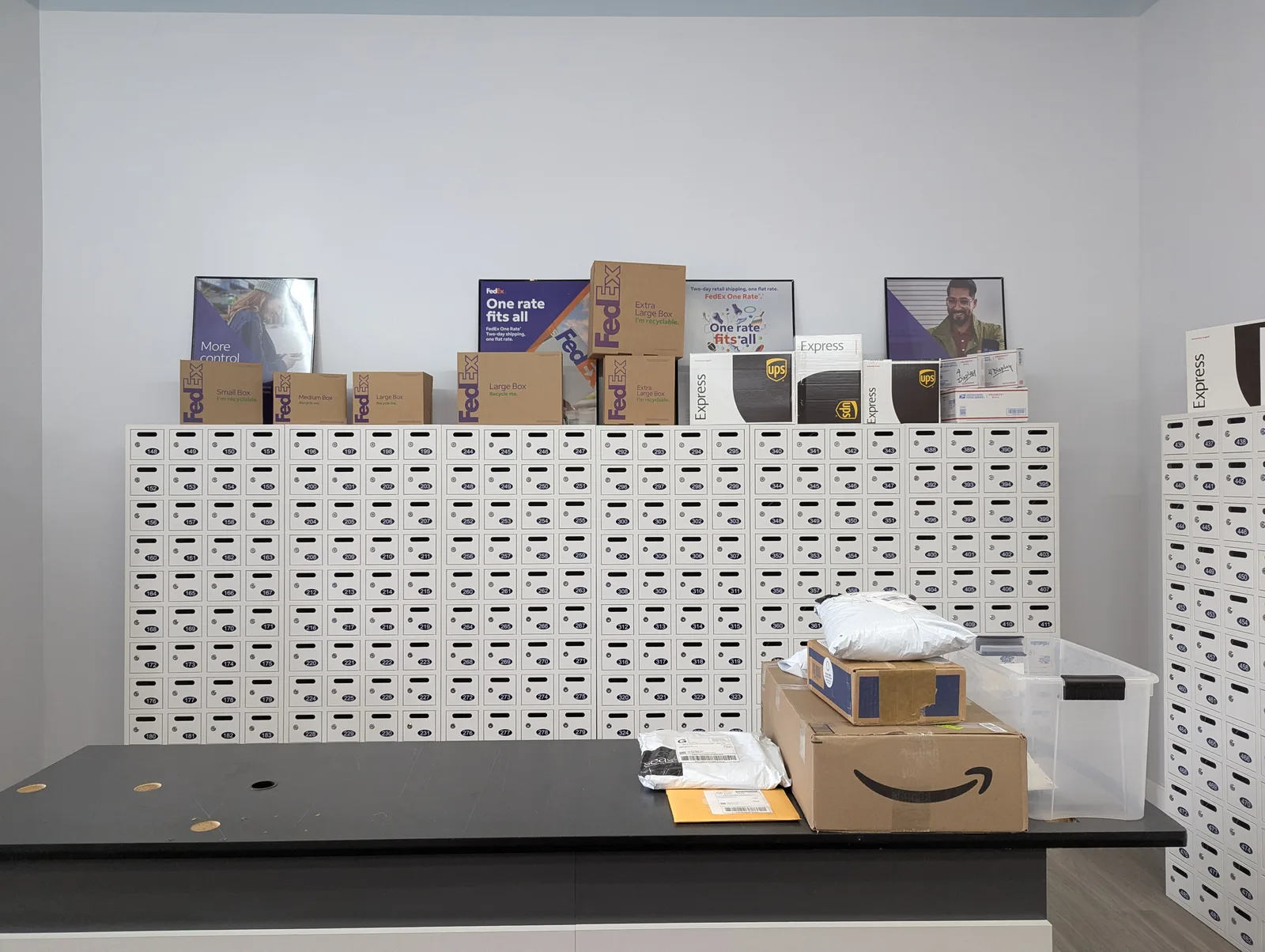
Shipping counter at Mailbox Plus in Concord Township with FedEx, UPS, and USPS shipments staged for pickup
What Actually Happens at the Counter
The process is deliberately boring. No homework, no rate-shopping apps, no spreadsheets.
You bring it in as-is. Gift, product, misshapen hand-me-down, that one weirdly heavy box of books — in whatever state it's in. No forms to fake your way through. If you've ever stood at a shipping counter sweating the questions — "Anything fragile in there? Liquids? Batteries? Do you want to declare a value?" — you know the small dread of looking like you don't know what you're doing. Nobody here is grading you. The questions have to get asked — they're how the box gets packed right — but you can answer them in plain words.
It goes on the scale, and you see all four carriers side by side — before anything prints. Real prices and real transit times for your box and your date, current peak surcharges included — the same published tables that quietly add $11.90 to a mis-sized box during the busiest weeks (more on those in our UPS holiday surcharge breakdown). You choose with your eyes open.
We pack it for the December it's about to live through. Proper box, kraft paper crinkled tight into the corners, the rip of the tape gun, a label that scans clean the first time — because December is hard on boxes, and a packing problem fixed at the counter never has to survive the trailer. Then it goes on the next pickup, and you leave with a receipt and a tracking number instead of a to-do item.
One honesty note, because you'll thank us for it: no honest counter promises you a specific ground delivery date in December, because December belongs to the network, not to any of us. What an early, well-packed, right-carrier box gets you is margin — room for the network to be slow without it costing you the day.
What Waiting Until Black Friday Costs
The squeeze has a price list, and it's public.
UPS's own surcharge calendar runs from Sept. 27 through Jan. 16, 2027. The per-package demand surcharges on ground residential and air services begin Oct. 25. And the steepest stretch — the peak of the peak — runs Nov. 22 through Dec. 26, when additional handling fees reach their $11.90 ceiling and large-package fees touch $117.50. We walked through every line of that table, with the exact dates and amounts, here. The pattern holds across carriers — our 2027 surcharge forecast covers where the fees go from here — and the trend lines all point the same direction: shipping gets more expensive in exactly the weeks you most need to ship.
Then there's the expedite trap. Miss the window and the only way left to make the date is to buy speed — air service, premium tiers, guaranteed-early options — at multiples of what the same box cost in October. You're not paying for faster physics. You're paying to fix a calendar decision three weeks late.
And the quietest cost is the one that never shows on a receipt: the lunch break spent driving to a pickup facility, the box you re-taped twice at the door, the gift that lands on December 27 with its moment gone. Waiting doesn't just risk money. It spends your December.
The First Week of December, Done Early
Now picture the alternative, because it's a real place you can stand.
It's the first week of December. The boxes that matter — the customer orders, the family packages, the thing for your sister in Columbus — are already gone. They left in November, on the right carrier, packed to take a hit, with tracking numbers you checked exactly once, the day they left. The network can double its volume next week and it will not touch you; your boxes are already in the system with room around them, not idling in a trailer yard waiting for a door. You're out ahead of it.
No more "I still have to ship to Dad" running in the back of your head at 11 p.m. No refresh at a red light. It just stops. December becomes what the ads pretend it is: errands that end, evenings that don't involve a scale, a holiday you're actually inside of. The boxes were never the point. Getting to keep the month is the point.
And around here, that version of December starts with a short drive — down Crile Road, into Gristmill Village, the plaza with Pub Frato in it.
Walk In and Ask
You do not need to know carriers, zones, surcharge tables, or cutoff dates. You do not need boxes, tape, or a plan. You need to bring in the thing you need shipped — even the stack, even the awkward one — and put it on the counter.
That's it. We'll take it from there: the comparison, the packing, the label, the handoff to the right truck. You'll leave knowing exactly what it cost, when it left, and how it's moving — and without a single evening lost to a tracking page.
We're at 7554 Fredle Drive in Gristmill Village, next to Pub Frato. Open Monday through Friday, 9:00 AM to 6:00 PM, and Saturdays, 9:00 AM to 2:00 PM. The squeeze starts whether you're ready or not — the earlier you walk in, the more of your December stays yours.
Sources: