The Freeze Nobody Warned You About
It shows up in r/digitalnomad every few months. A traveler, three years into living abroad, logs into their bank app one morning and the accounts are gone. Not overdrawn. Not suspicious transactions. Closed — because of an address.
In the version people actually post about, the account belonged to a household-name credit card issuer, and the address on file belonged to a popular mail-forwarding service. The poster's theory, echoed by dozens of commenters: the bank's system flagged the forwarding address itself. Whether or not that exact theory is right, the pattern is real — and it's why so many expats and nomads now worry about the one thing they used to ignore: what their US address looks like to a bank.
Here's the honest part up front. Nobody can promise you that any single address will satisfy every bank forever — banks make their own decisions, and this article is not legal or financial advice. But there is a meaningful difference between an address that looks like a forwarding service and an address you can actually document. That difference is the whole story.
Why Banks Care About Where Your Mail Goes
When you open or keep a US bank account, brokerage, or credit card while living abroad, the institution runs your address through automated verification. These checks come from the same anti-money-laundering and know-your-customer rules that govern every US financial account. The software isn't judging whether you're a nice person. It's checking one thing: does this address look like a legitimate place a person actually receives mail?
That's where mail-forwarding services run into trouble. The United States Postal Service classifies private mailbox businesses as Commercial Mail Receiving Agencies (CMRAs) — a specific, searchable category. Address verification databases used by financial institutions flag addresses against that CMRA list, along with a Residential Delivery Indicator that says whether the address reads as commercial or residential. An address that comes back flagged can get rejected as a primary address of record, or trigger a "confirm your address" hold that you can't easily clear from another country.
None of this is a secret backdoor. It's how the system is designed to work — and it's exactly why the address you choose matters more than the monthly fee you pay for it.
The Honest Truth About Every Mailbox Service
Before we go further, one thing needs to be said plainly, because anyone who implies otherwise is selling you something: every private mailbox service in the United States — Mailbox Plus included — is a CMRA. That's not a loophole we found; it's the law. Any business that receives USPS mail on your behalf has to register as a CMRA and keep a USPS Form 1583 on file for every mailbox holder. If a service tells you it's "not a CMRA," it's either confused or it isn't actually handling your mail the legal way.
So the real question was never "CMRA or not." Every option on the table — the national forwarder, the big-box store, the local shop — sits in the same USPS category. The question that actually matters is what that address looks like when a bank's verification system looks at it, and what you can do to prove it's yours when a human looks at it.
The Address You Can Document
Here's where the difference gets concrete.
A national forwarding service rents mailbox space from partner stores all over the country and assigns you one. Thousands of customers share that single address. The same address appears across thousands of accounts, in multiple names, with no consistent story attached. To an automated system, that address pattern is indistinguishable from a mail drop — because functionally, that's what it is.
A real, staffed local mailbox is different in a way you can point to:
- It's a physical place you can walk into. The address is a storefront on a real street — for us, 7554 Fredle Drive in Concord Township, Ohio — not a suite number in an aggregator's database.
- It has a person behind the counter who knows you. When a bank's verification team calls or a courier needs a signature, there's a human being who can confirm the address, confirm your box, and confirm your mail — not a phone tree.
- It's an address you can document with paperwork. Your Form 1583 is on file, your ID was verified in person, and you can produce receipts, forwarding labels, and correspondence showing you actually use the address. "Care of a forwarding service in South Dakota" is hard to defend. "A mailbox I've rented at a store in Ohio for three years" is a story with evidence.
- It's used consistently. One address for banking, cards, brokerage, IRS mail, and packages — the same address, year after year — looks like a person's address. A new forwarding address that appears out of nowhere, shared by thousands, does not.
That's the honest version of "an address banks won't flag." Not a guarantee — a defense.
How a Nomad's Mailbox Actually Works
Here's the practical version, from the Mailbox Plus side of the counter.
You set up a mailbox at 7554 Fredle Drive, Concord Township, OH 44077 — about ten minutes with two forms of ID and the same USPS Form 1583 every licensed service uses. Your address is a real street address, not a PO box number, so all four carriers — USPS, UPS, FedEx, and DHL — can deliver, and we sign for packages that would otherwise sit on a porch in a country you're not in.
Then you leave. That's the whole trick — nothing else changes.
While you're abroad, our virtual mailbox service handles the day-to-day:
- Mail arrives and we scan the envelope — typically within four hours — and upload it to your portal.
- You see everything from your phone, wherever in the world you are. No guessing what's in the pile; no asking a relative to open your statements.
- You decide what happens next. Tell us to scan the contents, hold it, shred it, or forward it — one click. Banks' letters, IRS notices, replacement cards, and the occasional physical check all get handled on your schedule, not the mail's.
- We consolidate and forward anywhere on earth. When you want the actual documents — not just scans — we bundle them and send them via UPS, FedEx, DHL, or USPS to wherever you are. Weekly, bi-weekly, monthly, or just when you call.
The digital layer is the same technology the national services sell — in fact, we partner with iPostal1, Anytime Mailbox, and PostScan Mail for the portal itself. The difference is what sits behind it: a staffed local store in Lake County where your address is a real place, your mail is signed for by a human, and your Form 1583 is on file with a business you can call.
What It Costs to Get It Wrong
Let's make the stakes concrete, because the failure mode is rarely dramatic — it's a slow leak that starts with a hold.
- The credit card issuer that pauses your account for "address confirmation" while you're in a time zone twelve hours off — and the two-week phone gauntlet to prove you're you.
- The brokerage that rejects a flagged address as your primary of record, right when you need to move money.
- The replacement card or statement that never arrives because it was sent somewhere the system no longer trusts.
- The IRS letter with a deadline, sitting unopened in a relative's spare room, while the penalty clock runs.
- The freeze itself — the exact scenario from the top of this article: accounts closed, funds in limbo, and a support team that can't explain what "flagged" means.
Each one is survivable on its own. Together, they're the tax you pay for an address that can't be defended when it matters.
The Version Where It Works
Now the version where it works.
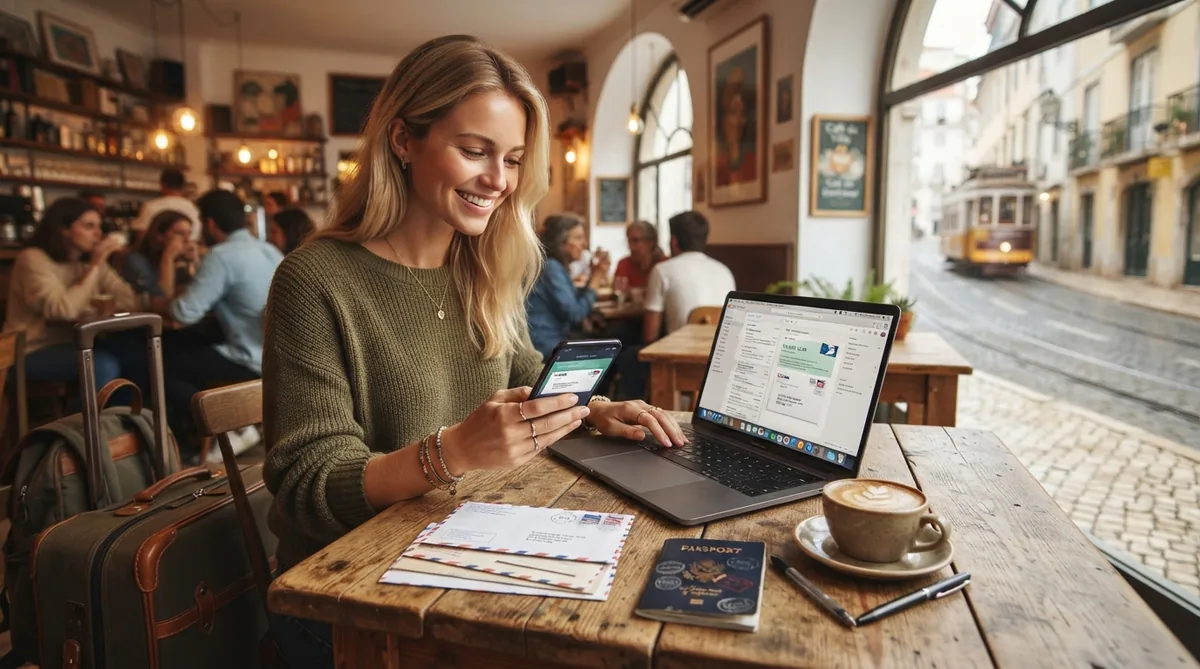
You're in Lisbon, or Bangkok, or Medellín. Your phone buzzes: the envelope from the IRS arrived, scanned, uploaded — it's the notice you've been expecting. One tap, it's forwarded. The replacement debit card arrives at the store in Concord, gets signed for, and sits in your box until you say send it. Your bank on the other side of the ocean sees a stable, documented Ohio address — a real street, a real business, a real you.
You're not thinking about your mail. That's the point.
Set It Up Before You Board the Plane
Ten minutes, two forms of ID, and the address you keep for years — not the address you lose when you cross a border. Start with our virtual mailbox page for the full rundown on scanning, forwarding, and pricing, or stop by 7554 Fredle Drive in Concord Township before you leave. If you just need a stable personal address for packages and mail while you travel, our private mailbox rental page covers that option.
If you're still weighing a PO box against a real address, Private Mailbox vs PO Box: Which Is Better for Your Business? covers the carrier and delivery differences that matter even more when you're not around to collect things. And when you're ready to manage it all remotely, the digital mailbox option walks through the portal — scans, shred requests, and one-click forwarding from anywhere.
One honest caveat, repeated: no mailbox service can guarantee what a bank will do. What a real local mailbox gives you is the address that survives the questions — the one you can document, walk into, and defend. That's the whole job, and it's the one that matters when you're 6,000 miles away.