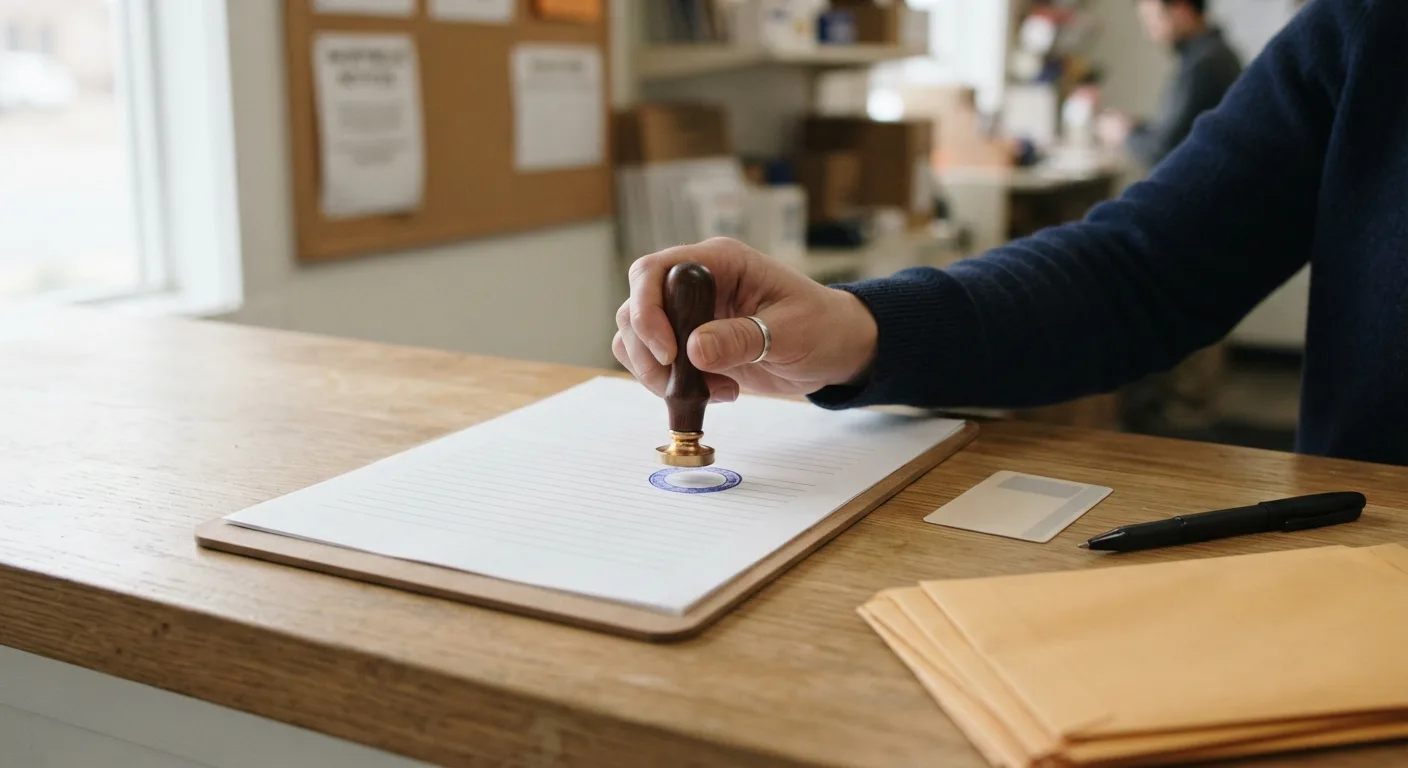
The Fine Print You Never Got
You found out the hard way: the document is ready, the deadline is real, and the notary is not. The bank down the road posts "Notary Available" in the lobby window, then the desk clerk tells you they only notarize for account holders — or only on Tuesday mornings. The office store wants an appointment slot three days out. Your signature takes forty-five seconds; the access takes a week.
It should work the other way. A notarization is a simple legal act — you appear, you prove who you are, you sign, the notary stamps. The whole thing takes minutes when a notary is actually on duty. This guide walks through where walk-in notarizations actually happen in Ohio, what the law lets notaries charge, what ID to bring, and how to tell before you drive anywhere whether the counter can help you.
The Appointment Wall in Plain Daylight
The obstacle is not the law. Ohio law makes a notarization easy to complete and cheap — the state caps the notarial-act fee at $5, and the identification rules are printed in plain English in the Revised Code (see the complete Ohio notary guide for the full rulebook). The obstacle is how notary desks get staffed.
Banks and large retail chains usually treat notary work as a courtesy add-on, not a service — the same pattern behind the notary runaround regulars already know. A specific employee holds the commission, that employee keeps banker's hours, and the desk closes when that person is at lunch, on vacation, or off for the day. You are not turned away by policy in writing — you are turned away by scheduling. The same mechanism runs in the other direction at banks: many reserve the courtesy for their own account holders, because the notary is on their payroll and the bank has no obligation to the general public. Neither arrangement is illegal. Both mean the person standing in front of them — you, with a finished document and a deadline — is not the customer that desk was built for. That is why the lobby sign says "Notary Available" while the desk says account holders only.
You've Done This Math Before
Picture the actual sequence. You print the power-of-attorney packet at home. You drive to the branch where your checking account lives. The parking lot is half full — good sign. Inside, the line is four people deep, and the person ahead of you is depositing a stack of coins. When you reach the desk, the answer is not "no" — it is worse: "Our notary is in until 2:00, but she stepped out. Can you come back Thursday?"
You just spent a lunch break and a gallon of gas to learn nothing you could have learned on the phone. And if the document is time-sensitive — a title transfer with a dealer waiting, a school travel form due tomorrow morning — "come back Thursday" is the same as no. You shift your weight, thank the clerk in the tone people use when they are not thankful, and walk out still holding the same unsigned paper.
The second attempt is where the real cost lands. You take time off work, or you burn a Saturday, because you cannot afford a third unknown. The errand that the law designed to be quick becomes a half-day project.
What the Counter Knows and Can't Say
Here is the part that stings. The rules that decide whether your notarization goes through are short, public, and identical at every notary desk in Ohio. The Secretary of State publishes them. Any clerk who has performed ten notarizations knows them cold. Nobody at the appointment-only desks is hiding the process — it just is not their job to route you to the counter that can actually take you today.
So you leave knowing less than the person who turned you away. The clerk knows the form numbers cold; you don't. That's the only gap — and it closes the moment you're at a counter built for walk-ins.
What the Clerks Behind the Counter Know
Walk into a counter staffed by working notaries — an independent shipping and mailbox center, for instance — and the experience inverts. At Mailbox Plus on Fredle Drive in Concord Township, notary service is a standing part of the business, available on a walk-in basis during store hours: Monday through Friday 9:00 AM to 6:00 PM, Saturday 9:00 AM to 2:00 PM. No account. No appointment. You bring the document, we witness and stamp it, and you are back in the car.
That counter independence matters beyond notary work. The same people who handle your signature handle UPS, FedEx, USPS, and DHL shipping, mailbox rentals, and document scanning every day. When a signature page also needs two copies, an envelope, and a certified-mail trip, it all happens at one counter instead of three errands.
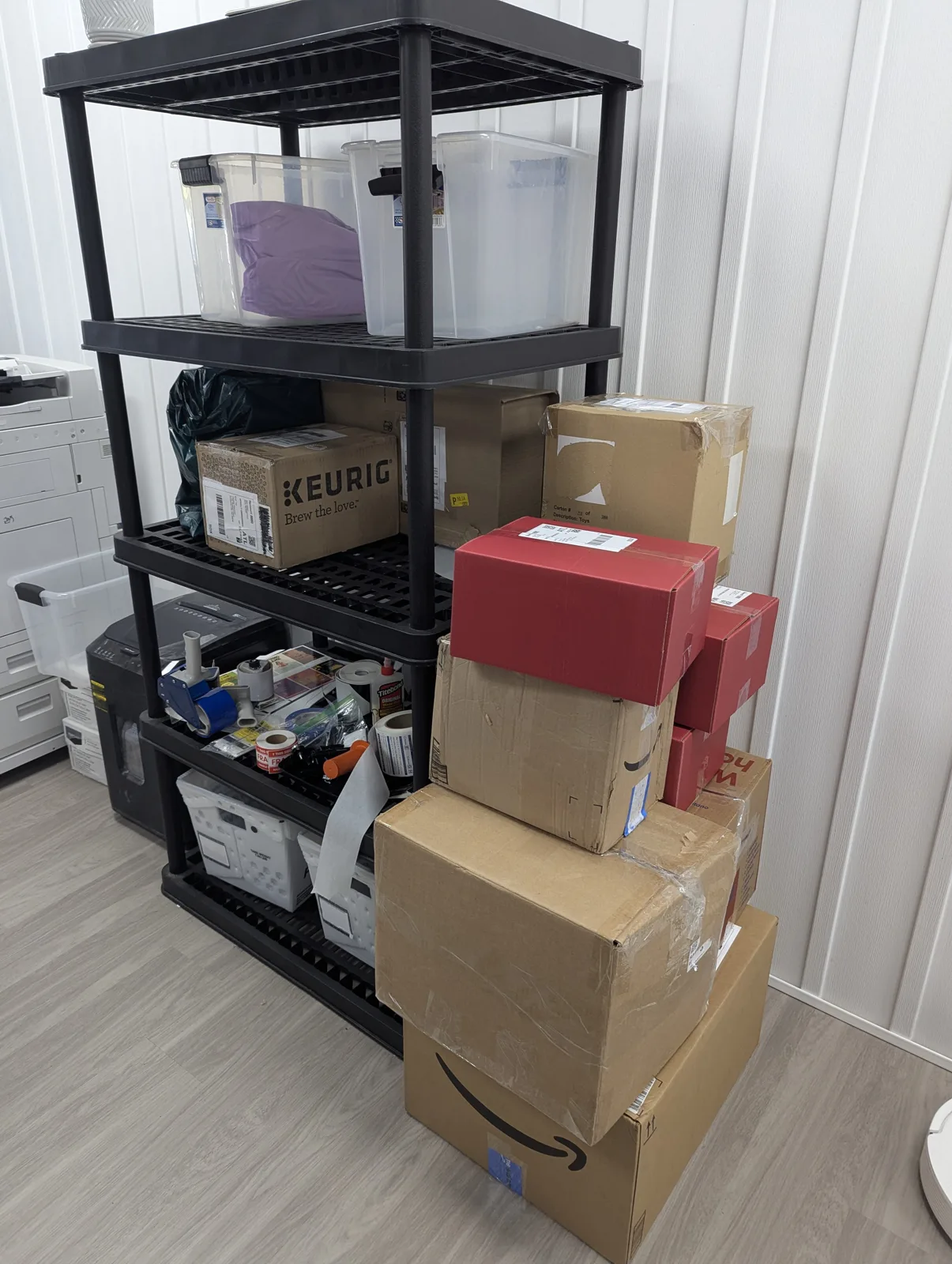
The commercial copier and print station at Mailbox Plus in Concord Township, Ohio, beside the packing bench where documents get scanned, copied, and emailed
The Honest Comparison
Every walk-in option has a real use case. None of them is right for every document. Here is the fair breakdown.
Your bank. If you already bank there, this is often the cheapest route — many banks waive the fee for their own customers. The tradeoffs are scheduling and scope: hours track the branch, the commissioned employee may not be on duty, and policies vary branch to branch. Call ahead with your document type before you drive.
Large shipping-franchise stores. Many offer notary service, but availability is store-specific — hours, staffing, and appointment policy change location by location. Treat the national brand as no guarantee of a walk-in desk at your local store, and phone the specific store first.
Independent shipping and mailbox centers. Notary service is part of the core business rather than a lobby courtesy, which is what makes regular walk-in hours possible. In Ohio, the statutory fee cap applies everywhere, so the price difference between options is smaller than the availability difference — the real question is who has a notary on duty when you show up.
Online notarization. Ohio law also allows remote online notarization — the notary and signer meet by two-way audio-video at a higher statutory fee (ORC 147.08). It solves the travel problem, but it requires the right documents, an online platform, and identity verification steps. For a single-page form due today, driving to a live counter is usually simpler.
What Actually Happens at the Counter
Walk-in notarization is three steps, and none of them are homework.
- Walk in with your document and your ID — leave it unsigned, since a jurat must be signed in front of the notary. Bring a passport, driver's license, or other government-issued ID with your photo or signature, current or expired no more than three years (ORC 147.50).
- Sign as the certificate requires. For a jurat, you sign in the notary's presence. For an acknowledgment, you may have signed already and simply confirm the signature is yours. The notary then completes the notarial certificate — the state, county, date, and their seal and commission date, per ORC 147.542.
- Pay and go. The notarial-act fee is capped by Ohio law at $5 per act (ORC 147.08), and it cannot be calculated per signature. Ask at the counter about any additional services — copies, envelopes, outbound shipping — before you commit.
One warning that saves second trips: the notary cannot choose the notarization type for you. Ohio notaries may explain the difference between an acknowledgment and a jurat, but only attorneys can advise which one your document needs. If your paperwork does not specify, ask the document's issuer which wording it requires before you walk in.
What All This Adds Up To
Stay in the appointment maze and you pay three ways. Time: a half-day errand for a forty-five-second signature, repeated once or twice when the desk is closed. Money: the statute caps the act fee at $5, but nobody refunds the lunch hour, the fuel, or the second drive. Deadline risk: the document that "just needs a stamp" holds up a title transfer, a closing, a school trip, or a healthcare decision — and the delay is never your fault, but it is always your problem.
The mental drag compounds it. An errand you cannot schedule with confidence is an errand you postpone — and postponed legal paperwork is the kind that turns a small task into a small emergency.
What Regulars Do Instead
Once you find a counter that keeps walk-in hours, the errand changes shape. You finish the document at home in the evening. Next morning on the way to work you turn onto Fredle Drive in Concord Township — just off Crile Road, minutes from SR-44 and I-90 — park, and carry the page inside with your license. A few minutes later the seal is on the paper, the copies are made, and the envelope is either in your hand or already on a UPS truck. The clock in the car says you are behind schedule for work — except you are not, because the whole stop cost minutes, not a morning.
That is what the process feels like when the desk was built for walk-ins in the first place. The signature was never the hard part.
You Don't Have to Figure It Out First
You do not need to know which notarial certificate your document needs, whether it counts as an acknowledgment or a jurat, or how many copies to bring before you walk in. Bring the document, bring your ID, leave it unsigned, and tell the counter what it is for. Figuring out the rest is what a working notary desk is for — that is the entire point of keeping walk-in hours.
If the paper is ready and the deadline is real, the counter at Mailbox Plus, 7554 Fredle Drive in Concord Township, takes walk-ins during store hours — Monday through Friday 9:00 AM to 6:00 PM, Saturday 9:00 AM to 2:00 PM. Call 440-709-1946 if you want to confirm a notary is on duty before you drive. Bring the mess; the stamp is the easy part.