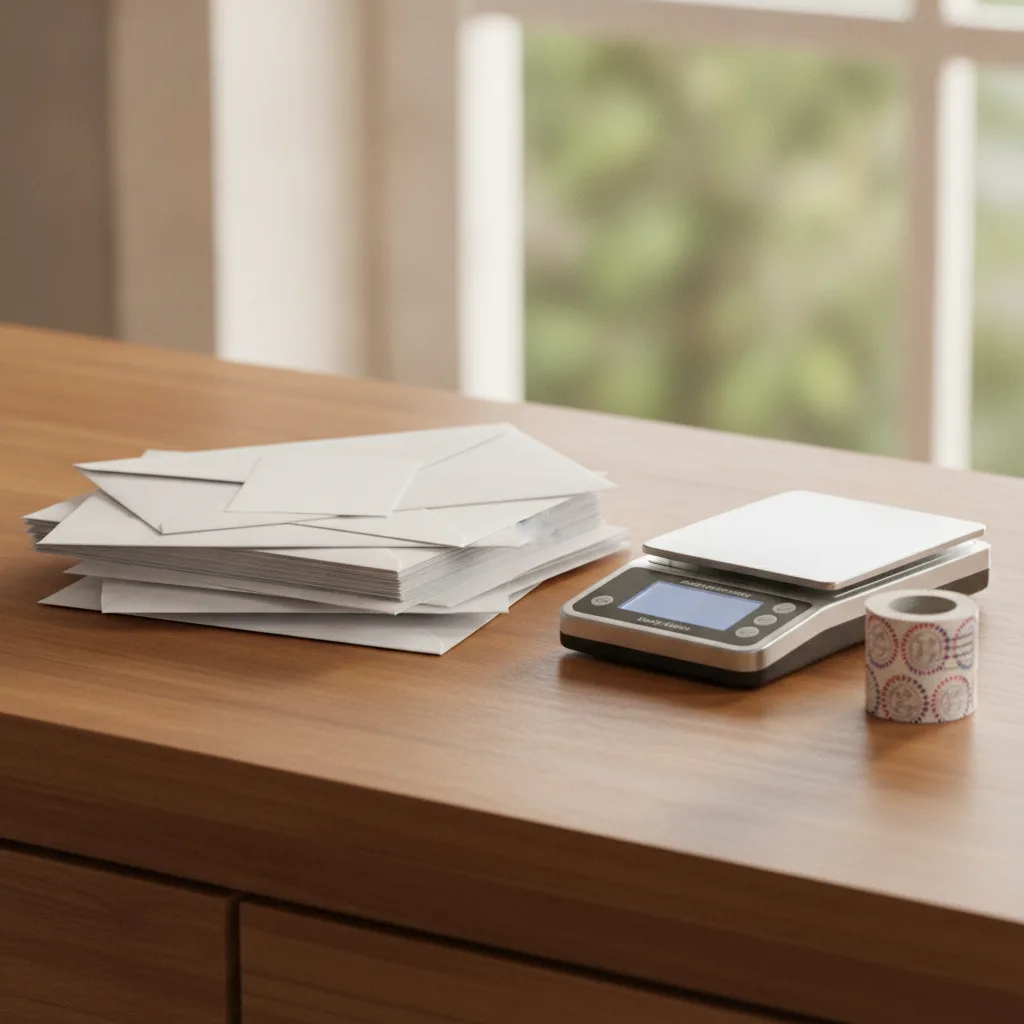
The Fine Print You Never Got
You mailed a letter last month with one stamp. It arrived. So this month you did the same thing — same envelope, one more card tucked in — and it came back with a yellow sticker about insufficient postage. Nobody told you a Forever stamp covers an ounce, not an envelope, and nobody weighed it before you sealed it.
It should work the way the name implies: one stamp, one letter, done. You bought the stamp at the current price, the price is printed in your memory, and "Forever" sounds like a promise that the answer never changes.
Here's how it actually works, and how to check any envelope in about thirty seconds instead of guessing. The stamp price is one number. The postage your letter owes is a different number, and the gap between them is where returned mail and wasted money live.
The Machine Behind The Ounce Trap
The systemic problem here isn't the postal clerk or the stamp itself. It's a pricing system built around one question machines can answer cheaply: can a sorting machine run this envelope at speed?
That question splits every letter into two categories, and the split is invisible until it costs you money.
The first category is machinable mail: a standard rectangular envelope, flexible, flat, nothing sticking out. For those, price is a weight ladder. As of the July 12, 2026 rate change, a one-ounce letter costs 82 cents, a two-ounce letter $1.11, a three-ounce letter $1.40, and three and a half ounces $1.69. Each additional ounce past the first adds 29 cents. That ladder is the entire pricing model for stamped letters.
The second category is nonmachinable mail — and this is where the trap sits. Anything a machine can't safely process pays a 49-cent surcharge, even at one ounce. Square envelopes. Vertical orientation. Rigid stiff envelopes. Lumpy envelopes with objects inside. Clasps, strings, or buttons. Envelopes addressed parallel to the short edge. Any one of those characteristics, and your 1-ounce card owes $1.31 instead of 82 cents — a 60 percent premium for a shape.
Then there's the ceiling. First-Class letters stop at 3.5 ounces. A thicker envelope doesn't cost a little more as a letter — it becomes a different class of mail entirely. From 4 ounces, you're in large-envelope (flat) pricing: $2.56 at 4 ounces, climbing to $5.24 at 13 ounces. And a large envelope that's rigid, nonrectangular, or not uniformly thick doesn't price as a flat at all — it pays parcel prices, which start higher again.
So the machine's rules stack like this: weight ladder, then shape surcharge, then class boundary. Miss any one of the three and the postage you stuck on is a guess, not an answer.
The Feeling Every Regular Recognizes
You've done the math in a checkout line before. Envelope in one hand, stamps in the other, trying to remember whether the invitation with the raised lining needs one stamp or two. You don't own a scale. The envelope is sealed, which means you can't add paper or remove it. So you put on two stamps and hope. Your hand hovers over the mailbox slot. You let go anyway.
Hoping has two failure modes, and both sting differently.
Under-post, and the letter comes back days later — the yellow sticker is on your kitchen counter, and you're on the phone explaining why their payment is late. Over-post, and nothing comes back. You never find out you paid $1.64 to mail something that cost $1.11, because the difference is collected silently. Fifty-three cents is nothing once. It's a different number when you're mailing fifty greeting cards in December, or invoices every week, and the rounding error becomes a standing tax on your guesswork.
And there's the special sting of the returned item: the sticker. "Returned for postage" means the system measured your envelope after you were gone, applied rules you never saw, and sent it home to explain itself. You weren't wrong about anything you could see. You just couldn't see the scale.
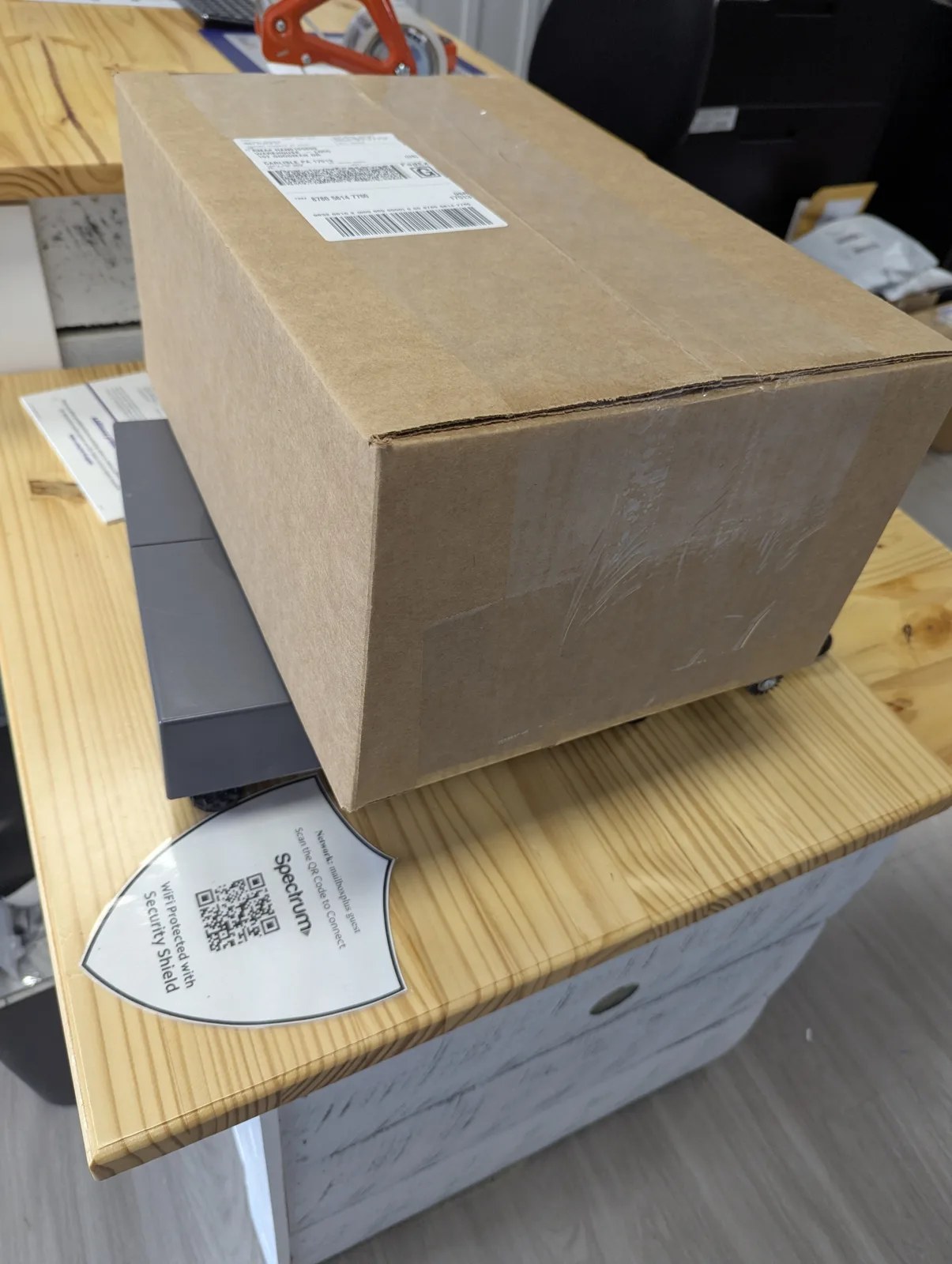
A sealed envelope on the parcel scale at the Mailbox Plus counter in Concord Township, where exact postage gets quoted before anything ships.
The Assumption Nobody Questions
The assumption is that "Forever" means "always enough." It's a brilliant product name, and it's true — but only in a narrow sense the name doesn't spell out.
A Forever stamp is always valid for the first ounce of First-Class letter postage, no matter what you paid for it or how far rates climb later. Stamps bought years ago mail a letter today right alongside stamps bought this month. Nothing expires. That part of the promise is real, and it's why Forever stamps are still the right thing to keep in the drawer.
What the name doesn't promise: that one stamp covers one envelope. It covers one ounce. A thick greeting card, a padded invitation, a birthday card with a gift card taped inside — those aren't 1-ounce mail, and no stamp design changes that. The second assumption people never question: that shape is free. It isn't. The 49-cent surcharge applies to a square envelope even when it weighs less than an ounce, because hand-canceling costs the Postal Service real labor, and they price it back to you.
Rates also move. The Postal Service now files price changes in twice-yearly cycles — January 2026 left the stamp untouched, and July 12, 2026 took it from 78 to 82 cents (how the rate increases work). Nobody outside the process can tell you the next one's date or size, which is exactly why "one stamp per envelope, forever" is a memory rather than a rule.
Inside a Store That Isn't a Franchise
Here's the part that fixes the guessing: there's a scale at our counter at 7554 Fredle Drive in Concord Township — Gristmill Village, next to Pub Frato, just off Crile Road — and using it takes less time than explaining the problem. You hand the envelope across the counter the way it is, and you leave with the answer instead of a bet.
We're an independent postal store, not a franchise, and not a post office lobby with one clerk and a line out the door. You bring the envelope sealed, the way it is. We put it on the scale, check its dimensions against the letter, flat, and parcel rules, and tell you the exact postage before you pay. If it's 1.2 ounces, you owe 82 cents plus a 29-cent additional-ounce stamp — not two Forever stamps. If it's square, we tell you it owes the 49-cent surcharge so the card doesn't boomerang back the week of the event. If it crossed the 3.5-ounce letter ceiling, you find out here, at the counter, with options — instead of finding out via a yellow sticker.
We stock Forever stamps and additional-ounce stamps individually, so you can buy exactly the difference you need instead of rounding up. And when the next rate change lands — whenever it lands — the number we quote you at the scale is the current one, not the one from when you bought your stamp roll.
Zero Homework: Three Steps at the Counter
- Bring the envelope sealed. Don't weigh it at home, don't look up a stamp chart, don't unseal and reseal. The envelope as it will actually travel is the thing that gets measured — contents, stiffness, shape and all.
- We put it on the scale and check the shape. Weight against the 82-cent / $1.11 / $1.40 / $1.69 letter ladder, dimensions against the nonmachinable list, thickness against the 3.5-ounce letter ceiling. One pass, all three rules.
- You pay exact postage. One Forever stamp, or a Forever plus additional-ounce stamps, or a flat rate — whatever the envelope actually owes. No rounding up to the next whole stamp, and no guessing what the counter will say.
That's it. The scale and the rules live at the counter; you bring the letter.
What Nobody Tells You You're Paying
Stay in guesswork mode and the costs are quiet but steady.
Money. Two Forever stamps on every 2-ounce letter is 53 cents of drift per envelope. Mail forty greeting cards or invoices a month and that's over $21 a month vanishing into overpaid postage — more than $250 a year if your volume holds. The surcharge miss is worse per incident: a $1.31 requirement shorted to 82 cents means a returned invitation, a reprint, a re-mail, and an apology call.
Time. A returned letter costs a round trip you didn't plan: open, re-post, re-mail, and days of delay stacked on top. If the envelope held anything deadline-bound — a payment, a form, a permit — the delay is the expensive part, and no refund covers it.
The standing dread. This is the part nobody prices: the hesitation at the mailbox. Your hand hovers over the slot with something thicker than a flat sheet, you let go anyway, and three days later you're calling someone to explain why their invitation never showed. A ten-second task becomes a recurring low-grade bet you keep losing in public. Multiply that by every envelope you'll mail this year and the guesswork tax is mostly paid in attention, not cents.
The Trip That Clears Your Head
Next time, it's different. You're heading up Crile Road with a stack of sealed envelopes in the passenger seat — the wedding invites, the thick birthday card, the square thank-you notes. You pull into Gristmill Village, park next to Pub Frato, and walk them in as one pile.
The scale does the thinking. The square ones get flagged, the thick card gets its additional ounce, the plain ones get one stamp each and you're done. Nothing left the counter on a guess, so there's no sticker waiting to correct it at the other end. And the drawer at home still holds a roll of Forever stamps — which never expire, and which we can top off with exact additional postage any time.
The feeling isn't triumph. You just stop bracing at the mailbox. The stack that used to be a puzzle you solved alone becomes a thing you hand to a scale, and your week has one fewer open question rattling around in it.
Next to Pub Frato in Gristmill Village
Bring the envelopes exactly as they are — sealed, lumpy, square, whatever the last person's handwriting did to them. You don't need to know the weight, the surcharge rules, or the current rate ladder. That's literally what the counter scale is for.
Stop by Mailbox Plus at 7554 Fredle Drive in Concord Township — Gristmill Village, next to Pub Frato, just off Crile Road, minutes from SR-44 and I-90 — and put the stack on the scale. We'll tell you what each one owes, sell you the exact stamps, and you leave with postage that matches what the scale says instead of what you hoped. And if the drawer at home is also where your stamps live while your household mail gets sorted elsewhere, a private mailbox keeps that side of the system measured too.