Your Postage Price Is About to Get a Weekly Refresh
If you sell online, you already budget shipping to the penny. You know what a Ground Advantage label costs on a two-pound box to your most common zones, and you build that number into your prices. Starting in January 2027, USPS plans to make that number move — every single week. The Postal Service announced on October 26, 2026 that it will add a fuel surcharge to its package services, recalculated weekly from government-published diesel and jet fuel prices. It should be simple: one label, one price, known when you buy it. A price that drifts with the fuel market is none of those things.
The Weekly Shuffle
For years, USPS charged no fuel surcharge on these products — that is the part that changes in January 2027. FedEx and UPS publish fuel surcharges that update weekly against the same Energy Information Administration price indexes — if you have ever wondered why two ground labels cost different totals in the same week, that table is part of the answer. We covered that mechanism already in our fuel-surcharge explainer: most of what you pay above the base rate was set by the carriers, not by diesel.
Now USPS is joining them. According to the Fuel Surcharge Implementation FAQ the agency posted on PostalPro, the new surcharge applies to domestic Ground Advantage, Parcel Select, Priority Mail, and Priority Mail Express — including the matching return services — for retail and commercial shipments alike. Ground Advantage and Parcel Select prices follow diesel. Priority Mail and Priority Mail Express follow jet fuel. The surcharge is a percentage of base postage only, and the percentage can rise or fall every week.
Look closely at the fine print, because that is where the shuffle lives. USPS says it will publish each new percentage just three to five days before it takes effect on diesel-based services, and three to four days ahead on jet-fuel services. There is no announced starting percentage, no formula, and no stated minimum or maximum. And per the FAQ, a package mailed with a label bought at last week's percentage is subject to postage due.
There is a wrinkle worth knowing: two days after USPS published the FAQ, it pulled it from PostalPro. No explanation was given, and it is not clear whether the removal signals any change to the plan. So treat everything here as the plan as announced in late October 2026 — not as settled fact. That is precisely the problem with a weekly price: even the plan itself moves.
What Lands on Your Desk
Here is what this looks like from your side of the screen. You list an item at $24 with free shipping, priced off last month's label. A buyer orders. You print the label — and the fuel percentage underneath it changed four days ago, silently. Maybe it is a hair cheaper. Maybe it is not. Either way, the margin you calculated is now a guess you already sold.
Sellers shipping through marketplaces have spent 2026 getting hammered by exactly this: negotiated Ground Advantage discounts that appeared without warning in June, targeted increases in July, September changes that hit certain rates with a single day's notice, then October's geographic pricing groups and holiday increases stacked on top. One shipping-software company publicly stopped sending routine rate-change alerts because carriers now change prices multiple times a week. The weekly fuel fee does not just add a cost — it adds a cost that re-arms itself every seven days, on top of a schedule that is already hard to track.
And the pressure behind it is not easing. USPS raised package revenue 7.7% year over year in fiscal Q3 2026 even while package volume fell 3.4% — rates, not demand, are doing the work. The agency posted a $2.5 billion net loss that same quarter. When the Postal Service called its temporary 8% price increase "a necessary bridge to a permanent mechanism" back in March, this weekly fee is the bridge landing on the other side.
Why a Price You Cannot Predict Is Not a Price
You quoted one number on Tuesday. On Friday, the label prints a different one — higher. That is not a price; that is a moving target you already sold.
The old fuel-surcharge model at least had a rhythm you could learn: rates changed on schedule, the tables were published, and the bigger driver of increases turned out to be the carriers themselves. The weekly model removes even the rhythm. When USPS framed its 8% increase as less than one-third of what competitors charge for fuel alone, it was making a fairness argument — and maybe a fair one. But the mechanism it chose to close that gap is one where you find out the new number a few days before you pay it, with no ceiling published and no floor.
You did not do anything wrong here. You did not misprice your items or misread the rate chart. The system changed under the price, which is exactly the kind of thing a counter is for.
What We See From the Counter
We ship USPS, UPS, and FedEx from the same counter at 7554 Fredle Drive in Concord Township, every day, for eBay and Etsy sellers, small businesses, and neighbors mailing one box. We are an independent multi-carrier counter — no single carrier sets our recommendations. We watch these tables move all year — and we watch what they do to people who budget per order.
Here is the part that matters to you: the weekly shuffle is our problem to track, not yours. Because we are an independent multi-carrier counter, when the fuel percentage moves on UPS, FedEx, or USPS, our job is to lay the numbers side by side. We quote each carrier's price for the day — fees included — before you decide. If USPS looks like the expensive lane for your box this week, we will say so, and we will show you what the other two charge. You get one number, current as of the moment it prints, for the carrier that actually wins your shipment.
Here is the odd gift in this: with USPS joining the weekly fee model, the cheapest lane now changes week to week. Checking which lane wins for your actual box is what we do at the counter before you decide.
How to Ship Through the Shuffle
You do not need a spreadsheet or an API subscription. Three steps:
- Stop pre-committing to a rate. If you offer free or flat-rate shipping, build a cushion that assumes the number moves, or switch to calculated shipping so the charge tracks reality.
- Bring the box to the counter. No homework, no carrier tabs open — we weigh it, and we quote all three carriers at their current, full rates.
- Pick the lane and hand it over. Labels, forms, drop-offs, the whole thing handled in one stop — with the price you agreed to, not the price from four days ago.
What Guessing Costs You
Run the math on a guess. If your shipping cushion is off by even a small amount per order, and you ship a few hundred packages through a season, the shortfall comes straight out of the same margin you use to restock inventory. And the failure mode is not just overpaying — it is postage due on a package mailed at last week's percentage, which means an interrupted delivery and an annoyed customer, over a fee you never saw.
There is a quieter cost too. It is 9:40 p.m. and you are back on the rate page, coffee cold, comparing this week's fuel table to last week's — while the orders you could be sourcing and listing sit in a pile. The carriers changed the price; they do not get your evening too.
The Label That Is Right This Week
Here is the afternoon that changes. You finish packing orders on your schedule, drive to the shop next to Pub Frato in Gristmill Village, Concord Township, and set the stack on the counter. We weigh, quote all three carriers at today's full rates, and you pick. The label that prints carries the number you just saw — not last week's, not a formula you have to reconstruct. Nothing about fuel indexes follows you home. That silence in your head, where the rate-table anxiety used to be, is the actual product.
Bring Us the Box, Not the Math
You do not need to know which carrier's fuel table moved this week, and you do not need to have anything pre-measured or sorted. Bring the boxes as they are — tape half-finished, question marks and all. Figuring out the right price on the day you ship is literally why the counter exists. Stop in at Mailbox Plus in Concord Township, or learn more about package drop-offs and why shipping costs keep rising.
The USPS weekly fuel surcharge has not taken effect, and USPS removed its implementation FAQ on Oct. 28, 2026 without explanation. Details above reflect the program as announced in late October 2026 — check back for updates, or ask at the counter what applies to your shipment today.
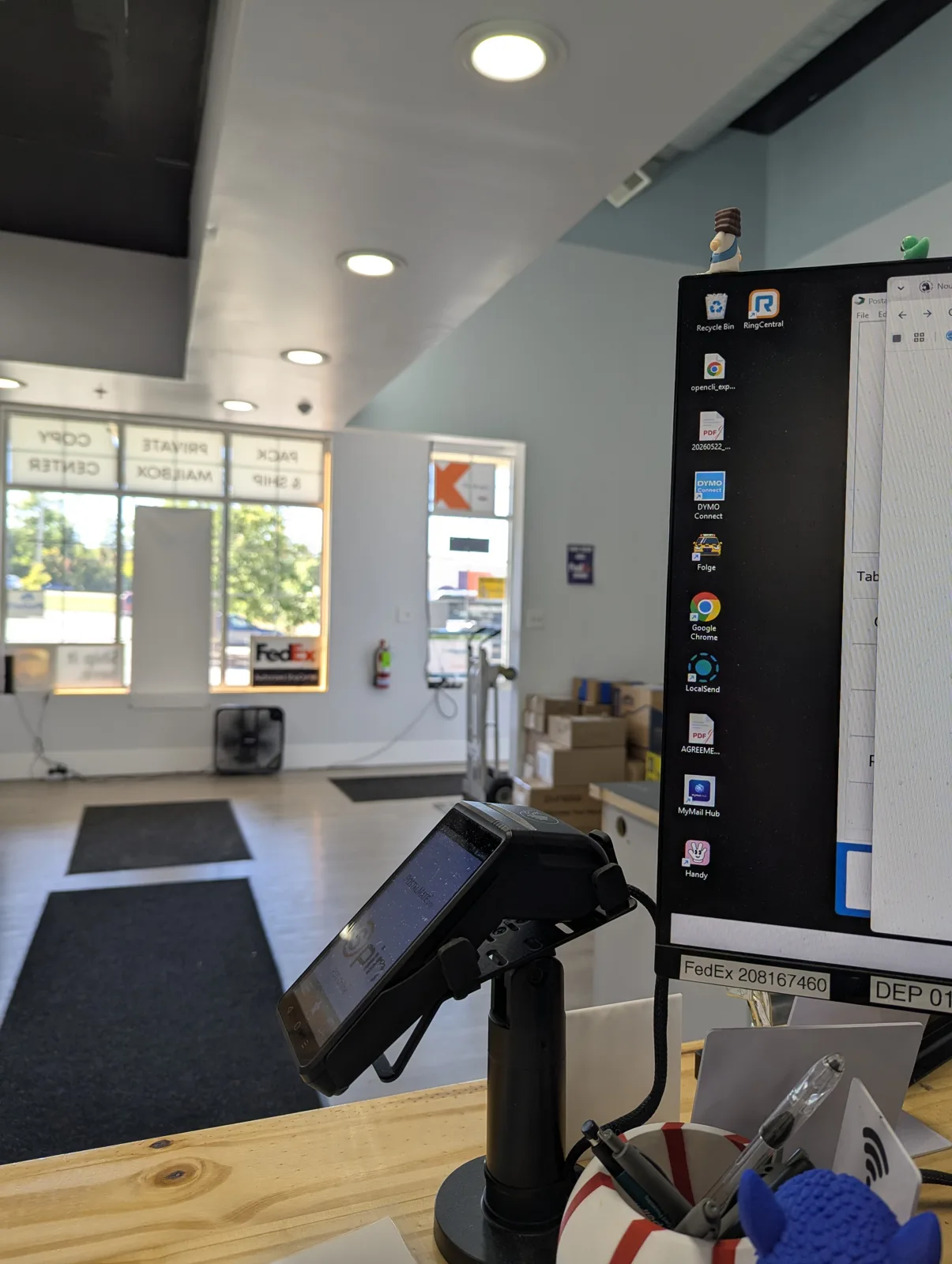
The pack-and-ship counter at Mailbox Plus in Concord Township, where every carrier's current rates are quoted before a label prints.